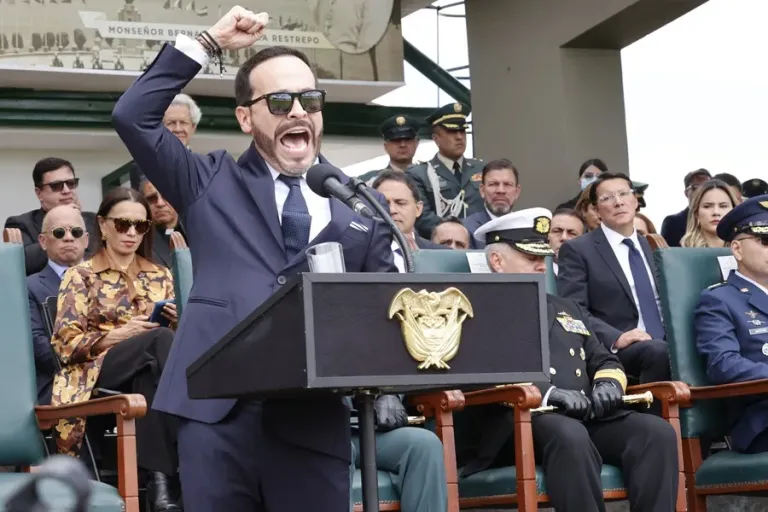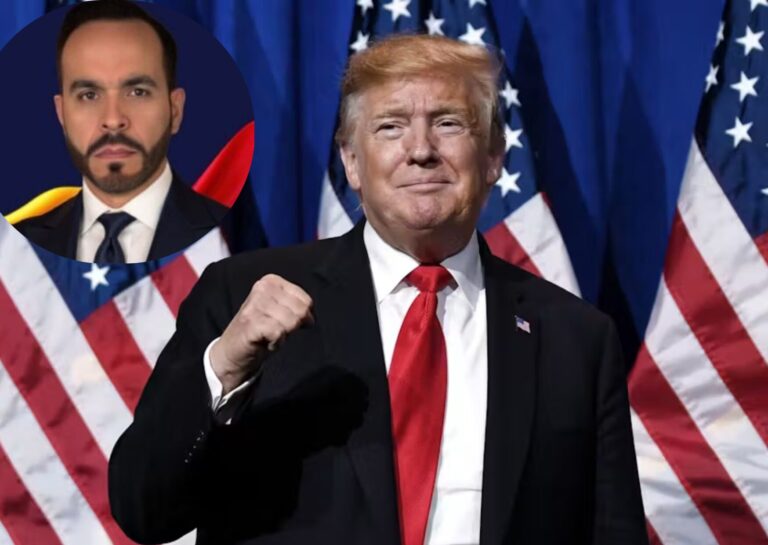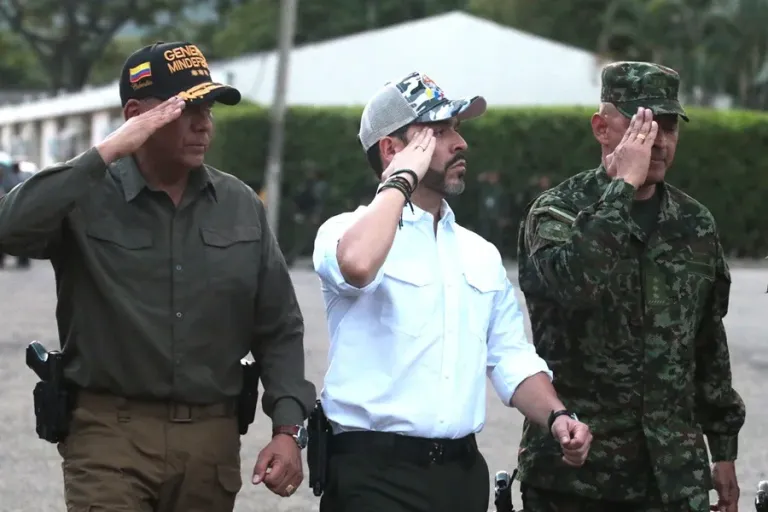

The progressive radicalization, instability, and personalism are characterizing the presidency of Abelardo de la Espriella, who marks one hundred days this Sunday, focused on security policies, fiscal cuts, and economic reactivation.
The far-right ruler arrived with an agenda that he has had to adjust almost from the very first moment because on August 10, just three days after taking office, a 7.4 magnitude earthquake devastated central-western Colombia.
However, the first 100 days of the new Government have been marked by instability, as nearly twenty officials have left their posts, including the Ministers of Education Viviane Morales and Interior Rodrigo Lara.
He has also radicalized his discourse and unleashed a ‘culture war,’ with the rejection of the peace agreement signed by the Government and the Revolutionary Armed Forces of Colombia (FARC) guerrilla in 2016 and the (failed) attempt to remove more than 60 works from the National Museum that he considered ideological.

Closing of ‘total peace’ and terrorism
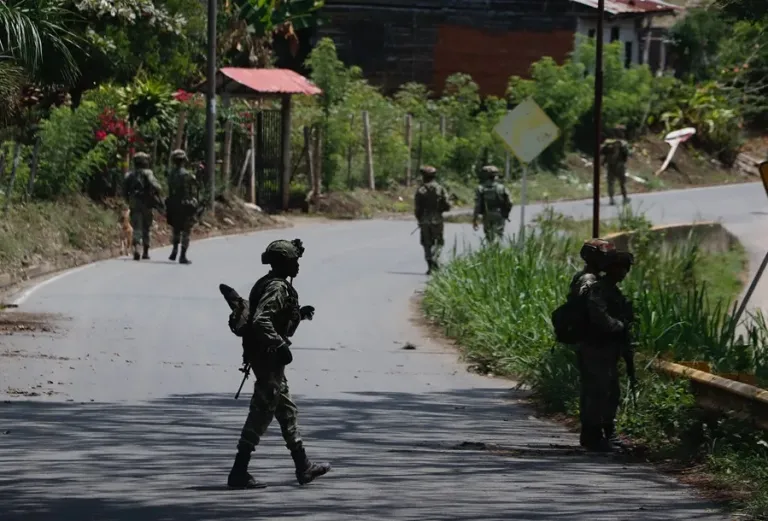
De la Espriella received a delicate security situation, with an increase in the number of members of armed groups to 29,000, including those in arms and logistical and financial support networks.
In one of his first decisions, at the end of August, he made the decision to end the talks with all armed groups, initiated by his predecessor, alleging that those organizations did not have a true will for peace.
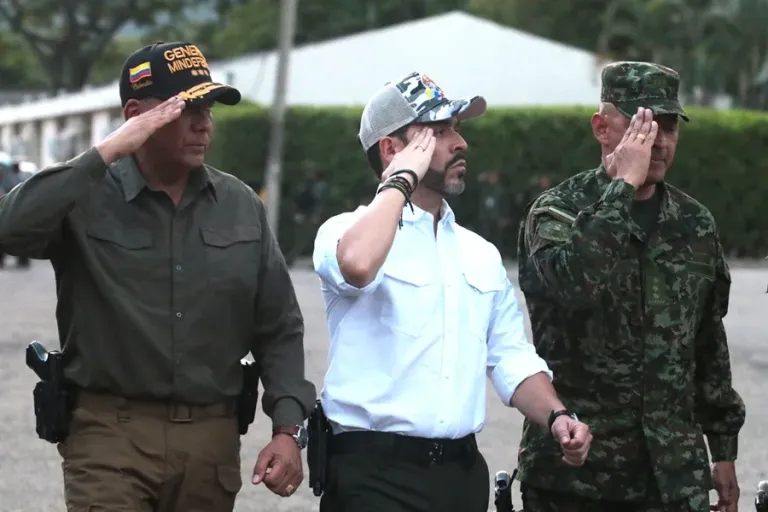
In that vein, with a pistol on his belt, a radio, and accompanying police and military operations, the president is promoting a hard-line policy against guerrillas, paramilitaries, and drug traffickers following the end of the ‘total peace’ policy, which so far relies on shock tactics, media announcements, and the ostentatious display of results.
The Ideas for Peace Foundation (FIP) highlighted in the analysis ‘Beyond the narrative, what has happened in the first 100 days of De la Espriella?’ that although security is the center of the Government’s agenda, there is still no “strategy capable of translating operations into a reduction of the power of armed groups”.

Transcending communication strategy
For the IFJ, “the prominence that the president has assumed in communicating the results must also be reviewed.”
Specifically, it considered that “the display of bodies of deceased persons, public confrontation with detainees, and the president’s presence in operations may produce immediate political dividends, but it displaces the institutions in charge of conducting security and opens legal and legitimacy flanks.”
The foundation subsequently added: “Presidential leadership is necessary; personal prominence, on the other hand, can weaken the institutions that should sustain policy.”
When comparing the security figures for August and September of this year with those of the same period in 2025, the FIP highlighted, for example, that homicides decreased by 10.6%, kidnappings fell by 66.3%, and clashes dropped by 61.9%, while attacks against infrastructure and civilian property increased by 44.4% and confinements grew by 37.5%.
“This combination confirms that the reduction of some expressions of violence does not necessarily mean that armed groups have lost their capacity for control or influence,” he added.
Radicalization
The new government received on August 7 an economy with a fiscal deficit equivalent to 6.4% of GDP in 2025 and a public debt at 60.5% of the gross domestic product (GDP), a record rate.
De la Espriella ordered his economic team to initiate talks with the International Monetary Fund (IMF) to seek a way out of the fiscal situation, although so far the support has not materialized.
He also announced a cut of 13.8 trillion pesos (about 4.158 billion dollars) in state spending, which he attributed to austerity measures, lower debt service costs, and the elimination of contracts.
His Government also presented to Congress an Economic Rescue Bill that seeks to curb the growth of public debt, strengthen the country’s finances, protect the most vulnerable sectors, and incentivize private investment.
“The comprehensive approval of the law is the only scenario in which the Government receives more than it spends before paying interest,” warns the economic think tank ANIF.
However, the opposition, led by former presidential candidate and senator Iván Cepeda, considers that the government’s proposal “severely” affects citizens.
“We are concerned because this is a way of paying back or fulfilling our obligations to the IMF. It is a tax reform that returns to the past in terms of breaking with the principle of progressivity in the payment of taxes and reversing the burdens once again,” Cepeda explained to EFE on October 30.