
China has completed two critical superconducting components for its Experimental Advanced Superconducting Tokamak (EAST), commonly known as the country’s “artificial sun,” marking a major milestone in its nuclear fusion research program.
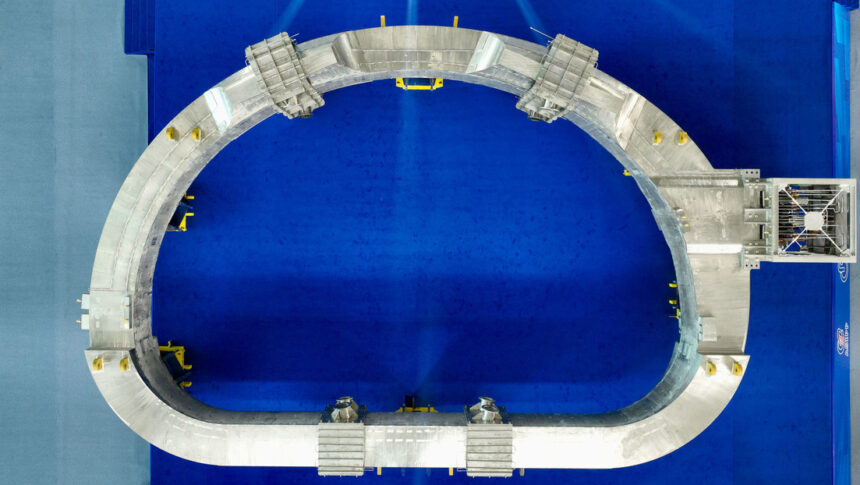
According to the Institute of Plasma Physics of the Chinese Academy of Sciences (ASIPP), the newly developed components successfully passed full-parameter testing and expert evaluation. They include a D-shaped superconducting toroidal field magnet measuring 21 meters long, 12 meters wide and weighing 582 tons, making it the largest superconducting magnet ever built for a fusion reactor.
Researchers said the magnet generates an intense magnetic field capable of confining plasma at temperatures of around 100 million degrees inside the reactor’s vacuum chamber. A superconducting coil described as the system’s “energy heart” also passed performance tests, achieving internationally recognized benchmarks for stored energy, magnetic field ramp-up speed and connection resistance.

ASIPP Director Song Yuntao said the project demonstrates China’s technological self-sufficiency, noting that every stage of development, from superconducting materials to precision manufacturing, was completed domestically. The six-year project has resulted in 47 authorized patents and 25 industry standards.
More Read

According to the project’s roadmap, the compact experimental fusion device is expected to be completed by the end of 2027, while fusion-based electricity generation is targeted for around 2030. Researchers say the successful testing of the superconducting magnets represents about 80% of the engineering work, with full system assembly and long-duration operational testing still to come.