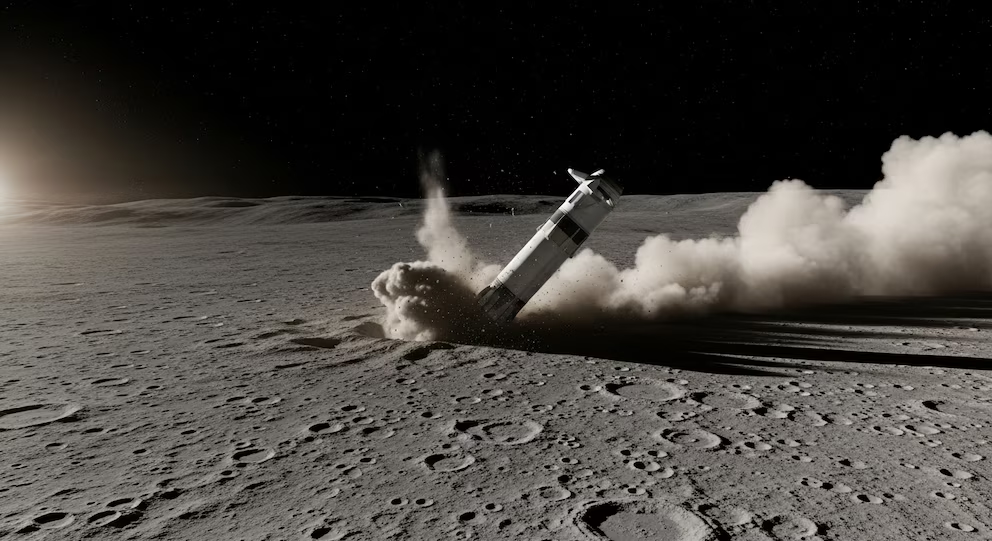
NASA confirmed that debris from a SpaceX rocket impacted the Moon this Wednesday, after being diverted by a combination of solar activity and gravitational forces. The collision, described by the agency as safe, posed no risks to Earth or missions on the lunar surface, and opens the possibility of studying the formation of lunar craters.
The object was part of a launch carried out in 2025, which deployed the Blue Ghost One lander, from Firefly Aerospace, as part of NASA’s Commercial Lunar Payload Services initiative. This program seeks to facilitate the delivery of scientific and technological payloads to the Moon through commercial services.
In a video posted on X, the space agency clarified that the impact was not deliberately planned. Dr. Kelsey Evans Young, Director of Science and Exploration, explained that it was “a technically accepted and safe method for disposing of equipment in low lunar orbit”.
In addition, he highlighted that some mission operators prefer to end their operations with a controlled impact on the lunar surface, as it represents a predictable and traceable strategy for the disposal of hardware at the end of its useful life.
We recommend reading:SpaceX rocket debris to impact the Moon on Wednesday
More Read

The role of solar activity and gravity in the deviation
The collision occurred after a deviation attributed to solar activity and gravity.
NASA attributed the change in the upper stage’s trajectory to the combined action of solar activity and gravitational forces. The agency emphasized that this episode poses “absolutely no danger” to people on Earth or to the equipment currently operating on the Moon.
The official publication highlighted the scientific interest following the incident. Researchers hope the event will help improve the tracking of similar objects in the future, turning the impact into a valuable observation opportunity, as well as an operational procedure.

Faced with the doubts generated by the episode, NASA was categorical: the collision does not compromise any active mission nor does it generate risk outside the lunar environment. Its relevance lies in the information it can provide about orbital dynamics and surface impacts.
The Moon as a natural laboratory for the study of craters
The Moon has been constantly impacted for about 4 billion years (EFE/ Miguel Gutiérrez)
The space agency described the Moon as a “natural laboratory for studying processes that occur throughout the solar system,” because it lacks an atmosphere and preserves a stable surface for long periods. These conditions allow for the clear analysis of impact traces.
As they detailed, crashing an object of known size and speed into the lunar surface allows scientists to better understand the process of crater formation and the type of mark these events leave behind.
This analysis is part of a much broader history: the Moon has been constantly impacted for about 4 billion years: meteorites, asteroids, comets, and other objects strike the Moon all the time.
NASA clarified that it represents “absolutely no danger” to people on Earth or to the equipment currently operating on the Moon (Illustrative Image Infobae)
More Read

The most recent reference cited by the agency comes from the Artemis II mission. During this year’s lunar flyby, astronauts observed several impact phenomena, including active flashes and craters forming on the lunar surface during the few hours that the journey lasted.

Below are the 5 keys explained by Dr. Kelsey Evans Young, NASA’s Director of Science and Exploration.
- How was the lunar impact?
In the early hours of Wednesday, August 5, a SpaceX Falcon 9 rocket upper stage made an unplanned impact on the lunar surface. This Falcon 9 upper stage came from a January 2025 launch that successfully deployed Firefly Aerospace’s Blue Ghost 1 lander, through NASA’s CLPS, or Commercial Lunar Payload Services, initiative. A combination of solar activity and gravitational forces actually caused the unplanned impact.
Dr. Kelsey Evans Young, NASA’s Director of Science and Exploration, answered 5 questions about the rocket impact on the Moon
- Did NASA deliberately plan for this upper stage to impact the Moon?
NASA did not deliberately plan for this upper stage to impact the Moon. However, this is not something that really concerns us. In fact, this is a technically accepted and safe method for disposing of hardware in low lunar orbit, and in some cases, mission operators actually choose to end their mission by having their hardware impact the lunar surface because it is a predictable and trackable strategy for end-of-life hardware disposal.
- Does this pose a danger to the Earth or the Moon?
This implies absolutely no danger to anyone on Earth or any hardware on the Moon, and, in fact, scientists are eager to study this impact event, as it may help us limit how to track things like this in the future.
- What kind of science can we obtain from the study of this type of impact?
We love the Moon for many reasons, and one of them is that it is a natural laboratory for processes that occur throughout the solar system. There is no atmosphere or environment, and the regolith, or the surface of the Moon, is stable for really long periods of time. Impact cratering, especially, is a process that occurs throughout the solar system, and by impacting an object of known size at a known speed onto the lunar surface, it can help scientists constrain the cratering process and what type of crater results from an impact of that size.
- Is this common?
The Moon is always being hit by things. Meteorites, asteroids, comets, and other objects have been impacting the Moon all the time throughout its four-billion-year history. In fact, the Artemis II astronauts actually observed several active impact flashes or craters forming on the lunar surface during their multi-hour flyby.
Here is the journalistic integration of SpaceX’s explanation, ready to be added to the article:
SpaceX’s stance after the lunar impact
SpaceX reiterated its commitment to space safety and collaboration with NASA to optimize the management and disposal of hardware.
Minutes after NASA’s announcement, SpaceX released a statement in which it offered details about the mission and the fate of the upper stage involved.
The company recalled that on January 15, 2025, a Falcon 9 rocket successfully deployed Firefly Aerospace’s Blue Ghost Mission 1 and ispace’s RESILIENCE lunar landers from the Kennedy Space Center in Florida, bound for the Moon.
SpaceX explained that, for most of its missions, it plans a controlled deorbit of the Falcon 9 second stage so that it reenters safely over the ocean. However, in higher-energy projects, such as those requiring reaching a lunar transfer orbit, almost all of the vehicle’s performance is dedicated to placing the payload on the intended trajectory, which makes it difficult to execute a controlled disposal maneuver.
The company emphasized that it is working “actively to be as responsible as possible with hardware left in space, in order to ensure space safety, including the most complex missions.” In this case, the combined action of solar activity and gravity diverted the upper stage toward the lunar surface.
SpaceX noted that, while impacts of this type are rare, they can occur with objects inserted into similar orbits, and highlighted its collaboration with NASA to define optimal disposal solutions.
Finally, he highlighted his goal of moving towards more sustainable operations with the development of Starship, the fully reusable vehicle designed to eliminate the need for expendable upper stages. This technology, they stated, will reduce abandoned hardware in space and will enable new missions to the Moon, Mars, and other destinations.