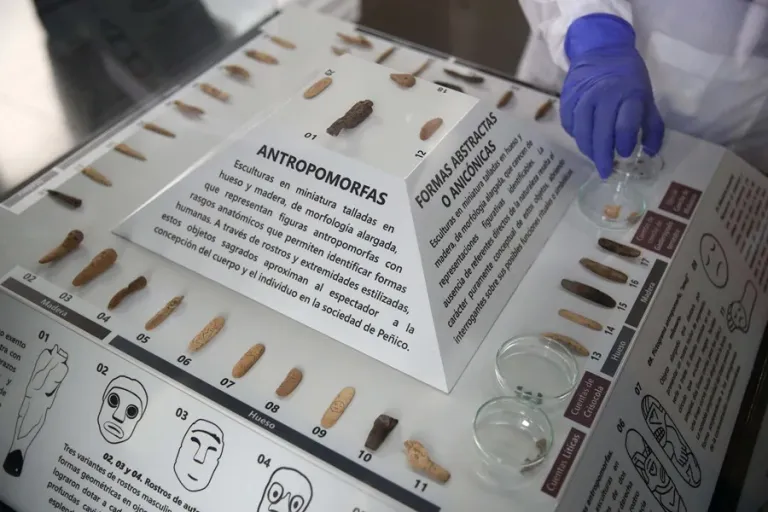

A series of 43 ancient figurines in the shapes of gods, animals, and human faces, belonging to the Caral civilization, which is considered the oldest in the Americas, were discovered in the remains of Peñico, the Peruvian city that has been the focus of research in recent years.
These figures, crafted from bone and wood, are estimated to date back to between 1,800 and 1,500 years before Christ, and are believed to be part of an offering that provides new evidence regarding the processes of cultural continuity that developed in the Supe Valley, located north of Lima, following the abandonment of the main urban centers of the Caral civilization (3000-1800 B.C.).
During the presentation of the objects this Monday at the Peruvian Ministry of Culture, archaeologist Mauro Ordóñez, head of the Peñico archaeological site, explained to EFE that the miniatures “have a very powerful iconographic charge in symbolic terms.”
What they found in the figures
Ordóñez pointed out that they are waiting for the carbon-14 results to determine its age, although the building where they were found is about 3,800 years old.

“Of the 43, there are anthropomorphic, geometric, and zoomorphic representations. For example, among the anthropomorphic ones, there are representations likely of their gods and their authorities,” the archaeologist indicated, highlighting that they have also found a “Venus of Peñico,” a headless carved female figure.
There are two tablets with images of gods carved with red dye, with triangular eyes and headdresses whose shapes would be unprecedented in the area, another that sports a decorated conical hat that would represent an authority, and several have deep cavities in the eyes that indicate that at one time they had inlays of minerals or semiprecious stones.
In the case of the zoomorphic ones, there are representations of snakes, tadpoles, birds, and also some that represent rivers, several with the so-called “god’s eye” carved and symmetrical geometric figures.
The offering
The miniatures placed carefully around stones arranged in a semicircular shape and several show fire marks, which indicates that they were used in a ritual associated with the construction of a new platform for the settlement’s largest public building.

“They were found in an offering process, during the architectural renovation process of the main public building, so there is a context of respect at the moment of leaving this offering,” added Ordóñez.
The archaeologists who will continue their work, led by archaeologist Ruth Shady, head of the Caral Zone, hope to find more figures and characters in the same place, and are also studying other buildings in the Peñico complex to understand the social dynamics of this town.
The Peñico urban center was founded around 1800 B.C., with an archaeological occupation area of 19.44 hectares, in a period following the loss of prestige of the first urban centers of the Caral civilization, including the Sacred City of Caral-Supe, which is located 13 kilometers away.
Far from representing a cultural rupture, research indicates that this city, in which 15 public buildings were found, was conceived as a space of integration between the coast and the highlands, to which goods from the jungle even arrived.