Bangui.- A group of 30 migrants deported by the United States arrived in the capital of the Central African Republic, Bangui, as part of a bilateral agreement under which the CAR agreed to host migrants expelled from the U.S. in exchange for 81 million dollars (about 70 million euros), signed last May.
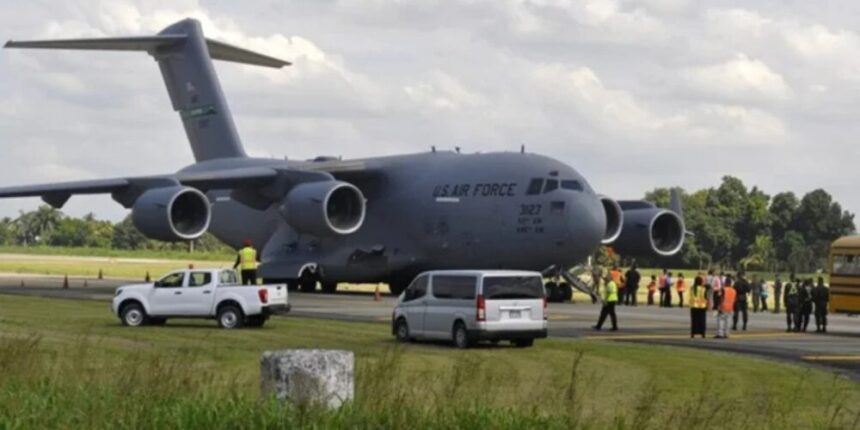
A plane from the U.S. landed on Friday at 7:35 p.m. (18:35 GMT) at Bangui M’poko International Airport, where they were received by Central African and U.S. officials in an event closed to the press, lawyers representing these migrants confirmed to EFE.
According to the same source, who wished to remain anonymous, the migrants “are demotivated and discouraged because they have no ties to the country,” without indicating the nationality of the newcomers and without providing further information for security reasons.
EFE attempted to contact the CAR authorities, but did not receive any comment on the matter.
More Read

The aircraft, which made previous stops in Dakar and Accra, is the second to arrive in the country with people deported by the U.S., after 25 other migrants of Turkish, Syrian, Iranian, Afghan, and Tibetan origin did the same on June 12.
This new arrival has sparked reactions among the opposition and civil society, such as the president of the opposition party Movement for Integral Development for Social Progress (MDI), Raymond Adouma, who told EFE that the country’s president, Faustin Archange Touadera, owes “an explanation”.

Furthermore, he accused him of receiving something in exchange for a “dishonorable agreement” that turns the country into a “human dumping ground to which the powerful” send “the unwanted.”
More Read

“How many migrants are supposed to come here and what can the CAR do for them in the short, medium, and long term? What is happening is indecent and horrible,” added Adouma.
For his part, the coordinator of the civil society organization Asociación I Gwé, Quentin Ngbouando, lamented in statements to EFE the country’s decision to “violate” international law through this agreement with Washington.
“These people were unjustly imprisoned before being sent here, violating their rights, why not help them return to their country or go to the country of their choice?” declared Ngbouando.
Humanitarian organizations such as Amnesty International (AI) and Human Rights Watch (HRW) have previously denounced that deportees lack legal assistance and, at times, are held in maximum-security prisons without charges having been filed.
These NGOs have asked African countries to reject expulsion treaties signed with the United States and have stated that existing ones expose hundreds of people to risks of arbitrary detention, ill-treatment, and forced return to countries where they could suffer persecution or torture.
This program places the CAR among a growing number of countries in Africa that are collaborating with Washington to receive deportees from third countries, such as Ghana, Cameroon, Equatorial Guinea, the Democratic Republic of the Congo, Eswatini, or Rwanda.