Santo Domingo.- The Minister of Energy and Mines, Joel Santos, stated yesterday that the Dominican Republic will experience the greatest energy expansion of the last decades, with an increase of more than 50% of the firm installed capacity between 2025-2028, which will strengthen the conditions for economic growth, competitiveness, and the attraction of investments for future years.
During his participation in the Mercado Energy Summit 2026, held at the Intercontinental Hotel in Santo Domingo, Santos highlighted that, in addition to firm capacity, the country also has 2,000 megawatts (MW) of renewable energy in operation and another 1,000 MW in projects that will be integrated by 2028, many of them in different stages of development.
While presenting the paper “Dominican Republic: Energy to grow, transform and lead”, Santos maintained that energy has become one of the main pillars for the economic and productive development of the country. “Energy is no longer just an essential service. Today it is one of the main enablers of economic growth and national competitiveness”, he emphasized.
The minister highlighted that the national electricity demand will reach a peak power of 4,250 megawatts (MW) this year, a figure that evidences the dynamism of the Dominican economy and the country’s growing energy requirements. This level represents an increase of approximately 59% compared to the 2,681 MW recorded in 2019, reflecting the expansion of key sectors such as tourism, industry, commerce, and services. “These numbers confirm that energy must grow at the same pace as the economy to guarantee competitiveness, attract new investments, and sustain development for the coming decades,” he stated.
Furthermore, he highlighted that energy demand has become one of the main indicators of national economic dynamism. “There is no sustainable economic growth without sufficient, reliable, and competitive energy. Every new hotel room, every industrial investment, every logistics center, every company that expands, and every job that is created requires energy. Therefore, energy planning cannot respond solely to the needs of the present; it must anticipate the demands of the future,” he stated.
Santos indicated that the Government is focused on building the energy capacity that the country will need during the next decade, ensuring that economic growth, investment attraction, and social development have a solid and sustainable foundation.

He specified that the government’s vision seeks for the growth of the energy system to translate into greater opportunities for the population, new investments, and the creation of jobs and development for the communities.
He explained that the national energy security strategy is based on the diversification of the energy matrix, technological and geographical diversification, competitiveness, and a long-term vision. “The energy transition does not consist of replacing one source with another; it consists of building a more resilient and diversified matrix,” the minister maintained.
More Read

Santos indicated that the Dominican energy model is committed to a balanced combination of renewable energy, natural gas, and storage systems to ensure sustainability, reliability, and flexibility in the face of growing demand.
In addition, he highlighted the initiatives aimed at universalizing access to electricity, promoting rural electrification, reducing losses, and strengthening the regulatory framework through the implementation of the Energy Efficiency Law and the updating of the General Electricity Law 125-01.
Likewise, he addressed the issue of energy storage and specified that it has become a fundamental component of the modern energy transition, because this technology allows for more efficient use of renewable generation, storing electricity when production is abundant and releasing it during times of peak demand, providing stability, flexibility, and reliability to the electrical system. “For the Dominican Republic, storage represents a strategic tool to strengthen energy security, reduce dependence on fossil fuels, and support the sustained growth of the economy with a more resilient and competitive matrix,” he expressed.
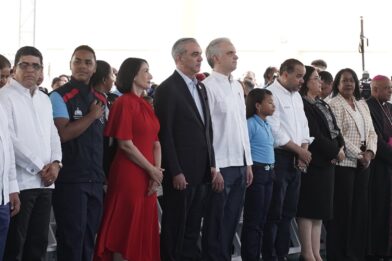
The activity was attended by Andrés Astacio, Superintendent of Electricity; Alfonso Rodríguez, Executive Vice President of the Dominican Electric Transmission Company (ETED); and Edward Veras, Executive Director of the National Energy Commission (CNE). In addition, the Vice Ministers of Energy, Ricardo Guerrero; of Innovation and Energy Transition, Betty Soto; of Hydrocarbons, Noel Báez; and of Mines, Giovanni Bloise, as well as other officials from the Ministry of Energy and Mines and representatives of the national energy sector.