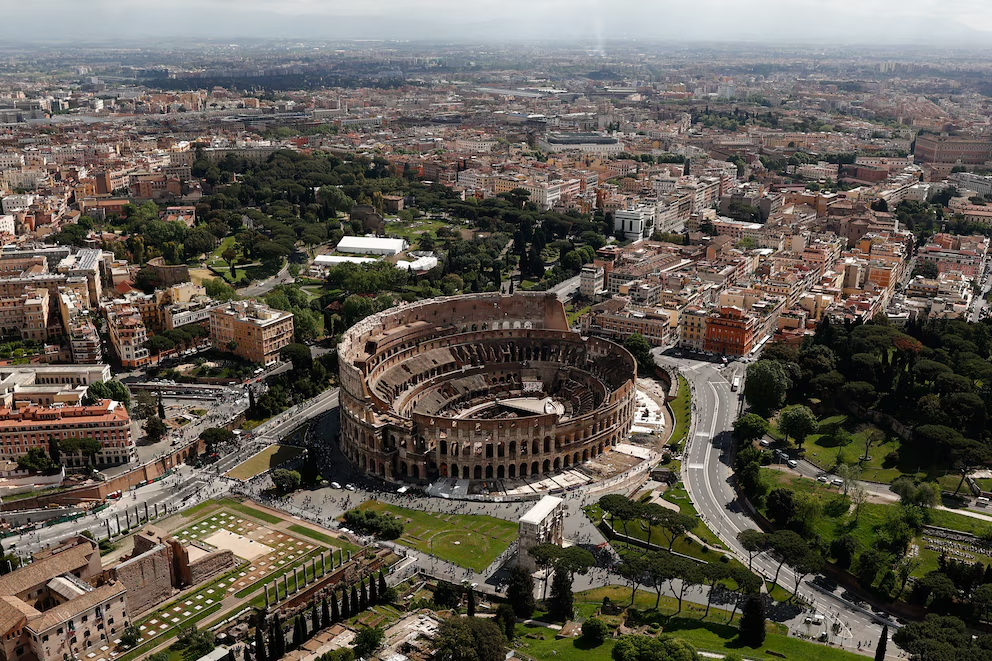
The city of Rome is exploring the possibility of converting its vast network of historical caverns and underground tunnels into climate shelters against extreme temperature increases, amidst one of the most persistent heat waves in recent years in Italy.
The initiative, promoted by the Rome City Council, seeks to identify and analyze ancient spaces excavated under the city, such as quarries, catacombs, and bunkers, to offer shelter areas against the heat, a problem and cause for alarm in Europe after several consecutive years of thermal records.
The climate emergency affecting the Italian peninsula—where the heatwave has led to the activation of red alerts in several cities, including Florence and Bologna—has forced municipal authorities to adopt an innovative approach to circumstances that, according to experts, have ceased to be exceptional and have become a structural part of summer in the region.
Rome’s Heat Action Plan, officially presented this summer, combines a series of immediate measures, such as the opening of hundreds of public outdoor shelters and the reinforcement of green areas, with long-term solutions beneath the urban surface. According to EFE, the project is proposed as an exhaustive study, from both a technical and health perspective, of the Roman subsoil and its potential climate applications.
Experts and authorities warn about the importance of analyzing the structure and air quality in each cavern before allowing public access to these underground shelters.

City authorities, led by Mayor Roberto Gualtieri, see the underground network as an untapped resource for protecting citizens against extreme heat. “We want to carefully study the issue of underground spaces,” noted Edoardo Zanchini, director of Rome’s Climate Office, in statements reported by EFE.
Zanchini underscored the need to conduct rigorous analyses of each cavern and tunnel before opening them to the public, prioritizing the safety and social viability of the plan, which is proposed as a long-term strategy driven by collaboration with environmental organizations and scientific networks.
Rome sits upon a network of quarries excavated since ancient times, railway tunnels, catacombs, and World War II shelters, which evidences more than two millennia of underground exploitation. The Higher Institute for Environmental Protection and Research (ISPRA) and the Institute of Environmental Geology and Geoengineering (CNR-IGAG) are developing detailed mapping of these spaces, the result of which will serve as the basis for the climate shelter plan.
According to the report “The Hidden City” presented by ISPRA, more than 100 square kilometers (38.6 square miles) of the Roman territory present underground cavities, with a special concentration in municipalities I, II, IV, V, and VIII, where stone quarrying was historically most intense.
How underground shelters would work
More than 100 square kilometers of underground cavities in Rome could serve as a base for new urban heat shelters.

The thermal advantages of this type of shelter are proven: in spaces such as the Caffarella Labyrinth, an ancient quarry located in the Via Appia Antica park, the interior temperature remains stable at around 15°C throughout the year, in contrast to the more than 30°C recorded outside on the most critical days. “Many people come in search of relief from the heat of this season,” explained Alessandro Placidi, a guide for the Roma Sotterranea Association, as reported by EFE.
However, specialists warn that the transformation of these spaces cannot be immediate. Geologist Giuseppe Delmonaco, from ISPRA, remarked that, before enabling them as shelters, it is necessary to thoroughly study the air quality and geological structure, given that poor ventilation can generate dangerous concentrations of gases such as carbon dioxide or radon, the latter recognized by the World Health Organization as the second leading cause of lung cancer. EFE details that the project plans to install environmental monitoring systems to ensure minimum safety and habitability conditions before approving any public use of these caverns.
Financing and other plan measures
According to data published by Roma Sette, the Anti-Heat Plan has funding of 50 million euros over five years and integrates other lines of action such as urban reforestation—with some 38,000 new tree species since 2022—, the increase of green areas, and the “de-sealing” of surfaces to combat the heat island effect, aggravated by asphalt and urban density.
The municipal administration has launched a digital map with all public-access climate shelters, which will be supplemented with the eventual opening of safe underground spaces. In addition, the program includes summer camps for children, free pool passes for seniors, and specific prevention and healthcare campaigns, as recommended by the climate reports from the Euro-Mediterranean Center on Climate Change (CMCC).
More Read

A recent extreme heat wave pushed temperatures above 40°C in Italy, forcing authorities in Rome to implement extraordinary measures.
The phenomenon of intense heat waves is fully documented in the latest Rome Climate Monitoring Report, in collaboration with the CMCC, which confirms that 2025 was the third hottest year in the city since 1991, surpassed only by 2022 and 2024.
The Italian Ministry of Health has activated the maximum health alert level for the summer, and labor restrictions are in effect in the construction and agriculture sectors during the central hours of the day, as reported by Diario Libre. Nighttime temperatures above 20°C—the so-called “tropical nights”—increase the danger of these episodes for the most vulnerable sectors, such as the elderly or children.
The climate framework and international recommendations
The plan promoted by Rome works in line with Italy’s National Climate Change Adaptation Strategy and the recommendations of global organizations such as the World Meteorological Organization (WMO), which documented the record European temperature of 48.8 °C, recorded in Sicily in August 2021. The scientific committee that approved the verification of this data stresses that extreme weather “is becoming the new normal” in the region, a fact reiterated in European Union reports on adaptation and resilience.
The director of the Climate Office, Edoardo Zanchini, concluded his presentation by highlighting that the priority is public safety and that any future underground shelter must be fully accessible and free of charge. Meanwhile, the city council will continue studies and consultations with universities, associations, and citizens, with the goal of adapting the Italian capital to the thermal rigors of the present and the future.