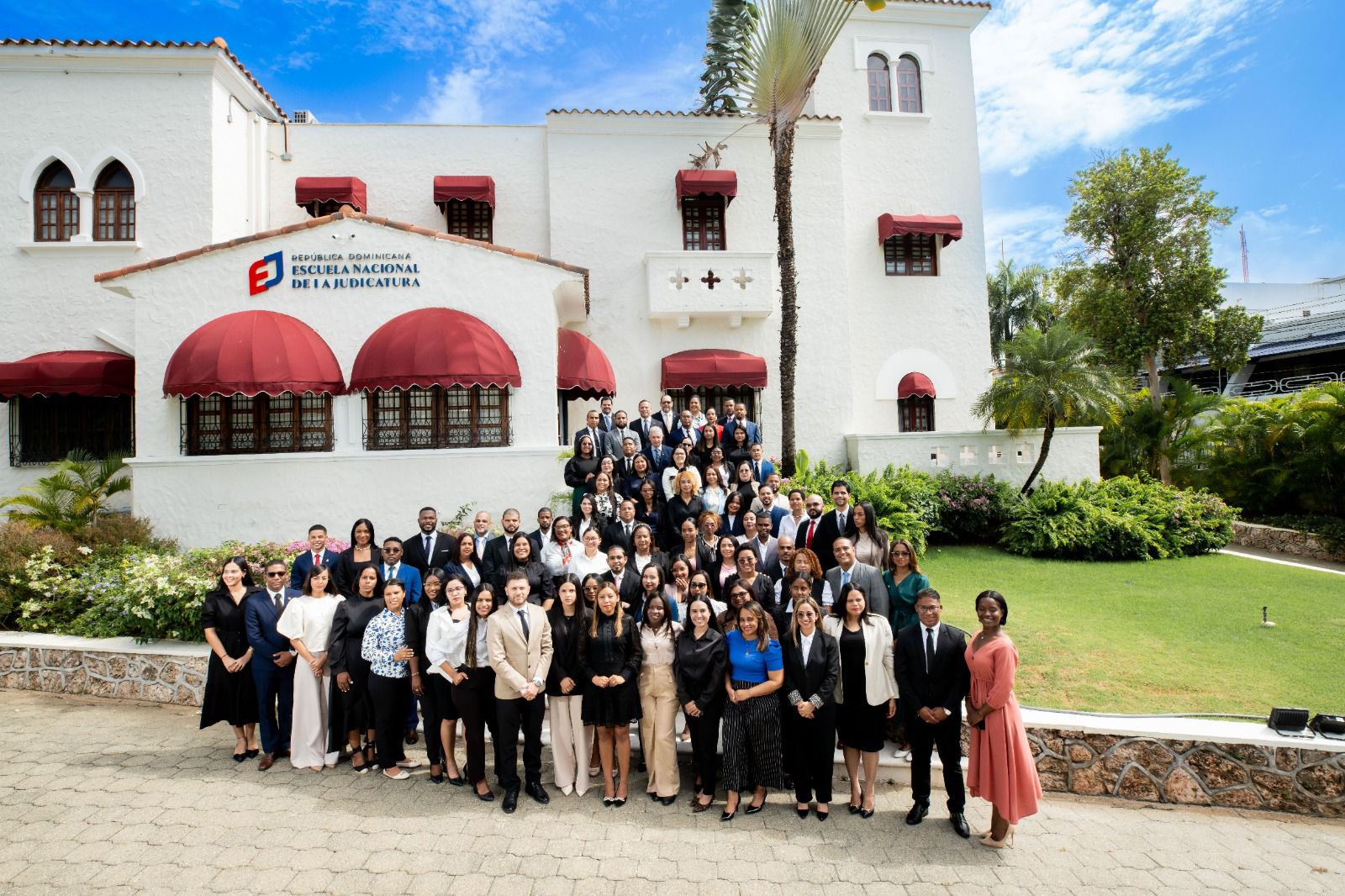
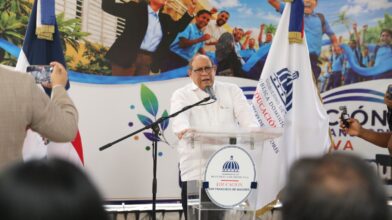
Santo Domingo.- The National School of the Judiciary (ENJ) opened this Tuesday the 2025 Public Defender Aspirant Training Program, with a group composed of 83 lawyers, to whom the presiding judge of the Supreme Court of Justice, Luis Henry Molina, exhorted them to have human dignity as the guiding principle of their work, assuming it in their daily practice.
Magistrate Molina, who also chairs the Board of Directors of the Public Defense and the ENJ, revealed that 80% of the criminal cases that are brought to trial in the country are handled by the public defender’s office.
“Aspiring to be a public defender is to assume a commitment to truth, to equity, and to the most vulnerable people; you are not chosen at random, you have passed filters, tests, evaluations, because the service you will offer demands excellence. It is not just about knowing: it is about serving using that knowledge with conviction of the ethics and values they represent before society”, Molina affirmed, also president of the Council of the Judiciary.
During the central words of the act, he affirmed that the training they are starting has a dimension that exceeds books and even courts, it is about also developing institutional sensitivity, critical perspective and ethical disposition.
The Chief Justice of the Supreme Court emphasized that preventive detention cannot be the rule, but the exception; in that sense, he considered that the solution “cannot always be more prison, more time, more punishment”, but that justice should be thought of from the solution, reintegration, dignified treatment and due process.
He also said that sometimes, the biggest obstacle to access to justice is not the law, but the mentality, with the congestion of the system being a proven cause of judicial delay that results in limits and denial of access to the system.
“Agreements are a viable solution in all functioning judicial systems. In the United States, more than 90% of cases do not go to trial. Alternative dispute resolution methods are a priority because they allow the system to function. It’s as simple as that. But also because the pursuit of a justice system in a democracy is to resolve conflicts, not to punish,” explained Henry Molina.
On his part, the director of Public Defense, Rodolfo Valentín Santos, affirmed that the group will be formed as defending machines, as defending warriors of due process, constitutional guarantees, and the fundamental rights of people in conflict with criminal law.
“Today, you are embarking on a path that demands vocation, human sensitivity, and legal firmness; Public Defense is the living guarantee of access to justice for those who need it most,” he expressed.
The closing remarks were delivered by the director of the ENJ, Ángel Brito, who highlighted that from the Judiciary, in coordination with the Public Ministry and the Public Defender’s Office, the Criminal Process Optimization Plan is being promoted, which includes 11 points, among which are: the increase of agreements in criminal matters, presentation of conclusive acts within the terms of the law, timely health care for those deprived of liberty, reduction of pre-trial detention, strict criteria for appeal, among others.
“To the extent that those points are achieved, it will be the measure by which we have a justice system that truly works, that provides justice on a daily basis to guarantee the dignity of people, therefore, those points are of priority attention in each initial or continuing training program of this school,” Brito assured.
Supreme Court President Urges Public Defenders to Prioritize Human Dignity