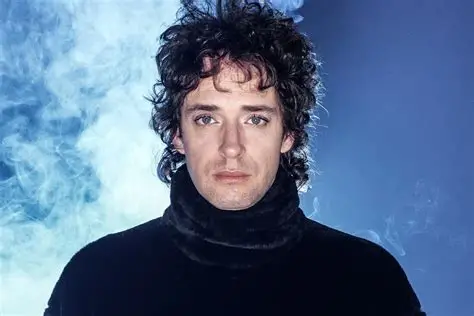
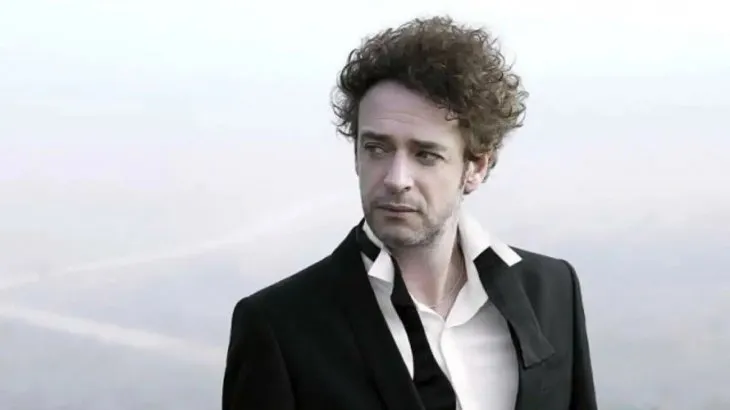
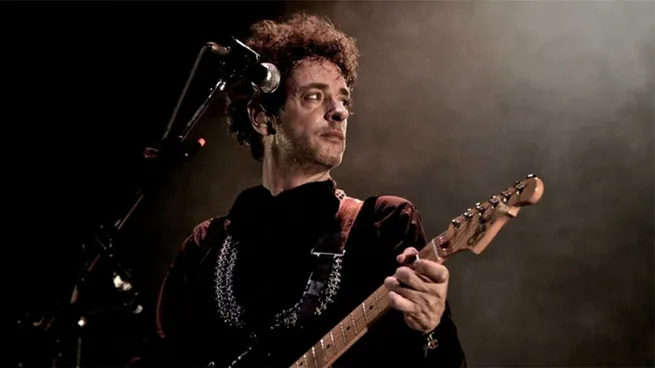
Talking about Cerati is referring to one of the most innovative, sensitive, and transcendent personalities of rock in Spanish. His name is inevitably linked to the history of Soda Stereo, the band that revolutionized Latin American music in the eighties and nineties, but also to a solo career where he knew how to experiment with electronics, poetry, and guitars like few artists. More than a musician, Cerati was a creator of atmospheres, a sound architect who marked generations and whose work continues to inspire millions.
His beginnings:
Gustavo Adrián Cerati was born in Buenos Aires on August 11, 1959. From a young age, Gustavo showed artistic inclinations, as he grew up in a middle-class family, where music was always present. He learned guitar autodidactically, inspired by The Beatles, David Bowie and Pink Floyd, although also nourished by Argentine folklore and the melodic richness of Latin American music. In the early eighties, while studying advertising at the Universidad del Salvador, he met Héctor “Zeta” Bosio and Charly Alberti, with whom he would form Soda Stereo in 1982. The chemistry between the three was immediate, and they quickly went from playing in bars and parties to conquering the biggest stages in Latin America. With Soda Stereo, Cerati achieved unprecedented success. The trio became the first Latin American band to tour the entire continent with an impact similar to that of the great Anglo-Saxon groups. Albums like Signos (1986), Doble Vida (1988), and Canción Animal (1990) became pillars of rock in Spanish. Cerati’s style as a composer was unique: he knew how to combine simple melodies with lyrics full of metaphors, as well as a constant search for sonic innovation. Songs like De música ligera, En la ciudad de la furia or Nada personal became anthems for an entire generation. His ability to reinvent himself meant that Soda never got trapped in a repetitive formula; each album explored a new aesthetic and musical universe. The band’s breakup in 1997, after the “The Last Concert” tour, was a painful event for their fans.The comeback with Soda Stereo and the tragedy
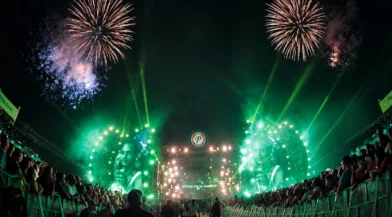
In 2007, Gustavo surprised the world by announcing the reunion of Soda Stereo with the “Me verás volver” tour. The reunion was apoteotic: millions of fans attended the concerts throughout the continent, confirming that the magic of the trio was still intact. However, shortly thereafter the hardest blow would come. On May 15, 2010, after a concert in Caracas, Venezuela, Cerati suffered a stroke that left him in a coma. He spent more than four years in that condition, until he died on September 4, 2014 in Buenos Aires.Legacy and Validity
Gustavo Cerati’s legacy goes beyond his albums and concerts. He was a pioneer who paved the way for Latin American music to engage on equal terms with international trends. He knew how to absorb influences from British and American music, but without losing his own identity. His work continues to be the subject of study and inspiration. Musicians from different genres cite him as a reference, from alternative rock bands to pop and electronic artists. In addition, his lyrics remain relevant for their poetic richness and their ability to connect with universal emotions: love, the city, time, nostalgia, and hope. The phrase “Thank you all”, pronounced at Soda Stereo’s last concert in 1997, became an eternal farewell and a symbol of mutual gratitude between the artist and his audience. Today, those two words sum up the feeling of millions of fans who keep his memory alive. Gustavo Cerati was not only a brilliant musician, but also a visionary. He knew how to transform rock in Spanish, take it to new sonic and emotional dimensions, and demonstrate that Latin American music could be universal without losing its essence. His death left a huge void, but his legacy remains intact. Whenever a guitar begins to play with enveloping chords or a poetic lyric resonates in someone’s heart, Cerati is still present.Because as he himself once wrote: “You deserve what you dream”.