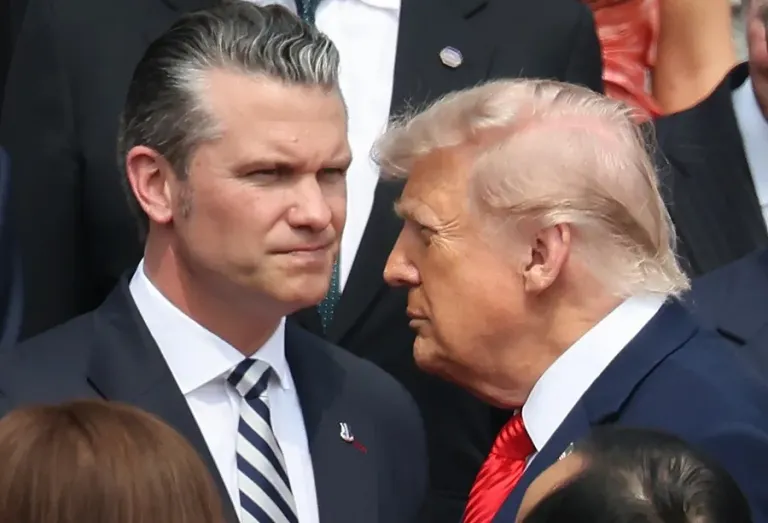

The White House denied this Wednesday an alleged disagreement between the President of the United States, Donald Trump, and his Secretary of Defense, Pete Hegseth, over concerns regarding the depletion of ammunition used in the war with Iran, after The Washington Post published an exclusive on the subject.
White House Press Secretary Karoline Leavitt asserted on her X account that the alleged confrontation between the president and Hegseth at Camp David, the presidential retreat in Maryland, “literally never happened.”
Leavitt’s reaction came hours after The Washington Post reported, citing officials present at a meeting held last Friday, that Trump expressed frustration that he was not informed in a timely manner about a concerning shortage of ammunition in the Middle East.
According to the newspaper, the episode occurred on the sidelines of a cabinet meeting, when Trump reprimanded Hegseth, stating he believed the ammunition supply issue “was already resolved.”

We recommend reading:
According to one of the sources cited by the newspaper, the shortage, especially of long-range guided missiles and interceptors for air defense systems, has been one of the factors that led the president to desist from launching new massive attacks against Iran in recent days.
The increase in the production of precision weaponry
Trump stated on Monday that he had ordered and subsequently canceled “the largest attack since World War II,” pending the start of new negotiations regarding the Strait of Hormuz.
Leavitt claimed to have been present during the meeting and categorically denied that there was a confrontation between the two officials. Furthermore, she stated that Trump “has a lot of appreciation for Secretary Hegseth.”

The Pentagon and major U.S. defense manufacturers accelerated plans to expand the production of precision weaponry.
Companies like Lockheed Martin and RTX (formerly Raytheon) are working to increase the manufacturing of Patriot, THAAD, Tomahawk missiles, and other systems, although officials and analysts warn that a significant increase in industrial capacity will take months and even years to translate into larger stockpiles.
At the end of July, Hegseth visited the Senate to request an increase in the budget allocated both to replenish ammunition stocks consumed during the war with Iran and to strengthen industrial defense capacity.
The Pentagon is seeking at least $67 billion in additional funding to replenish stockpiles and accelerate weapons production, while warning about the impact the conflict could have on U.S. military readiness for other potential scenarios, such as China and Russia.