Scientists from the Massachusetts Institute of Technology (MIT) and the Federal Polytechnic School of Lausanne in Switzerland have designed a robot capable of swimming underwater and then surfacing to fly through the air, mimicking the behavior of diving birds.
This breakthrough combines robotics and the study of animal mechanics and could open up new possibilities for the development of drones and vehicles dedicated to ocean exploration.
There are approximately a hundred species of birds, such as loons, gulls, puffins, cormorants, petrels, and kingfishers, that use their wings to fly and to swim or dive. Studying these movements in live animals is difficult, and computer simulations fail to accurately reproduce the interaction between flapping, forces, and the transition from water to air.
The work was published in Science. Raphael Zufferey, lead author of the study and assistant professor of mechanical engineering at MIT, explained that robotic models offer a useful alternative because they are governed by the same physical principles as animals. They also allow for precise control over the design and movement of the system.
We recommend reading:Humanoid robots arrive in U.S. schools as teacher assistants
More Read

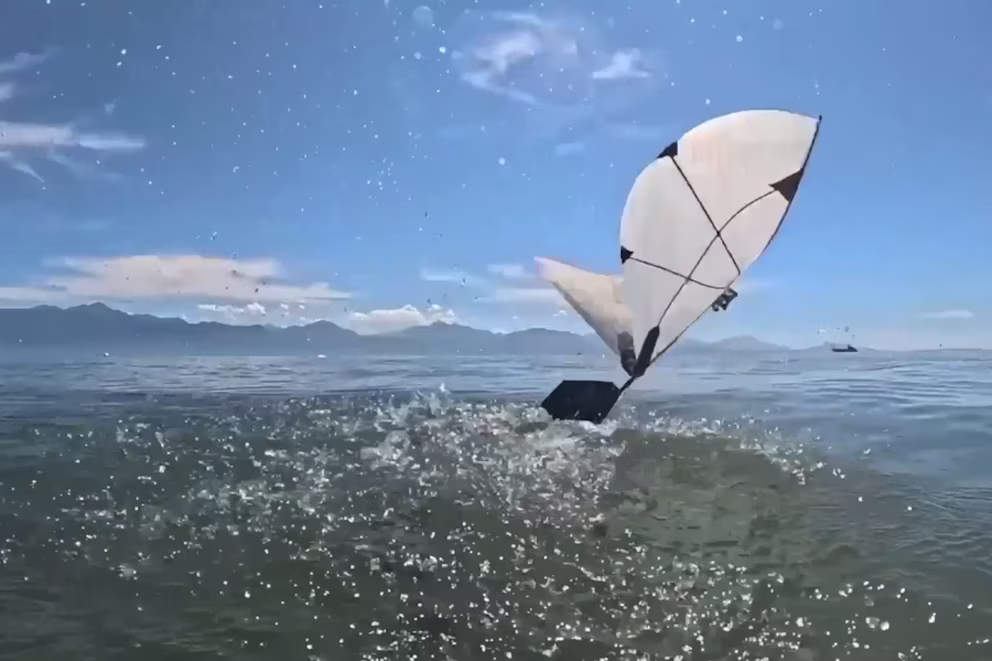
An unmanned surface vehicle with a black and white sail emerges from the Caspian Sea, generating a spray of water, with mountains visible on the horizon.
How the diving bird-inspired robot is designed
The flapping-wing aerial-aquatic vehicle, or FAAV, weighs about 250 grams. It has a streamlined fuselage, two flexible membrane wings, a movable tail, and electronics integrated into a waterproof, wireless structure.
The team reviewed scientific literature and collected data on diving birds to adjust the robot to flapping frequencies comparable to those of real species. According to that data, small birds can flap about 10 times per second in flight and about four times underwater, while larger ones do so at a slightly lower frequency in both environments.
More Read

The wings are made with thin membranes coated to repel water, and the tail can change angle to assist in ascent or descent. Researchers also manufactured interchangeable parts to modify the size of the wings.
What the water and air tests revealed
The tests were carried out with three sets of wings: small 60-centimeter, medium 80-centimeter, and large 100-centimeter ones. The team tested the robot in a water tank and in Lake Geneva, in Switzerland, after placing it at a depth of half a meter and programming the flapping frequency and tail inclination.

A bird with olive green, yellow, and white plumage flies energetically over a rough sea with waves, under a cloudy sky, in a painterly style illustration with a canvas texture. (Illustrative Image Infobae)
The researchers verified that the device could swim, fly, and transition from one medium to another reliably with medium-sized wings. They also concluded that the flexibility of the wings is decisive, because they must yield enough in the water and maintain the necessary firmness to sustain flight.
The robot reached nearly 1 meter per second underwater with a frequency of about 5 hertz. In the air, it reached about 6 meters per second with a similar frequency, in values comparable to those of real diving birds.
To complete the water exit, the robot had to tilt 70 degrees. That angle prevents the wingtips from touching the surface when lifting off, while a greater tilt caused it to fall back into the water.
More Read

The team also observed that the prototype could take off without legs. Zufferey summarized it as follows: “If we look at birds, most need to paddle on the surface to take off. The question was: do we need the same for robots? And it turns out we don’t.”
What it could be used for in oceanography
The authors suggest that this design could lead to a new generation of drones and aerial-aquatic vehicles for oceanography. The idea is for these devices to fly to regions that traditional ocean vessels cannot access or where operating is dangerous.
A dense meadow of aquatic plants with green and reddish leaves, possibly the first on Earth, covers the seabed with bubbles rising toward the surface.
Zufferey described a use intended for coastal and marine fieldwork: “Our ideal vision is that oceanographers, marine biologists, and members of coastal communities can launch this robot from a boat or from the shore, and that it flies near the area of interest, such as an iceberg, a port facility, or over a group of whales.”
The researcher added that the device could enter the water to collect information and return later with it. “It would submerge to take a measurement or collect a sample, and return to deliver the data at a fraction of the cost of traditional methods. Then it could submerge again to obtain more information.”
The team’s next steps involve improving the wings so that they can also rotate and testing the robot in rough waters and windy conditions. The goal is to have a platform capable of repeating measurements and sampling at different points with a higher frequency than standard oceanographic methods.