The consultant warned that negative narratives can consolidate in less than four hours and recommended that companies invest in early detection
Boca Chica. Artificial intelligence can help companies detect reputational threats, analyze conversations, and respond more quickly, but it should not replace human strategic judgment, empathy, or responsibility in the face of a crisis.
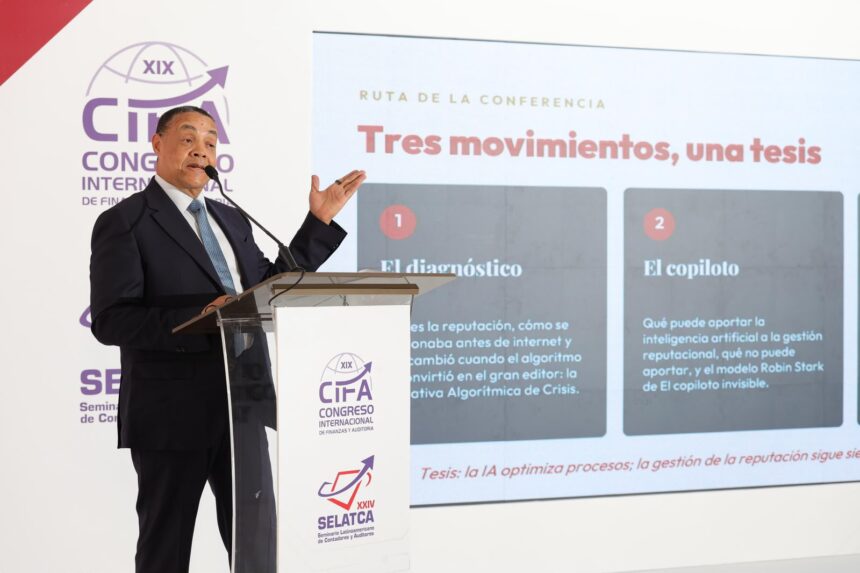
This was stated by consultant Víctor Bautista during the conference “AI for managing reputational crises in companies,” held within the framework of the XIX International Congress of Finance and Auditing (CIFA) and the XXIV Latin American Seminar of Accountants and Auditors (SELATCA), organized by the Association of Multiple Banks of the Dominican Republic (ABA) and BDO.
The meeting, held in Boca Chica from July 30 to August 2, brought together professionals from the fields of finance, auditing, risk, and compliance to analyze trends and tools related to business management.
Bautista, managing partner of Mediáticos Consultores en Comunicación, maintained that reputation must be treated as a particularly vulnerable strategic asset, because it can take years to build, deteriorate in a few hours, and leave consequences that remain for a long time in search engines, social networks, and digital archives.
“Artificial intelligence is an extraordinary tool today for protecting reputation, but it is a copilot. It helps, alerts, proposes, and accelerates. It does not drive,” he stated.
During his presentation, he explained that current crises no longer develop solely under the influence of traditional media. The algorithms of digital platforms intervene in the selection, prioritization, and dissemination of content, frequently favoring those that generate higher levels of emotion, confrontation, and interaction.
According to Bautista, this dynamic can cause an incomplete, decontextualized, or even false version to quickly become the dominant interpretation of an event.
More Read

To describe that phenomenon, he introduced the concept of Algorithmic Crisis Narrative, defined as the account that emerges from the aggregation of interaction signals and which algorithms prioritize and distribute, regardless of its veracity or its correspondence with the actual conduct of an organization.

The speaker also developed the notion of the Zero Narrative Window, with which he identifies the progressive reduction of the time available for a company to intervene before an adverse narrative is consolidated.
He explained that, on high-frequency platforms, the dominant narrative can be structured in less than four hours, while the organization is still trying to assemble its crisis committee, verify the facts, and approve a response. “Intervening during the initial phase is worth much more than responding brilliantly when the narrative has already consolidated. Companies must invest in radar rather than fire extinguishers,” he stated.
Bautista indicated that the main contribution of artificial intelligence lies precisely in that capacity for anticipation. Among its applications, he mentioned the monitoring of millions of conversations, the identification of weak signals, the analysis of emotions and influential actors, the preparation of response drafts, the simulation of scenarios, and the preservation of an institutional memory of crises.
He warned, however, that these possibilities do not authorize organizations to delegate decisions involving values, social sensitivity, or accountability to automated systems. “AI does not decide what to recognize, what to repair, who to answer to, or how much to assume. Nor can it face victims, communities, or public opinion. The algorithm does not sign,” he pointed out.
As part of the conference, Bautista introduced Robin Stark, a functional model and pedagogical metaphor developed in his book The Invisible Copilot: Artificial Intelligence for Managing Crises and Narratives. The assistant integrates five capabilities: intelligent listening, strategic analysis, alert issuance, assisted response generation, and learning from previous experiences.
He pointed out that this type of tool can gain the necessary minutes to detect and contain a threat, while it is up to the human team to validate the information, interpret the context, decide on the strategy, and publicly assume the consequences.
The consultant also presented applications used by Mediáticos to combine technological processing and specialized analysis, including netnographic studies, press analysis, digital presence audits, and the evaluation of how companies are represented in search engines and artificial intelligence models.
In conclusion, he stated that the future of reputation management will be in the hands of hybrid teams capable of integrating the speed and scale of machines with the contextual knowledge, ethical sense, and legitimacy of people.
“21st-century crisis communication is built at the intersection of data, strategy, and humanity. Data is best processed by machines; strategy and humanity remain ours,” he concluded.