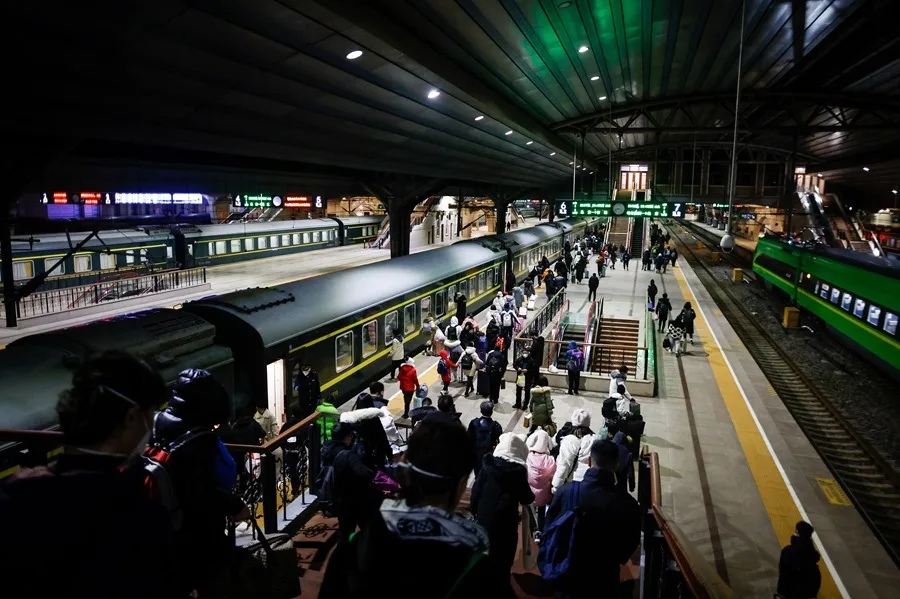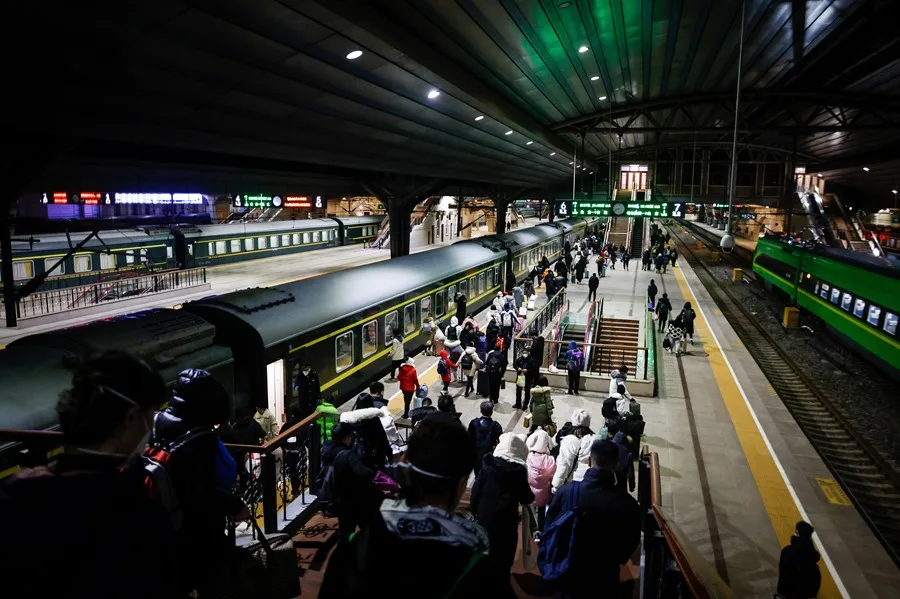

China and Russia resumed this week, after a six-year suspension, international passenger rail transport through Mongolia, with the launch of a train connecting Beijing to the Russian city of Irkutsk, a journey of about 2,666 kilometers.
The first convoy of the new service, with code V3/4, departed this Wednesday from the Beijing station with nearly 200 passengers, reported the official newspaper China Daily this Thursday.
The route, which passes through Ulaanbaatar, has a duration of approximately 55 hours and is scheduled to arrive in Irkutsk this Friday afternoon.
The service will have a weekly frequency, with departures from Beijing on Wednesdays and returns from Irkutsk on Saturdays, arriving in the Chinese capital on Mondays.

As things stand, the new connection partially replaces the old K3/4 international train, which had linked Beijing to Moscow via Mongolia for decades and whose service was suspended in 2020 due to the COVID-19 pandemic.
Unlike that route, which covered about 7,800 kilometers to the Russian capital, the new service ends in Irkutsk, located about 65 kilometers from Lake Baikal.
How much will a train ticket cost?
According to Chinese media, the train has 16 carriages, including sleeper cars of different categories and a dining car, and is equipped to withstand “extremely low” temperatures.
Tickets cost 2,411 yuan ($362) for a conventional sleeper car and 3,763 yuan ($565) for higher-category compartments.

The restoration of the link coincides with the strengthening of exchanges between Beijing and Moscow, which have expanded their economic, energy, and transport cooperation in recent years.
Both countries have also promoted mutual visa exemption measures to facilitate travel for their citizens.