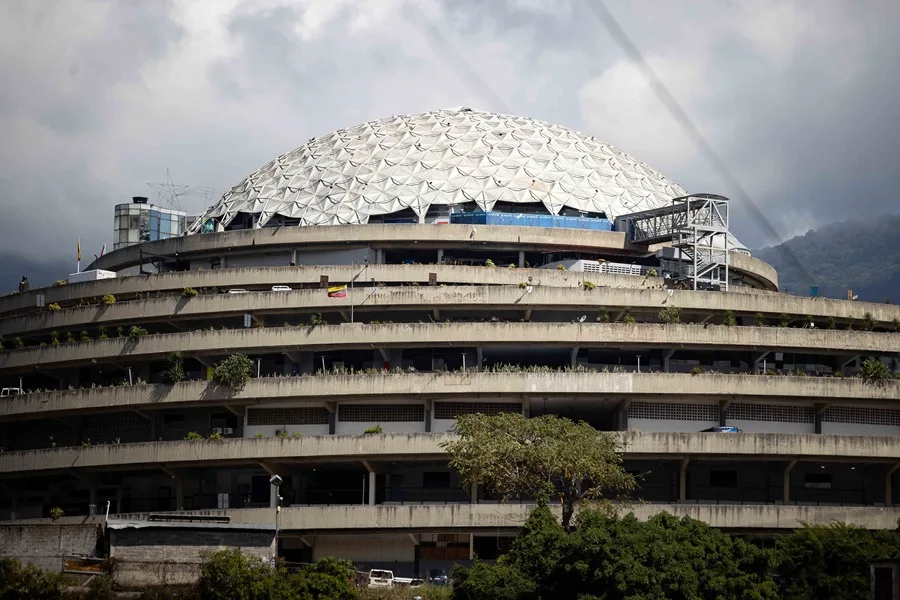
The Helicoide -a structure in Caracas from the 1950s used today as a detention center for political prisoners- will become “a social, sports, cultural and commercial center”, said the acting president of Venezuela, Delcy Rodríguez, who revealed the proposal after the releases announced a couple of weeks ago.
Originally conceived as a shopping center, this facility returned to the spotlight after the President of the United States, Donald Trump, spoke, a couple of weeks ago, about the closure of a “torture” site in the Venezuelan capital.
In this unfinished building – described as a “cutting-edge project” due to its futuristic helix-shaped design – the headquarters of the Bolivarian National Police (PNB), the Bolivarian National Intelligence Service (Sebin), and others operate, according to the NGO Foro Penal, dedicated to the defense of political prisoners.
The Helicoide is a place where organizations of the UN have denounced the existence of “torture chambers” and where several detainees have died in custody, including the opposition figure Fernando Albán and General Raúl Isaías Baduel, former Minister of Defense under the late President Hugo Chávez.
Here are some key facts about this place:
Human Rights
The word “Helicoide” has increased in reports from the Independent International Fact-Finding Mission on Venezuela of the UN, which investigates alleged human rights violations in the country since 2014.
In the first mission report, in 2020, this word appears only twice, compared to about 60 in 2024, the year in which a crisis erupted – which included anti-government protests and accusations of “repression” – following the accusation of electoral fraud in the result that gave victory to Nicolás Maduro in the presidential elections.
In 2023, the mission documented that the authorities of the Venezuelan State have resorted to “torture and ill-treatment” as methods to “generate and perpetuate” a “climate of fear” in Venezuelan civil society.
According to this report, some interviewees emphasized that the “symbolic impact of the cases of torture and ill-treatment served to terrorize civil society and inhibit dissent, in particular the maintenance of torture chambers in El Helicoide.”
Deaths
In October 2018, opposition figure Fernando Albán died in El Helicoide, where he was being held for allegedly being involved in a drone attack against Maduro.
His family “could not conduct an independent autopsy or bury his body, despite numerous requests,” indicated the UN Independent International Fact-Finding Mission.
The authorities then reported that it was a suicide, although the forensic evidence “raises doubts about that conclusion,” the mission stressed.
Various politicians and NGOs denounced that it was actually a murder, so they asked for the case to be investigated, currently considered “unpunished” because, although two Sebin officials were convicted, the court later reduced their sentence.
Furthermore, the mission also investigated the death of General and former Minister of Defense Raúl Isaías Baduel, who allegedly died of COVID on October 12, 2021, in El Helicoide. His daughter, Andreína Baduel, believes that her father – accused of corruption – was unjustly detained and demands justice.
Amnesty
Delcy Rodríguez, who was sworn in as acting president on January 5th, two days after the U.S. captured Nicolás Maduro and his wife, Cilia Flores, during a military operation, announced this Friday her decision to “promote a general amnesty law covering the entire political period of political violence from 1999 to the present.”
In 1999, the era known as Chavismo began with the arrival to power of Hugo Chávez, who governed until 2013 – the year of his death – and was succeeded by Maduro.
When intervening in the act of the beginning of the judicial year, Rodríguez asked the Judicial Revolution Commission and the Program for coexistence and peace to present the law before the National Assembly (AN, Parliament) in the “next few hours”, as well as the “maximum collaboration” to the legislative body for its approval.
“May it be a law that serves to heal the wounds left by political confrontation, from violence, from extremism, that serves to redirect justice in our country and that serves to redirect coexistence among Venezuelans,” added the acting president.
Several NGOs in Venezuela have clarified that the amnesty proposal is not a “pardon.” Provea, an organization dedicated to the defense of human rights, has warned that “these people were arbitrarily imprisoned.”
The last time an amnesty law was enacted in Venezuela was in December 2007, when Chávez pardoned people involved in the coup against him in 2002.
Releases
On January 8th, the president of the Venezuelan Parliament and chief negotiator of Chavismo, Jorge Rodríguez, announced the release of “a significant number of people”, including Venezuelans and foreigners, -without specifying the number or conditions-, as a “unilateral gesture” to “consolidate peace and peaceful coexistence” in the country.
By Thursday, Foro Penal had confirmed the release of 302 people since January 8. According to the count of that NGO, there are 711 political prisoners in the country.
We are a multiplatform outlet offering news and television content. The fastest-growing news outlet in audience in the history of Caribbean communication.
Newsletter
Subscribe to our newsletter to receive our latest articles instantly!