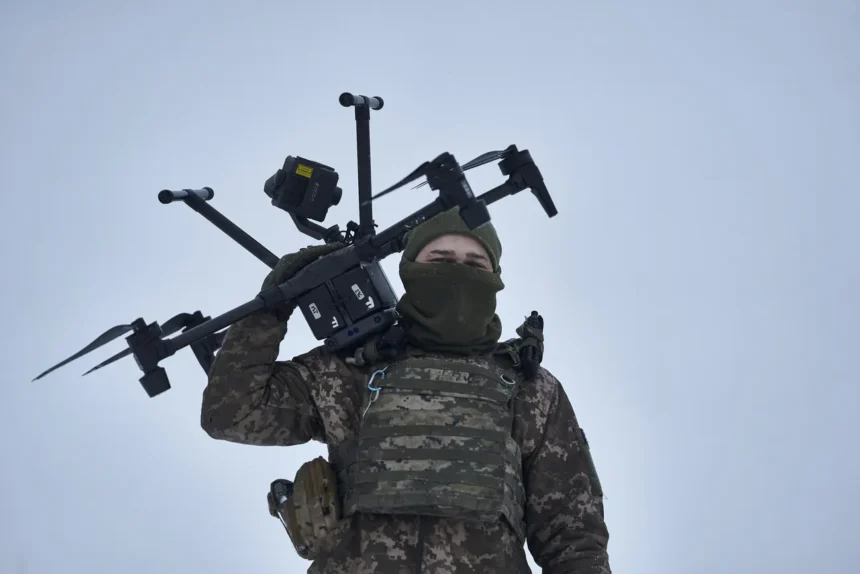
Geneva.- The UN and the International Committee of the Red Cross (ICRC) said that the start of international negotiations to regulate the use of autonomous weapons is urgent, as their production is increasing and they are being used more and more on the battlefield, increasing the risk to civilian populations.
“We are dangerously close to crossing a moral red line: the autonomous attack of machines against human beings,” stated UN Secretary-General Antonio Guterres and ICRC President Mirjana Spoljaric in a joint statement.
Despite being strictly prohibited by international humanitarian law, attacks against civilians and civilian infrastructure occur practically every day, but now the problem of weapons that select and pursue their target without human intervention is added, for which distinguishing who is a combatant and who is not in a conflict zone is very difficult, if not impossible, particularly when conditions change.
Read more: UN peacekeepers die in ambush in South Sudan
A changing condition can be represented by a wounded combatant, who in this case becomes protected by humanitarian norms, but who for a machine would remain a potential target.
Gutiérrez and Spoljaric recalled that autonomous weapons are no longer part of “a distant future,” but a reality in which they are proliferating because increased production makes them cheaper and because it is becoming easier to integrate them into existing weapons systems, explained the head of UN Disarmament Affairs in Geneva, Mélanie Régimbal, at a press conference.
More Read

As the development of weapons technologies advances relentlessly, international legal standards are becoming obsolete, which is why the UN and the ICRC have called on States to “show the courage” to begin negotiations this November to adopt a new legal framework to regulate autonomous weapons, clearly defining what is prohibited and setting clear restrictions.

In November, about 180 countries, as well as involved sectors, will meet in Geneva at the Seventh Conference of the Convention on Prohibitions or Restrictions on the Use of Certain Conventional Weapons Which May Be Deemed to Be Excessively Injurious or to Have Indiscriminate Effects, an event that has been preceded by nine years of work by a group of governmental experts that has produced the main elements that a new convention on autonomous weapons should contain.
“A lack of rapid action will cost lives,” said the heads of the UN and the ICRC, which is even more serious at a time when impunity prevails due to the difficulty in establishing accountability for errors and violations of the rules.
More Read

However, in the likely negotiations, it will not be proposed that all autonomous weapons be banned, but rather those that can be considered “unpredictable,” that is, when operators cannot anticipate the effects of their use, explained Laurent Gisel, head of the arms and conduct of hostilities unit at the ICRC, to the press.
It is also proposed to ban anti-personnel autonomous weapons systems.
Gun control
Firearm regulation seeks to establish controls over who can acquire, carry, store, and use a weapon, with the goal of reducing access by individuals who pose a risk and preventing violent acts, accidents, and deaths. Among the measures used are background checks, licenses or permits, safe storage requirements, and access restrictions for certain high-risk groups.
Scientific evidence indicates that stricter sets of regulations may be associated with a reduction in firearm deaths. An international review published in 2024, which examined more than 200 studies, concluded that restrictive national legislation can decrease gun-related mortality. Likewise, previous research has found associations between controls such as background checks and purchase permits and lower rates of firearm homicides.