

Nobody called it a tax reform. President Luis Abinader’s government presented it in June 2026 as a plan to boost growth, simplify the tax system, and mitigate the effects of the international crisis, and Congress approved it as a matter of urgency. Hours later, it was already Law 30-26. But just because it doesn’t bear the name doesn’t mean it isn’t one: the Minister of Finance himself, Magín Díaz, announced that it seeks to raise between RD$40,000 and RD$50,000 million in additional revenue for the State. That, here and anywhere else, is a tax reform. Only a silent one.
It is worth reading it without the disguise. Companies with revenues exceeding RD$1 billion will pay a 30% Corporate Income Tax until 2028, above the general rate of 27%. A new 27% bracket is created for individuals with annual incomes greater than RD$4.8 million. The tax on checks and electronic transfers increases from 1.5 to 2 per thousand, and the air departure tax increases from US$20 to US$30 per passenger, a 50% increase. It is true that the government did not touch the ITBIS (VAT) or the basic food basket, and that must be acknowledged. But no tax charged to a company stays with the company: it ends up, sooner or later, in the price paid by the consumer.
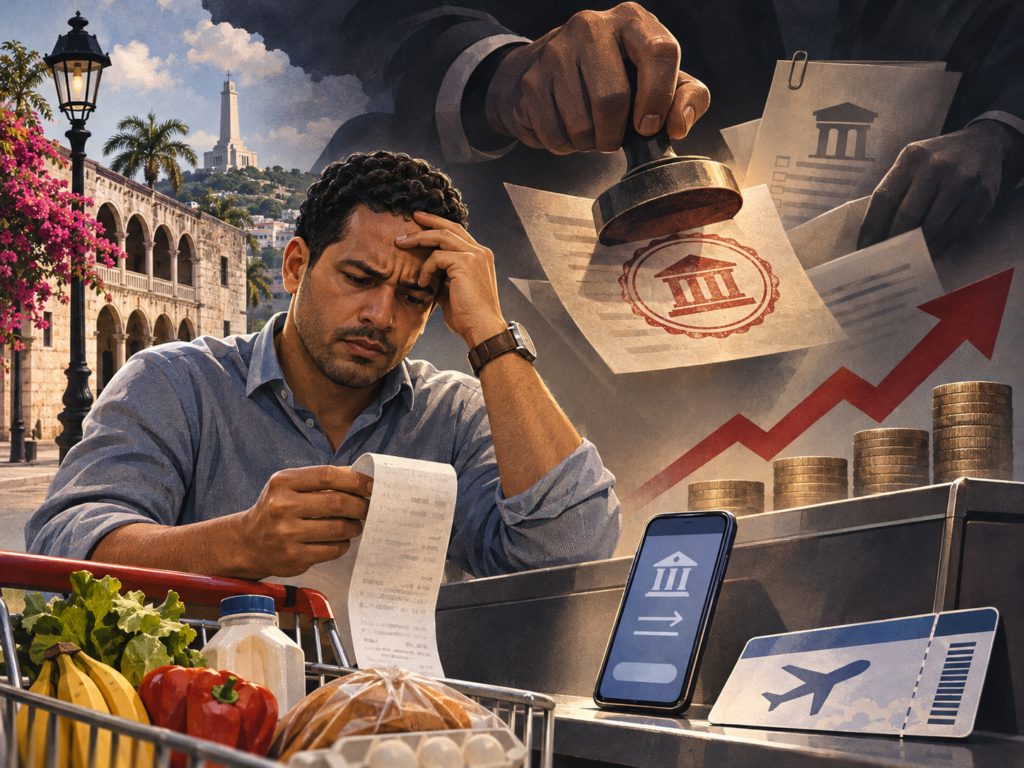
The blow will be felt in January. The tax amnesty brought by the law expires on December 31, 2026, and on January 1, 2027, the new Income Tax scale goes into effect, raising the exempt income to RD$480,000 per year. That relief for lower-income wage earners is fair and long overdue, as that amount had been frozen for years while everything else went up. But January is the toughest month for the Dominican pocketbook: it comes after the expenses of December, with holiday debts and new company budgets, which will have already calculated prices with the new taxes included. In January, the Dominican will discover at the supermarket checkout, in their bank transfer, and on their airline ticket a reform that no one explained to them by its true name.
The timing doesn’t help either, because the world is in trouble. In its October 2026 report, the International Monetary Fund projected that the world economy will grow by just 3.1% this year, that global inflation will rise to 4.7%, and that oil will increase by 41.3%, driven by the war in the Middle East. Global public debt is already equivalent to 94% of the planet’s gross domestic product and will reach 100% by 2029, with high interest rates making money more expensive for everyone. For a country that imports fuel and depends on tourism and remittances, like ours, that blow hits twice.

The underlying problem is real and no one can deny it. The Dominican Republic closed 2025 with a fiscal deficit of 3.45% of the gross domestic product, the consolidated debt is around 60% of GDP, and the 2027 Budget allocates RD$351.327 billion to interest payments, 23.3% of projected revenue. Almost one out of every four pesos the State collects goes toward interest, before paying a single teacher or doctor. The State needs to put its finances in order, but not behind closed doors, by placing the adjustment on companies that already pay and, through them, on the middle class and consumers, while evasion and informality remain untouched.
Dominican history has already written this chapter several times. In April 1984, an adjustment agreed upon with the International Monetary Fund, involving price hikes on basic goods, triggered the popular uprising that left people dead in the streets. In 1990, in the midst of another crisis, Balaguer did the opposite: he summoned business owners, workers, and social sectors to the Economic Solidarity Pact, and from that dialogue, the Tax Code that still governs us today was born in 1992. In 2012, Danilo Medina’s fiscal package filled the streets with protests, and in October 2024, President Abinader had to withdraw his Fiscal Modernization Law in the face of the country’s rejection. The lesson is clear: reforms that are discussed endure; those that are disguised are paid for with social interest.
The solution is not to deny the problem, but to face it head-on and with the truth. The government must call things by their name and convene an open fiscal pact, with business owners, workers, churches, universities, and parties, as was done in 1990. Before raising rates on those who already pay, it must attack evasion and informality, which is where the uncollected money lies. It must review tax expenditures: the exemptions estimated for 2026 total RD$441.445 billion, more than eight times what this law intends to collect. It must tighten its own belt and cut current spending before asking the people for sacrifices. And every new peso must have a declared and verifiable destination: health, education, security, and works that the people can see.
A country is not put in order with silent reforms. But with the truth on the table and with a government that tightens its own belt first before tightening the citizen’s. If in January the people feel the blow without having heard an explanation, the bill will not only be economic: it will be one of trust, and that is the most expensive debt a government can incur.