Every 19th of July, the 22 Ibero-American countries celebrate the Day of Ibero-America, a date to recognize and value the rich historical, linguistic, and cultural heritage that unites this community of nations distributed between Europe and Latin America.
The celebration has its origin in the first Ibero-American Summit of Heads of State and Government, held on July 19, 1991 in Guadalajara, Mexico. On that historic occasion, the leaders of 22 countries signed a joint declaration that gave birth to the Ibero-American Community of Nations, a common space based on shared values such as dialogue, cooperation, solidarity and unity.
In the year 2020, the Foreign Ministers of these countries agreed to institutionalize the date, designating July 19 as Ibero-America Day, with the aim of celebrating and reaffirming each year the ties that unite them.
What is understood by Latin America?
The term Latin America designates, in its most direct meaning, the territories of the American continent that were colonized by Spain and Portugal, thus integrating both nations of the Iberian Peninsula.
However, its meaning goes far beyond a geographical or historical reference. It is a notion that encompasses centuries of exchange, mutual influence, and joint evolution between peoples who, despite their differences, have built a shared fabric of languages, cultures, beliefs, and ways of understanding the world.
The idea of Ibero-America has consolidated not only as a political-cultural category, but also as a form of recognition of a complex and diverse history. Far from being a colonial vestige, this term encapsulates the deep interdependence between America and the Iberian Peninsula, whose relationship has generated a mixed and plural identity, visible in its cultural, social, and linguistic expressions.
Iberoamérica is not just a region; it is also a living memory, a permanent conversation between shores, a community that continues to shape its destiny in terms of diversity.
Geographic and Cultural Composition of Latin America
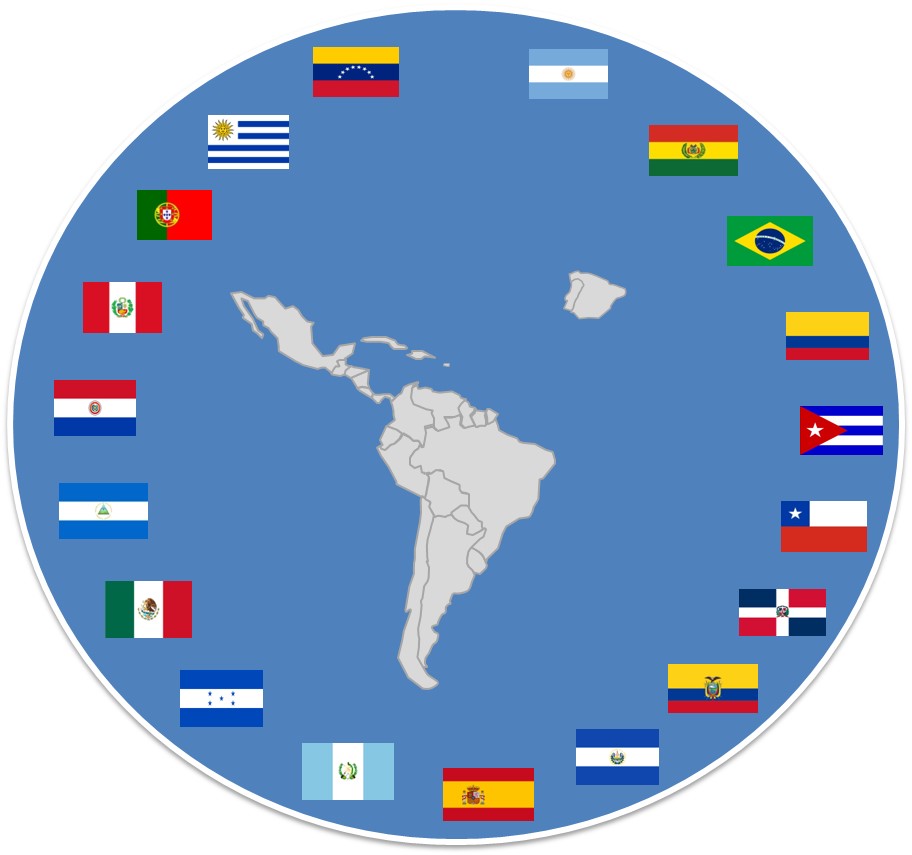
The Ibero-American Community is made up of 22 countries, of which 19 belong to Latin America and 3 to Europe. Although geographically dispersed, they maintain a close link based on their history, culture, and language.
Argentina, Bolivia, Brazil, Chile, Colombia, Costa Rica, Cuba, Ecuador, El Salvador, Guatemala, Honduras, Mexico, Nicaragua, Panama, Paraguay, Peru, Dominican Republic, Uruguay, and Venezuela are part of the American continent. From Europe, Spain, Portugal, and Andorra are integrated.
This union reflects the richness of their shared traditions and the joint commitment to strengthen their political, social, and economic relations in a globalized world.
The SEGIB
The SEGIB, or Ibero-American General Secretariat, is an international organization that supports the 22 countries of the Ibero-American community, promoting multilateral cooperation and cohesion among them, especially in the cultural, social, economic, and political fields.
The celebration of Ibero-America Day is promoted by the Ibero-American General Secretariat (SEGIB), an international organization in charge of promoting Ibero-American cooperation in various areas: from sustainable development to innovation, social justice, gender equality, and inclusion.
With the support of the Spanish Agency for International Development Cooperation (AECID) and the collaboration of Casa de América, SEGIB promotes commemorative activities, both institutional and citizen-led, that seek to bring closer the idea of a more united, prosperous and inclusive Ibero-America.
A diverse and supportive community
The Ibero-American Community is made up of countries with common cultural roots, mostly Spanish and Portuguese speakers, who share a vision of the future based on horizontal cooperation, democracy and human rights.
The Ibero-American Day is an occasion to celebrate that diversity, to reflect on regional challenges and, above all, to consolidate alliances that strengthen sustainable development, culture, education and equity among its peoples.