


Every October, the world unites for Breast Cancer Awareness Month, a commemoration dedicated to raising awareness about the paramount importance of early detection, preventive education, and equitable access to quality health services. In the Dominican Republic, breast cancer represents one of the most frequent diagnoses and constitutes one of the leading causes of cancer mortality in the female population.
In that context, Dr. Rachel Jimenez, a renowned radiation oncologist who leads the Breast Radiation Therapy Program at Massachusetts General Hospital and serves as an associate professor at Harvard Medical School, delved into the medical pillars of prevention and current therapeutic alternatives in an interview with De Último Minuto.
Mammography at 40: The cornerstone for gentler treatments and higher cure rates
The fundamental medical recommendation supported by Dr. Jiménez is clear: every woman should begin her breast cancer screening with an annual mammogram starting at age 40. The specialist emphasizes that the mammogram represents the cornerstone for the early diagnosis of the disease, allowing for the identification of structural anomalies long before they are palpable or generate clinical symptoms.
In cases where there is a first-degree family history or a confirmed genetic predisposition, the initiation schedule should be evaluated in conjunction with the primary care physician to determine if it is appropriate to begin testing at an earlier age.

According to the doctor, the difference between an early-stage and a late-stage diagnosis drastically alters the course of treatment and the patient’s quality of life, since when breast cancer is detected in its incipient phases, when the lesion is tiny and has not spread outside the breast tissue, the disease achieves extremely high cure rates. Likewise, she said that the medical intervention required in early stages is considerably milder: it demands less invasive surgical interventions, smaller-scale radiotherapy regimens, and a lower burden of systemic medications.
Conversely, it explains that if the evaluation is postponed until the tumor is clinically palpable or has migrated to the axillary lymph nodes, therapeutic protocols become considerably more intense and complex, requiring more extensive surgeries, aggressive pharmacological regimens, and recording a lower probability of cure.
Risk factors: Modifying lifestyle and managing genetic inheritance
Various factors are involved in the development of breast cancer. Dr. Rachel Jimenez explains that there are non-modifiable biological variables that increase a person’s vulnerability, such as the natural aging process, female sex, breast tissue density, and ancestral history. While these elements are beyond individual control, there are modifiable risk factors directly linked to lifestyle that each person can proactively adjust to decrease the likelihood of developing the disease.
“There are risk factors that we cannot change, such as age, being female, ancestral history, or having dense breasts. However, there are lifestyle habits that we can modify to lower the risk: exercising, losing weight, limiting alcohol, and managing stress. Likewise, it is essential to understand your risk and talk to your doctor about a personalized early detection plan,” the specialist stated.
Among the lifestyle habits with the greatest preventive impact, the specialist highlights the regular practice of physical exercise, maintaining a healthy body weight, and the moderation or limitation of alcoholic beverage consumption, along with strategies aimed at stress management. These measures contribute significantly to regulating the body’s hormonal and metabolic environment.
On the other hand, for those individuals with a significant family history of breast cancer or other related oncological conditions, Dr. Jiménez emphasizes the importance of undergoing specialized genetic testing.
Warning signs and the myth of radiation in preventive studies
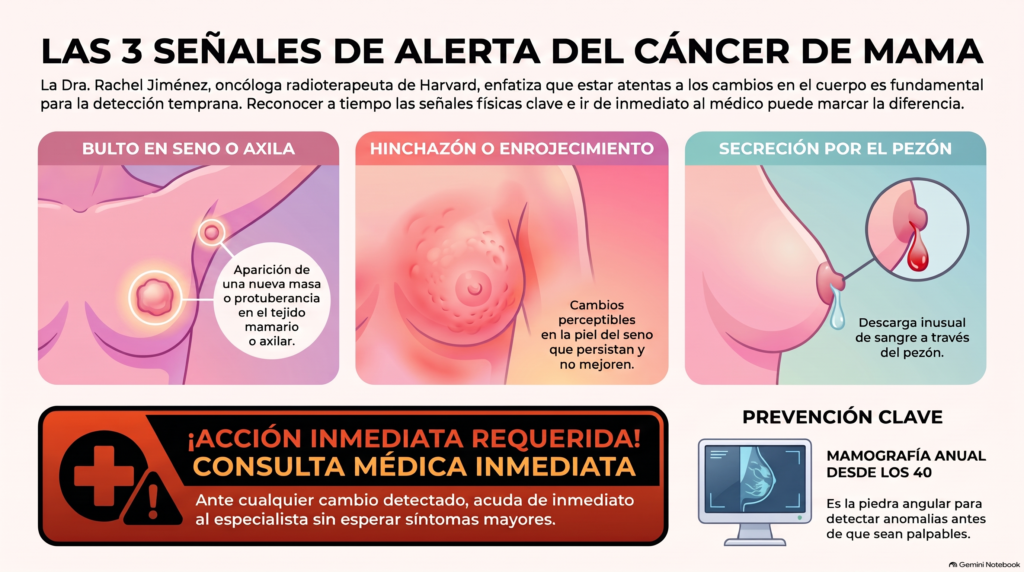
Being attentive to changes in one’s own body constitutes a complementary tool for self-knowledge. Dr. Jiménez points out that, although breast self-examination helps women become familiar with the structure of their breasts, under no circumstances should it replace clinical evaluations or scheduled imaging studies.
There are specific warning signs for which you should immediately seek medical attention:
- Appearance of a new lump, mass, or thickening in the breast or underarm area.
- Persistent swelling, edema, or redness of the breast skin that does not subside over time.
- Bloody discharge or abnormal changes from the nipple.
A frequent obstacle that distorts prevention is misinformation surrounding the safety of imaging tests. Dr. Jiménez categorically debunks the myth that undergoing annual mammograms exposes the body to dangerous levels of radiation capable of inducing biological damage. Modern mammography technology uses extremely low and controlled doses of radiation, making this exam a highly safe procedure whose diagnostic benefits far outweigh any theoretical risk.
Advances in oncology: Contrast-enhanced mammography, targeted treatments, and microscopic blood detection
Rachel Jiménez highlighted the significant advances that oncology medicine has experienced in recent years, especially in the early diagnosis of cancer and the development of increasingly precise, personalized, and effective treatments, which offer new hope to patients.
The specialist explained that one of the most significant advances in breast cancer diagnosis is contrast-enhanced mammography, a technology that allows for more precise identification of suspicious lesions by visualizing their vascularization. She noted that this tool facilitates the detection of tumors just a few millimeters in size, which could go unnoticed in conventional studies, particularly in women with dense breast tissue.
Likewise, Jiménez highlighted that modern oncology is advancing towards individualized treatments, thanks to the development of targeted drugs and therapies based on the molecular characteristics of each tumor. These procedures allow for attacking specific alterations in cancer cells, improving therapeutic response and, in certain cases, reducing the adverse effects associated with traditional treatments.
Another of the advances highlighted by the doctor is the incorporation of innovative blood tests, such as liquid biopsies and circulating tumor DNA analyses, capable of identifying fragments of genetic material released by cancer cells into the bloodstream.

Overcoming the fear of diagnosis and promoting equitable access to healthcare
Fear of a diagnosis, lack of time, or misinformation often lead women to postpone their breast health check-ups. Dr. Rachel Jimenez calls for overcoming fear and proactively consulting with a primary care physician. The specialist emphasizes that receiving a timely diagnosis is not a sentence, but a fundamental opportunity to access curative treatments and maintain a full and healthy life.
“Many women believe that getting a mammogram every year exposes them to dangerous levels of radiation. The reality is that in modern mammography the radiation level is extremely low and the study is completely safe,” she pointed out.
Likewise, the expert acknowledges that access to imaging technology can present disparities depending on the region or socioeconomic context. In the context of the Dominican Republic, she highlights the value of public initiatives and government programs such as the free check-up operations promoted within the framework of the First Lady’s initiative, which facilitate access to mammograms for thousands of women.
International evidence consistently demonstrates that the implementation of massive free screening programs contributes substantially to reducing breast cancer mortality rates through diagnosis at early stages.
Official statistics reflect the magnitude of this epidemiological reality in the country. In the context of this commemoration, the National Health Insurance (SeNaSa) reported that, between January and August 2026, a total of 12,752 women and 436 men received medical care for diagnoses associated with breast cancer. These consultations resulted in 864,149 authorized health services, accumulating a financial investment of RD$ 2,049.4 million.
The demographic analysis of SeNaSa data shows that more than 80% of the users served are 40 years of age or older, and that nearly six out of ten (approximately 60%) fall within the age range between 45 and 69 years. These epidemiological indicators convincingly confirm the strategic relevance of periodic check-ups and timely detection starting in adulthood, a factor that is decisive for improving the prognosis of the disease, reducing the aggressiveness of interventions, and increasing survival rates.