


Nvidia has unveiled a system that aims to transform the sustainability of data centers, completely eliminating the use of water for cooling. This proposal introduces a technology capable of maintaining servers at optimal temperatures without relying on the enormous volumes of water and energy required by traditional methods.
n” “nThe advancement is presented by the company as an alternative to reduce the water and energy footprint of artificial intelligence facilities.
n” “nWaterless cooling technology in data centers: Nvidia’s new method
n” “nNvidia has publicly unveiled a tempered cooling method aimed at its next-generation Rubin data centers, geared toward artificial intelligence applications. What sets this proposal apart is its ability to minimize both energy and water consumption, a growing concern among international authorities such as the United Nations and communities neighboring these facilities.
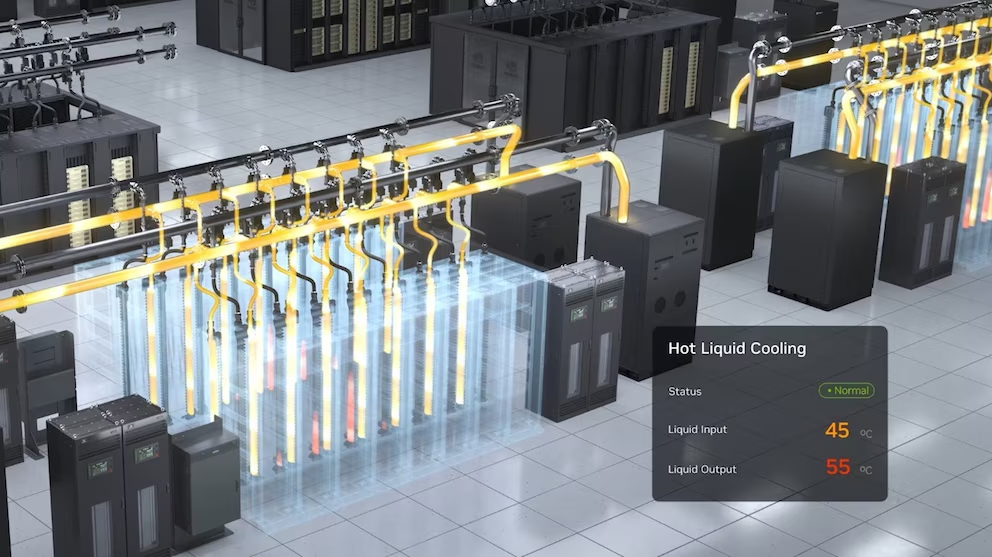
n” “nIn a facility dedicated to artificial intelligence, the coolant circulates from a unit responsible for its distribution to the servers, always remaining within a closed circuit.

We recommend reading:
n” “nThe company, led by Jensen Huang, has decided to do away with traditional large-scale fan and air conditioning systems, which are characterized by their high energy costs and for requiring intensive use of water. Instead, the solution is based on a closed-loop liquid cooling circuit that circulates directly over the processors and other key server components.
n” “nThe liquid used consists of a mixture of 75% water and 25% propylene glycol, which flows at a temperature of 45 degrees Celsius. This proximity to the silicon allows for efficient absorption of the heat generated by the chips, which can raise the liquid’s temperature to 55 degrees Celsius before it is extracted from the system.
n” “nHow the liquid cooling system works and its environmental impact
n” “nNvidia’s new system eliminates the need to evaporate water to dissipate heat. In conventional data centers, hot air is absorbed and transferred to a water circuit, whose final destination is usually an outdoor cooling tower. Liquid cooling systems used in large data centers or specialized machinery.

There, the water evaporates, releasing heat into the atmosphere and repeating the cycle. This method, although technically effective, involves the consumption of millions of liters of water each year.
n” “nWith Nvidia’s solution, the coolant remains in a closed loop, with no evaporation losses. Dry radiators, similar to those used in cars, allow heat to be expelled to the outside solely through the temperature difference with the ambient air. Thus, there is no need to turn on noisy air conditioning systems or perform complex additional piping installations.
n” “nIn this regard, Richard Whitmore, president and CEO of Motivair, a strategic partner of Nvidia for the development of this technology, said the following: “You can simply place large radiator coils outside and use the air temperature for all the cooling. It is incredibly efficient.”
n” “nThanks to this approach, a 100% reduction in water consumption is achieved, going from millions of liters evaporated annually to practically zero. The image shows the interior of what is a data processing center (data center), focusing on a large server cabinet or rack in operation.

What are the differences between the traditional system and Nvidia’s proposal
n” “nThe traditional cooling system in data centers operates using industrial fans and high-capacity air conditioning units, which supply cold air to the servers. To maintain the proper temperature, these machines absorb heat, transfer it to a water circuit, and finally, dissipate it through evaporation in external towers.
n” “nThis process involves a double demand: on one hand, large amounts of electrical energy to power the air conditioning systems, and on the other, water consumption that affects both local water resources and the global environmental balance.
n” “nIn contrast, Nvidia’s method uses a hermetic liquid circuit that eliminates evaporation and simplifies internal infrastructure by requiring only one inlet and one outlet for the coolant.
n” “nNvidia has unveiled a system that aims to transform data center sustainability.
n” “nCirculating liquid at 45 degrees Celsius over electronic components allows for leveraging the physics of heat exchange: the temperature difference with the outside facilitates heat expulsion without relying on evaporation, which represents a qualitative leap in efficiency and sustainability for the sector.
n” “nChallenges and limitations of Nvidia technology in data center sustainability
n” “nDespite the total reduction in water consumption, Nvidia’s proposal does not automatically resolve all social and environmental concerns associated with data centers. Territorial occupation and high energy requirements remain issues pending review.
n” “nFurthermore, the implementation of this solution implies an additional cost, both in the construction of the physical infrastructure and in the integration of the new cooling system into existing centers. In modern data centers, such robust hoses fulfill a critical function: they are part of advanced liquid cooling systems.
n” “nAdded to this is the public perception regarding the impact of data centers, which has been a cause for protests by neighborhood associations. International organizations have warned about the risks these facilities pose to the environment and land management, so technological innovations like Nvidia’s represent only part of the path toward a more sustainable model.
n” “nThe viability of the physical alternative proposed by the company will therefore depend on factors such as the investment, the adaptation of infrastructure, and the evolution of regulatory standards regarding environmental and territorial matters.
n”