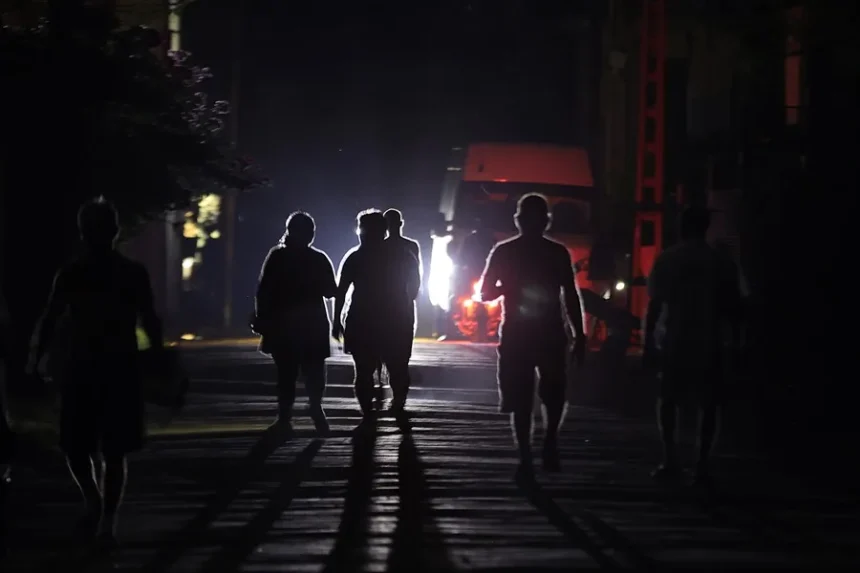
Havana.- Cuba will suffer another day this Friday with barely any power throughout its territory and with blackouts that will leave up to 70% of the island disconnected at the same time during the peak energy demand period, according to data from the state-owned company Unión Eléctrica (UNE), known to EFE.
The island has been plunged into a deep energy crisis since mid-2024, which is explained by the combination of a structural factor, the deeply obsolete energy system; and a circumstantial element, the oil blockade initiated in January by the U.S., a measure described by the United Nations as contrary to international law.
July has been one of the most tense months regarding the energy situation this year, as the island experienced three national blackouts in one week and record power outages were recorded across the country, with simultaneous power cuts that disconnected 74% of the territory in a single day.
It is common every day for blackouts due to a lack of generation capacity to exceed 20 consecutive hours in Havana and reach 40 continuous hours in the rest of the country.
In this context, the UNE, under the Ministry of Energy and Mines, forecasts a generation capacity of 1,000 megawatts (MW) and a maximum demand of 3,200 MW for this Friday’s peak demand hours.
More Read
Thus, the deficit -the difference between supply and demand- will be 2,200 MW and the estimated impact -what will actually be disconnected to avoid disorderly blackouts- will reach 2,230 MW.

The effect of U.S. pressure on the economy
This Friday, furthermore, the UNE reported that nine of the country’s 16 thermoelectric generation units remain out of operation due to breakdowns or maintenance work, a source responsible for 40% of the energy mix in the Caribbean country, which is fueled by national crude and is not affected by the U.S. oil blockade.
U.S. pressure has indeed forced the shutdown of generation engines due to a lack of raw materials, a power source that requires imported diesel and fuel oil, and which accounts for another 40% of the energy mix; while the remaining 20% is obtained from gas and renewable sources.

We recommend reading: Cuba denounces the withholding of more than 7,000 cargo containers due to US measures
The energy crisis affecting the island has fueled social discontent and motivated peaceful protests with pot-banging, sit-ins on Havana’s avenues, and the burning of trash bins in various neighborhoods of the capital city.
Furthermore, it has exacerbated the economic crisis in Cuba, which will face the deepest economic contraction in the region in 2026, with a 6.5% decrease in its Gross Domestic Product (GDP), according to estimates by the Economic Commission for Latin America and the Caribbean (ECLAC), to which must be added the accumulated decline of more than 15% between 2020 and 2025.