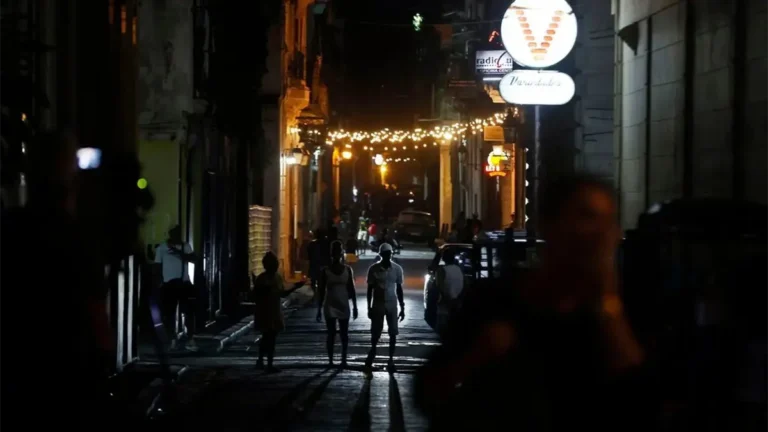

Cuba registers a new national blackout in Cuba, leaving more than nine million people without power.

10:26 pm
Havana.- A failure in Cuba’s National Electric System (SEN), the causes of which are still under investigation, left more than nine million people without power this Monday in the sixth nationwide blackout in a year and a half in Cuba.
Seven hours after the new SEN outage was recorded and well into the night, the vast majority of the country is still without electricity and, in most cases, without landline and mobile telephony and internet.
The General Director of Electricity of the Ministry of Energy and Mines (Minem), Lázaro Guerra, explained to state television that the “step by step” process of service recovery continues with the creation of microsystems to generate energy in small areas that are being interconnected.
Guerra said that the causes of this new total disconnection are being investigated and “all the parameters of the System” are being analyzed to identify what caused this general blackout on the island.
The state-owned Unión Eléctrica (UNE), dependent on the Minem, reported that they already have microsystems activated in areas of the western provinces of Pinar del Río, Havana, Matanzas, the central Villa Clara and Sancti Spíritus, and the eastern Las Tunas, Granma and Holguín have the microsystems.“So far, all parameters are fine, no impact was reported on the generating units that were in service at the time of the blackout,” he added.
You can also read: Trump says US could reach agreement with Cuba
Those interconnected generation sites serve a determined load and are created to bring electricity to vital centers (hospitals, communication centers, and food processing), he pointed out. In one of its latest reports, the UNE reported that in Havana, 42,372 customers currently have electricity service, which represents 4.9% in the capital city. In addition, it warned that the restoration of the current will be done “gradually as the conditions of the SEN allow.” According to the protocols for service restoration, energy sources such as solar, hydroelectric, and generation engines operating with diesel and fuel oil have also been activated, although those fuels are heavily limited on the island due to the US oil blockade. Energizing thermoelectric plants without this fast-starting energy source can be a challenge, as Guerra explained a week ago, after the previous massive blackout that affected about six million Cubans. Critical SituationBefore this new “total disconnection,” the situation was already critical on the island, with blackouts of about 15 hours a day in Havana and continuous periods without electricity of up to two days in the provinces. Economic activity is almost completely paralyzed and social discontent is increasing: in recent days protests have taken place in different cities of the country, at least one of which ended violently and with arrests. Cuba is going through a deep energy crisis since mid-2024, a situation that has worsened in the last three months with the oil blockade imposed by the U.S. that is completely paralyzing the economy and fueling social unrest. The structural situation of the SEN is critical due to frequent breakdowns in the country’s obsolete thermoelectric plants, but also because the Cuban government does not have enough foreign currency to import fuel for the generation engines that require diesel or fuel oil.
Periodista con experiencia en producción audiovisual y creación de contenido para marcas. Egresada de la UCSD en la carrera de Comunicación Social y estudiante de término de la maestría en Ciencias Políticas y Políticas Públicas.



#Most read
- 1.Lula leads Flávio Bolsonaro in first results of the 2026 Brazil elections
- 2.VIDEO: Tourists stranded with suitcases amid violent protests in Paris
- 3.Apple equips its AirPods with translation in English, Spanish, Portuguese, French, and German
- 4.NASA launches three missions to map the heliosphere and study the solar wind
- 5.Nvidia: From Video Games to the World’s Summit as a Colossus of Artificial Intelligence
- 6.Roberto Ángel Salcedo heads the first preparatory meeting for the 2026 carnivals
- 7.84% of teenage girls in Spain fear that AI will use their photos to create fake sexual content
- 8.Mexican student creates sound-based fire extinguisher and wins gold medal
- 9.Haitian gang leader challenges Bukele as search for missing Salvadorans continues
- 10.VIDEO: Haiti gang suppression force reports deaths as search continues for four missing Salvadoran soldiers

Newsletter
Subscribe to our newsletter to receive our latest articles instantly!