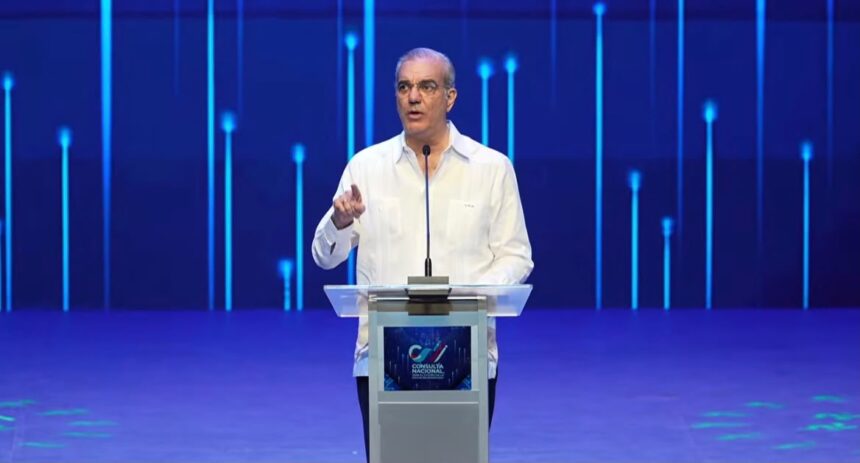
Santo Domingo.- President Luis Abinader stated this Wednesday that the Dominican Republic is beginning a new stage to transform its educational system, with the goal of preparing future generations for the challenges of artificial intelligence, automation, and new technologies.
Upon closing the process of the National Consultation for the Transformation of Education, the president recalled that the commitment was made during his accountability speech on February 27th and highlighted that he wanted to turn that initiative into a national cause.
The head of state reported that more than 7,000 people participated in the consultation process, presenting criticisms, concerns, and proposals to strengthen the educational system.
“Governing also means listening. And listening compels us to recognize a reality: we still have much to improve in the quality of our education,” he expressed.
The president pointed out that the educational system must stop preparing students for a world that has already changed and focus on developing capabilities to face the future.
More Read
We recommend reading: Abinader to meet with Peravia mango producers due to US restrictions
“The school cannot continue preparing our youth for a world that no longer exists. It must prepare them for the world that is coming,” he stated.
In that sense, he maintained that education must strengthen fundamental areas such as reading, writing, mathematics, and science, but also promote critical thinking, creativity, problem-solving, teamwork, and values-based education.

Likewise, he raised the need to guarantee educational opportunities for all sectors of the population, including students with special needs, people who dropped out of school, and adults whose jobs have been displaced by technological advances.
More Read
Abinader assured that, although the country has significantly increased investment in education with better infrastructure, school meals, books, technology, and better conditions for teachers, the main challenge now is to convert that investment into better results.
“The great challenge is to convert that investment into quality, so that every peso allocated to education translates into better learning, greater opportunities, and a more promising future for our children and youth,” he stated.
The president indicated that the educational transformation will be a State policy built on dialogue, consensus, and a long-term vision, placing students at the center of decisions.
Furthermore, he reiterated that the country’s economic development will depend on the strengthening of human talent.
“If we want to double our economy by the year 2036, we must first multiply our human talent,” he maintained.
Finally, he stated that the goal is for the Dominican Republic to be a protagonist of the fourth industrial revolution and not a victim of technological changes, by training young people capable of innovating, generating wealth, and competing globally without losing the values that identify the country.