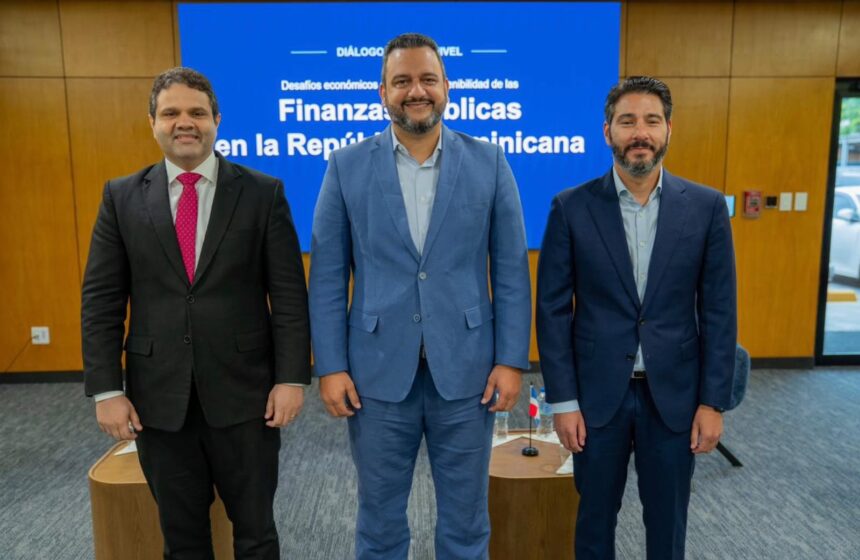
The platform was presented during the panel “Global Economic Challenges and Sustainability of Public Finances in the Dominican Republic,” with the participation of prominent specialists from the economic and governmental spheres.
Santo Domingo.- A group of graduates from the public sector programs of BARNA Management School presented a new initiative aimed at promoting permanent spaces for analysis, dialogue, and the generation of proposals regarding the main challenges facing the Dominican Republic in terms of public policy, economy, leadership, and sustainable development.
The initiative, promoted by Leandro Mieses, Irahisa Nolasco, Augusto de los Santos, Ángela González, and Laura Díaz, arises with the support of BARNA Management School and BARNA Alumni, with the purpose of connecting academic knowledge, professional experience, and the leadership of its community of graduates to contribute, from a technical, plural, and constructive perspective, to the debate on strategic issues for national development.
The launch took place within the framework of the high-level dialogue “Global Economic Challenges and Public Finance Sustainability in the Dominican Republic,” a space that brought together renowned specialists to analyze the impact of the international economic context on the Dominican economy and the challenges the country faces to ensure the sustainability of its public finances. This activity was held at the new facilities of Barna Management School.
We recommend reading:New executive vice presidents appointed for AFI Reservas and Inversiones y Reservas

The day began with welcoming remarks from Armando Barrios, Academic Director of Public Sector Programs at BARNA Management School, who highlighted the importance of creating spaces for reflection that strengthen the quality of public debate and contribute to the design of better policies for the country’s development.

Subsequently, Leandro Mieses, representing the driving group, formally presented the initiative, highlighting that its objective is to consolidate a permanent platform that promotes the exchange of knowledge between academia, the public sector, the private sector, and society, fostering the generation of proposals that contribute to the construction of solutions for major national challenges.
The panel was composed of Luis Madera Sued, Vice Minister of Monitoring and Government Coordination of the Ministry of the Presidency; Francisco Torres, Superintendent of Pensions of the Dominican Republic; and Richard Medina, economist, specialist in macroeconomics, international trade, and climate change, and managing partner of WCG, who shared their perspectives on the international economic landscape, fiscal challenges, and the need to strengthen institutional capacity to face an increasingly complex global environment.
More Read
The moderation of the dialogue was led by Laura Díaz and Ángela González, who conducted a conversation focused on the importance of promoting sustainable public policies and strengthening the coordination between different sectors to boost the country’s economic growth and financial stability.
As part of the academic closing of the meeting, Augusto de los Santos offered a synthesis of the main ideas and conclusions of the panel, highlighting the relevance of maintaining permanent spaces for strategic reflection that allow for anticipating challenges, building consensus, and generating high-impact proposals for the Dominican Republic.
The activity concluded with the words of Ailin Lockward, Director of Institutional Development at BARNA Management School, who reaffirmed the institution’s commitment to training leaders capable of generating positive transformations and actively contributing to institutional strengthening and the country’s sustainable development.
With this initiative, BARNA graduates aspire to consolidate a platform for thought and dialogue that promotes high-level conversations on major national challenges, strengthening the connection between academia, professional leadership, and the public and private sectors, as a contribution to the development of a more sustainable, competitive, and institutionally strengthened Dominican Republic.d