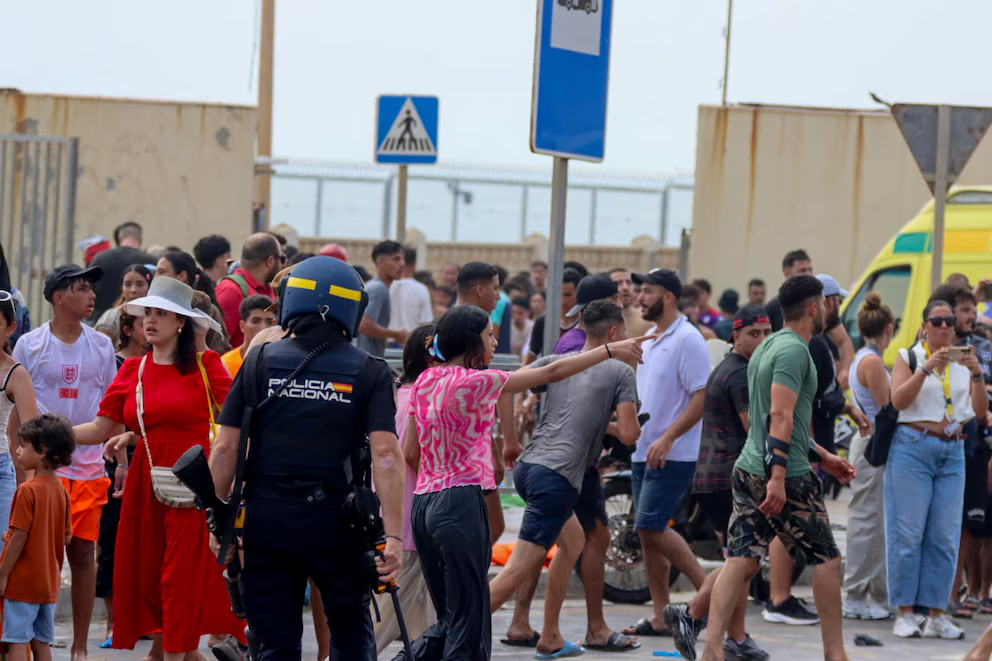


Ceuta is experiencing one of its most tense moments in years. Thousands of people have crossed into the autonomous city from Morocco this week. During this Thursday morning, there were moments of maximum concern with the police carrying out charges to stop the advance of hundreds of migrants. To find a precedent for a migration crisis of this type, one must go back to 2021, when the largest entry ever recorded occurred in two days.
The Government has pointed directly to human trafficking mafias. Morocco put forward this theory early on when its cooperation was being questioned, and Spain supported the same line, conveying a diplomatic understanding regarding the crisis. Afterwards, they announced a pact to return all migrants “as soon as possible”.
This rapid common stance comes two weeks after Pedro Sánchez’s visit to Algeria, a direct rival of the Moroccans, and with the suspicion among some people of a lack of support from the authorities on the other side of the border due to what happened five years ago, when the enmity over hosting the leader of the Polisario Front, Brahim Gali, led to the withdrawal of police custody from the fence by Morocco.
The Ministry of the Interior issued a statement pointing out that “human trafficking networks are instrumentalizing a judicial ruling to encourage the flow of undocumented migrants, mostly young people.” This ruling is the decision not to allow “hot returns” of people trying to swim across. Grande-Marlaska, who arrives this Friday in the autonomous city, thanked the Moroccan authorities for the recent efforts of their security forces, which he assures managed to stop thousands of attempts at irregular entry.

We recommend reading: Thousands of people swim across the border in Ceuta, triggering a migration crisis with at least 15 dead
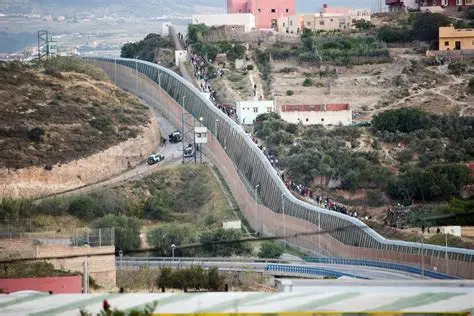
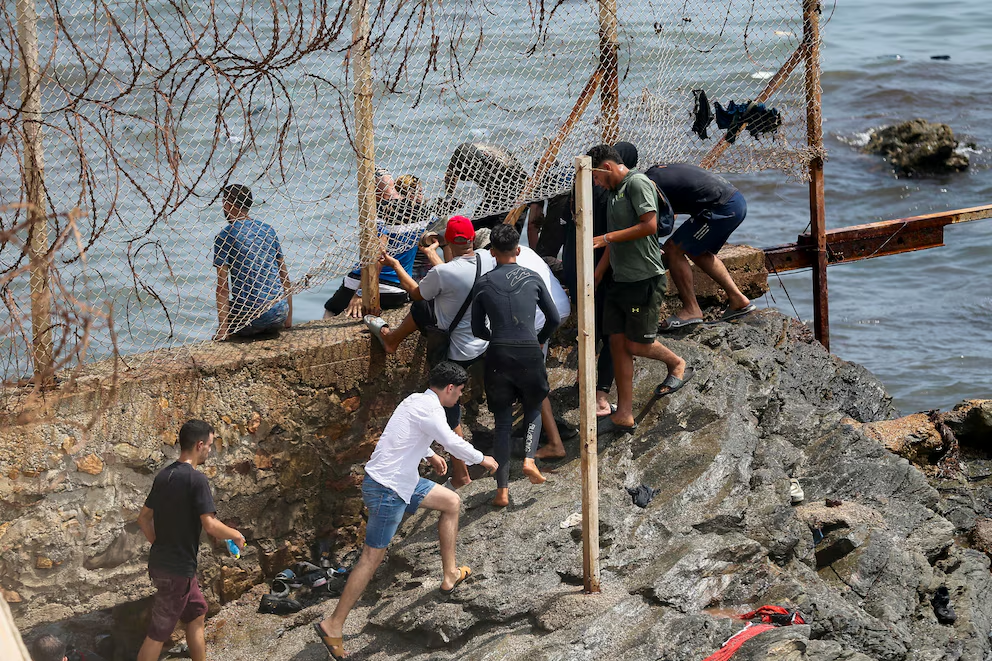
Infobae’s map illustrates the location of the Tarajal breakwater in Ceuta, on the border with Morocco, next to a photograph of the site.
For now, the Government has mobilized the Army in the autonomous city due to the collapse of the border following the massive arrival of migrants from Morocco.
The Supreme Court ruling
One of the factors that must be taken into account in the analysis of the situation is the recent Supreme Court ruling: the judicial body concluded less than a month ago that so-called “hot returns” cannot be extended to people who attempt to cross by swimming. This decision could have led to a rumor among Moroccan citizens that they could reach Spain without opposition.

The Supreme Court determined that those who attempt to enter Ceuta by sea cannot be turned away, according to the tenth additional provision of the Immigration Law, since they do not overcome a physical containment element, such as fences. The case that led to this study is that of an Algerian citizen intercepted at sea and handed over to Morocco, who appealed the expulsion for not having followed the legal procedure or guaranteed his rights. This legislative change has facilitated arrivals by sea.
ADVERTISINGHundreds of people of Maghrebi origin have crossed into Ceuta from Morocco throughout this morning, by swimming and via the breakwater, and a crowd is waiting on the other side of the border to be able to enter the autonomous city in the same way.
Migration data and the summer factor
According to police sources consulted by Europa Press, the Moroccan authorities are allegedly not providing all the necessary support, something that, according to what was communicated by both governments, would be debunked. Another theory is the usual spike in crossing attempts that occurs in summer, due to the temperature. In recent years, no exaggerated growth has been observed for this reason. In 2025, entries into Ceuta by sea in summer were limited to four people, while in 2024 it went from 11 to 19 during this season.
This data comes from the Interior Ministry’s database, where only arrivals via beaches are considered as maritime routes; however, during these days, many occur via breakwaters, which makes it difficult to truly differentiate between the types of arrivals. Virginia Álvarez, spokesperson for Amnesty International, reminded Infobae when consulted that, with the arrival of better conditions, these “arrival phenomena always occur,” and that one must take into account the “inequality that exists between these borders.”