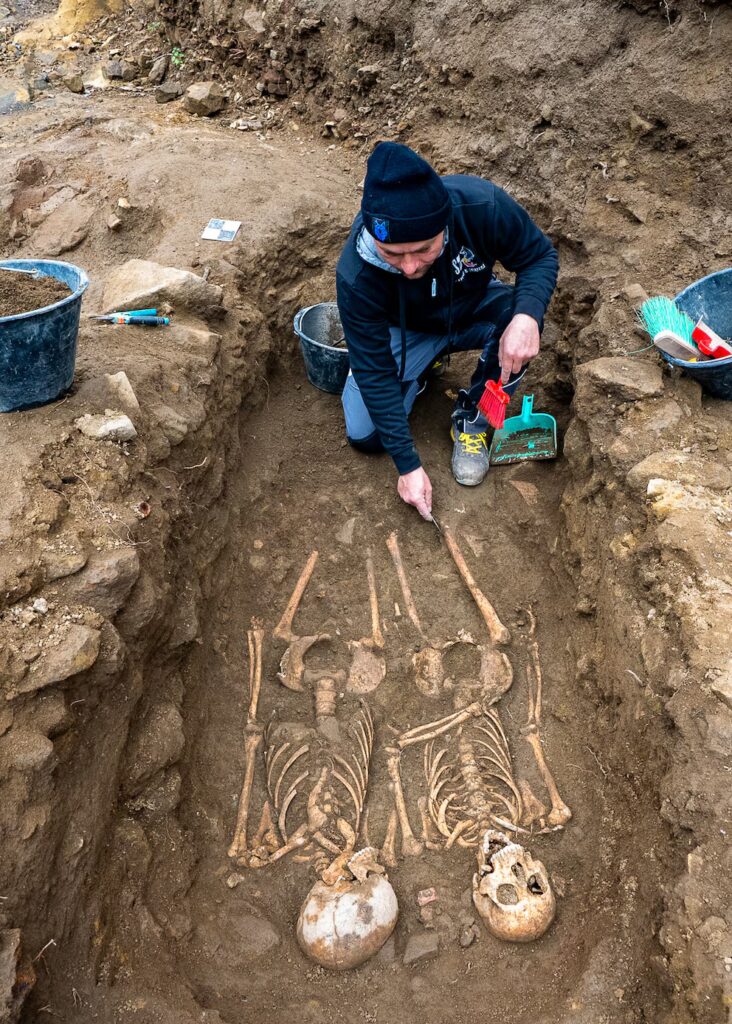
One of the largest necropolises of ancient Rome, which has preserved human skeletons, paintings and mosaics, was discovered near the basilica of Saint Paul Outside the Walls, during the construction of a student residence in the Italian capital. Rome’s millennial subsoil never ceases to amaze and during the excavations, as is usual in the capital, a new part of the necropolis was discovered, of which only a small part was known, but which would be made up of up to five funerary buildings dating from a period between the 1st century BC and the 4th century AD. In addition to the columbariums, about 50 human skeletons were also found, in some of them a nail was found at chest level, evidence of a known ritual to ward off evil in the afterlife. Furthermore, there is another peculiarity, observed by anthropologists working in the field: initial observations indicate that almost all skeletons belong to men between 20 and 40 years old who were of robust build.
We recommend reading:They discover fossilized bee nests in the jaws of prehistoric mammals in the Dominican Republic
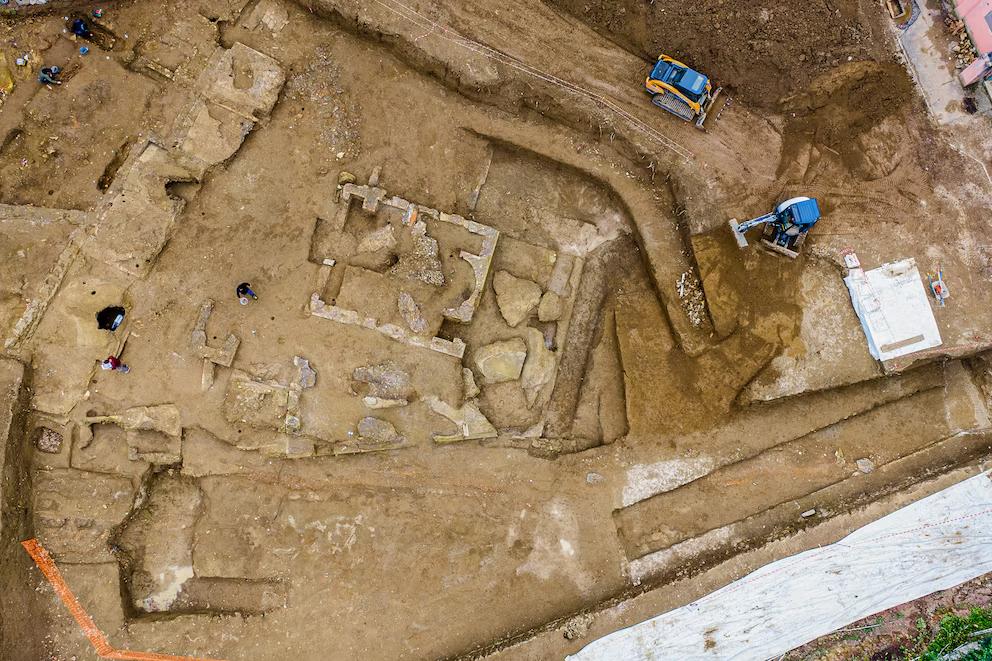
The most important discovery was that of several rooms, some with remains of paintings and two-color mosaics. Experts from the Special Superintendency of Rome, which directs the ongoing preventive archaeology investigations, believe that much more will be discovered as the work progresses. “The quality of the structures, the organization of the spaces and the richness of the decorative elements represent a significant opportunity for scientific study. The Superintendency will guarantee the full protection of the complex,” declared the special superintendent of Rome, Daniela Porro, in a statement. The excavation director, Diletta Menghinello, explained in the note that approximately one meter deep, a core of several funerary buildings from the imperial era emerged. They had a quadrangular plan and vaulted ceilings, aligned from northeast to southwest and preceded by two smaller structures. One building in particular, similar to the others but perpendicular to them, suggests, along with the remains of additional rooms, that the complex was organized around an inner courtyard.Some of the discovered tombs are probably columbaria and “currently visible, it is already possible to recognize an elaborate decorative apparatus, composed of plaster with frescoes, bands and plant motifs, stuccoes decorated with figures of Roman funerary symbolism, such as ‘orantes’ or ‘winged victories’, added the archaeologist.