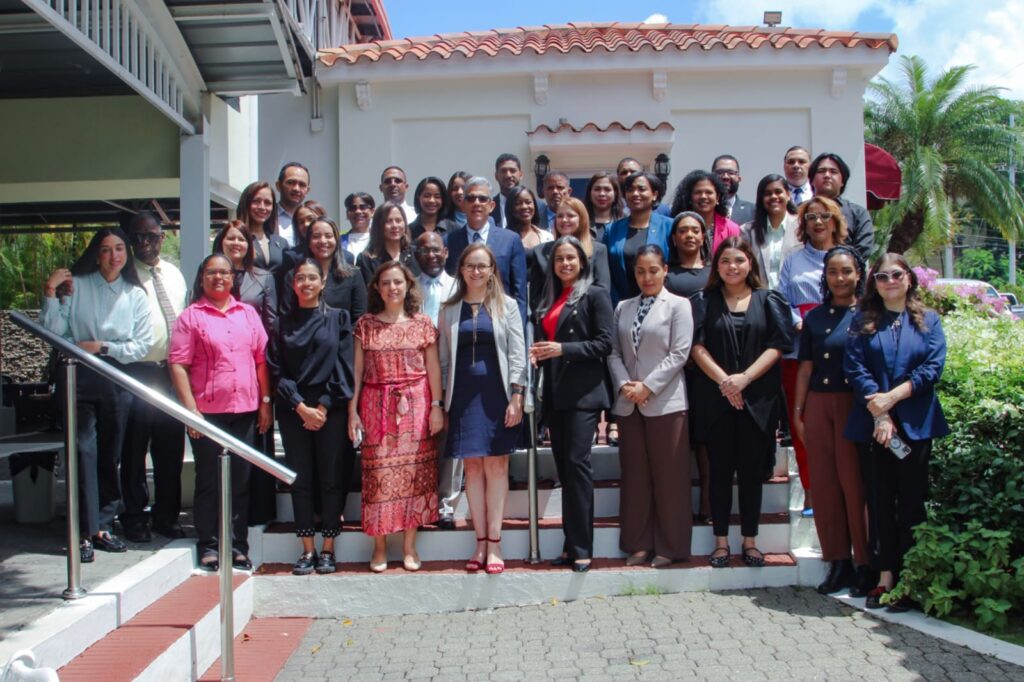
Santo Domingo.– The Judiciary of the Dominican Republic, in collaboration with the United Nations Development Programme (UNDP) and the World Justice Project (WJP), held a meeting to socialize the Open Justice Metric methodology, a tool aimed at strengthening transparency, citizen participation, and access to justice.
The activity took place at the National School of the Judiciary and is part of joint efforts to incorporate innovative international methodologies adapted to the Dominican context, with the aim of consolidating a more accessible, transparent, and people-centered justice system.
During the meeting, the UNDP Resident Representative in the country, Ana María Díaz, highlighted the cooperation between both organizations and the Judiciary within the framework of the Justice Action Coalition (JAC) project, through which people-centered justice indicators have been developed.
Among the aspects evaluated are case resolution times, the perception of the treatment received by users, trust in the judicial system, access to services, and citizen satisfaction levels.
We recommend reading: Judiciary agrees with the Treasury on a salary indexation of up to 50% for justice personnel
Díaz explained that these indicators were incorporated as part of the tracking and monitoring system of the 2025-2034 Justice of the Future Decennial Plan, strengthening its approach to evaluation and continuous improvement.
More Read

For her part, the Director of Analysis and Public Policy of the Judiciary, Rosaura Quiñones, pointed out that this initiative is part of the Open Justice Program, integrated into the Transparency axis promoted by the institution.

The presentation of the methodology was led by Ana Cárdenas, representative of the World Justice Project and coordinator of the Open Justice Metric, who explained that the evaluation considers four main dimensions: transparency, accountability, participation, and collaboration.
As indicated, the tool seeks to measure the degree of openness of the institutions that make up the Dominican justice ecosystem and place people at the center of judicial services.
More Read

The authorities highlighted that the Dominican Republic is positioned among the leading countries in the world in incorporating open justice and people-centered justice metrics into its institutional strategic processes.
The justice ecosystem evaluated includes entities such as the Judiciary, the Constitutional Court, the Superior Electoral Court, the Attorney General’s Office, the Ministry of Justice, the National Public Defense Office, the National Police, and the Ministry of Interior and Police, among other institutions linked to access to and administration of justice.
Likewise, the progress promoted by the Judiciary in terms of transparency was highlighted, including the Judiciary Observatory, the JURISTECA platform, the Digital Access portal, and various citizen participation spaces, aimed at strengthening public trust and bringing justice closer to the population.
The authorities reaffirmed their commitment to continue developing initiatives that promote innovation, the use of evidence, and the permanent improvement of judicial services for the benefit of the citizenry.