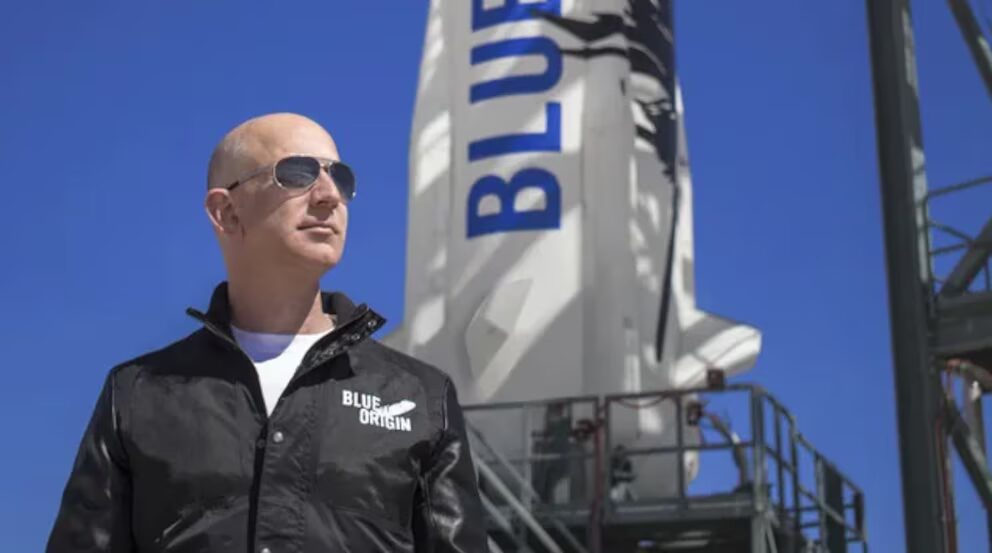
Blue Origin, the company founded by Jeff Bezos, has announced the launch of its TeraWave network, an ambitious infrastructure that seeks to offer high-capacity satellite connectivity to companies, public bodies, and data centers worldwide.
This system will combine a constellation of thousands of satellites with terrestrial fiber optic links, with the aim of closing the digital gap in rural and remote areas.
TeraWave: Architecture, Capacity, and Global Coverage
The proposal from Blue Origin is based on a constellation of 5,408 satellites distributed in two orbits: 5,280 in low Earth orbit (LEO) to offer upload and download speeds of up to 144 Gbps, and another 128 in medium Earth orbit (MEO) which, through optical links, will allow peaks of 6 Tbps to be reached.
This dual architecture, supported by integration with terrestrial fiber optic networks, is designed to guarantee symmetrical and high-density transmissions, facilitating the efficient operation of data centers and entities that require moving large volumes of information in real time.
According to Xataka, TeraWave is designed to ensure both point-to-point connections and open internet access, overcoming the geographical and infrastructure limitations that usually affect the most remote regions.
The initial deployment, scheduled for the last quarter of 2027, will offer service to up to one hundred thousand customers, with the promise of symmetrical speeds and robust connectivity even in areas where traditional infrastructure does not reach.REUTERS/Remo Casilli
Strategy and Expansion: The Role of Amazon Leo and Technological Integration
Blue Origin’s bet on satellite internet does not stop at TeraWave. Faced with the initial limitation of coverage, Jeff Bezos is also promoting the development of Amazon Leo, a parallel network under the Amazon brand that seeks to expand capacity and reach, with the intention of reaching millions of users globally.
It is necessary to point out that this strategy aims to make access to high-speed internet an affordable and scalable reality in any corner of the planet.
The system, by offering symmetrical speeds in any location, represents an innovative alternative to other existing solutions, positioning Blue Origin as a strong competitor to Starlink in the global satellite internet market.
The FCC Authorizes SpaceX to Expand Starlink with 7,500 New Satellites
The U.S. Federal Communications Commission (FCC) has given SpaceX the green light to launch 7,500 additional second-generation satellites for its Starlink network, which will raise the company’s global constellation of Elon Musk to a total of 15,000 satellites in the coming years.
This approval marks a significant advance in SpaceX’s operational capacity and signals a new phase in the global expansion of its satellite internet services, according to Reuters. FILE PHOTO: The SpaceX logo and a photo of Elon Musk are seen in this illustration created on December 19, 2022. REUTERS/Dado Ruvic/Illustration
The FCC explained that the authorization will allow SpaceX to operate an improved Gen2 network, capable of using five different frequency bands and updating its equipment in orbit, also lifting restrictions that previously limited coverage overlap and the expansion of technical capabilities.
Brendan Carr, chairman of the agency, called the decision “a turning point for enabling next-generation services.” Thanks to this permit, Starlink will be able to offer direct connectivity to mobile devices outside of the United States and increase coverage and speeds within the country, reaching up to 1 gigabit per second.
SpaceX had requested authorization to launch around 30,000 satellites, but the FCC only granted half that number for now. The agency argued that “the authorization for additional satellites is in the public interest, even when the improved Gen2 satellites have not yet been tested in orbit.”
The approval for the remaining 14,988 satellites, especially those that would operate at more than 600 kilometers altitude, was postponed.