San José .- Nicaragua will approve in the upcoming September legislative session a partial reform to the Constitution that seeks to exclude denationalized opponents and those considered “traitors to the homeland” from elections, a measure that has sparked international rejection, reported the country’s co-president, Rosario Murillo, this Monday.
Murillo, wife of President Daniel Ortega and designated co-president through a constitutional reform, said -to official media- that the reform process will be previously consulted “with all sectors” to be approved in the first days of September.
The National Assembly (Parliament), controlled by the ruling party, has begun consultations on those reforms after Ortega stated that “there will be no more elections” in his country.
Costa Rica, the USA, Panama -which withdrew its ambassador-, Guatemala, the Dominican Republic, Chile, Bolivia, Brazil, Peru, the European Union, Uruguay, the OAS Secretary General, Alberto Ramdin; and the UN High Commissioner for Human Rights, Volker Türk, have expressed their concern or rejection regarding those statements by Ortega.
We recommend reading: President-elect of Colombia announces the closure of 14 embassies and the breaking of relations with Cuba and Nicaragua
More Read

Murillo said that this Monday the deputies met with the ambassadors accredited in the country, to whom they explained the objective of drafting a bill for partial reform of the Constitution, without further explanation.

“We are waiting to know the results of this first respectful meeting with the diplomatic community that lives and works in Nicaragua,” he added.
Ortega’s proposal
The legislators will also meet with authorities such as the Supreme Court of Justice, the military forces of the Nicaraguan Army, and the police forces of the National Police, all coordinated by the Presidency.
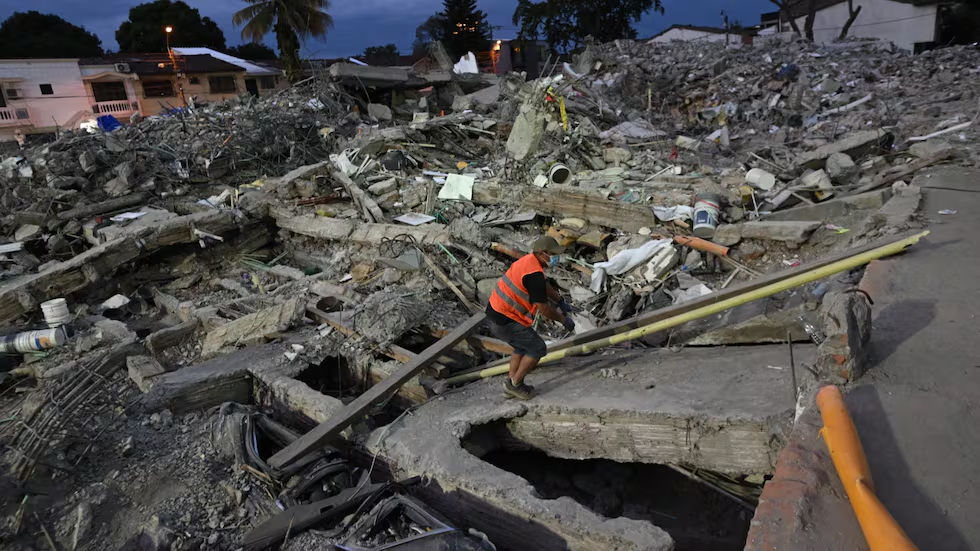
President Ortega proposed eliminating elections in his country, which he has governed since 2007 amidst accusations of electoral fraud, for eliminating and exiling the opposition, and declaring the article of the Constitution that prevented reelection “inapplicable.”
The announcement was made during the commemoration of the forty-seventh anniversary of the Sandinista Revolution, held last Sunday.
During the event, Ortega, an 80-year-old former guerrilla, asserted that in Nicaragua “there will never again be elections so that they (the opposition) can try to seize the Government, seize power through them.”
Last Wednesday, the head of the National Assembly of Nicaragua (Parliament), the Sandinista Gustavo Porras, said that elections will indeed be held in Nicaragua but under a new constitutional framework that shields them from foreign interference and from the “traitors to the homeland” in the country.