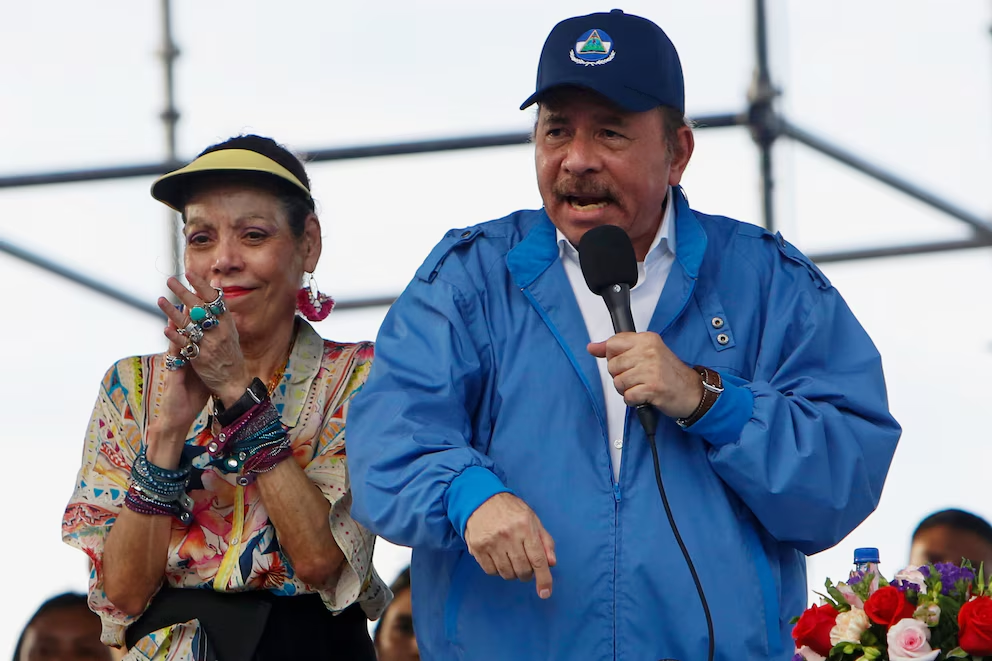
More than 2,000 common prisoners will be released in Nicaragua to transition to a regime of family coexistence in their homes, coinciding with the forty-seventh anniversary of the Sandinista revolution.
The measure, announced by co-president Rosario Murillo, is part of the policy of mass releases that the Executive branch implements on commemorative dates throughout the year.
The release will be formalized during an official ceremony at the headquarters of the National Penitentiary System, located near Managua and known as ‘La Modelo’, the largest prison in the country.
Similarly, the measure will be implemented in seven other prisons distributed across different regions. According to data provided by EFE, with this group, the number of common prisoners who have received this legal benefit so far this year rises to 6,400.
In recent months, the Government has carried out similar releases on symbolic dates. On May 30, 2,000 prisoners were released to mark Nicaraguan Mother’s Day.
More Read

We recommend reading: Nayib Bukele, who is seeking a third term, defends indefinite reelection in El Salvador
Previously, on February 2 and April 1, 1,200 convicts on each date were granted the family coexistence regime, the first time for the National Day of Reconciliation and Peace, in honor of Cardinal Miguel Obando y Bravo, and the second during Holy Week.
The authorities argue that these measures seek to favor the social reintegration of those who have served part of their sentence, in addition to allowing family reunions during days of national or religious significance.
More Read


According to the official version, the policy also aims to alleviate the burden faced by families and contribute to social reconciliation.
The release from prison will be formalized at La Modelo, near Managua, and will also extend to seven other prisons in Nicaragua.
In the last decade, the Nicaraguan regime managed by Daniel Ortega and Rosario Murillo has released 55,164 common prisoners to serve the remainder of their sentences under this regime, according to official figures.
Of that total, 7.18% have reoffended by committing at least one crime after their release. According to the EFE report, the year with the highest number of beneficiaries was 2025, when 9,900 people accessed the measure.
The family coexistence regime allows those released from prison to reside in their homes under legal conditions and controls, continuing to serve their sentences outside of prison. The Executive presents this modality as an alternative to promote reintegration and reduce recidivism, although it acknowledges that the policy has received criticism.
Some feminist organizations have expressed their concern regarding the impact of these releases on public safety. They point out that following the release of common prisoners, an increase in femicides and general crime has been detected in Nicaragua.

Therefore, these sectors are requesting the implementation of additional controls and special protection measures for the victims.
The practice of releasing common prisoners on significant dates remains a recurring policy of the Government. Meanwhile, different social sectors observe the results and debate the possible effects on public safety and social coexistence, in a context where the number of beneficiaries of this regime continues to rise.