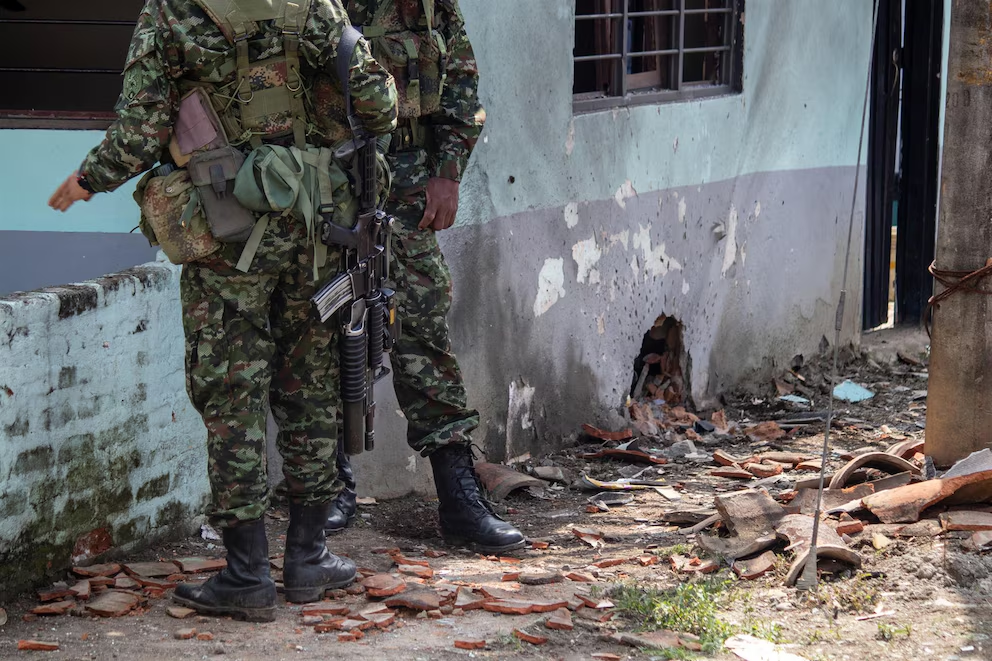


Alto Limón (Panama).- Near the Alto Limón Binational Post, on the edge of the Colombia-Panama border in the dense Darién jungle, about 500 hectares of coca crops extend into Colombian territory. Colombian soldiers are working on their eradication while Panamanian police guard them against a potential attack by armed groups.
“We are trying to combat them (coca cultivation hectares) with all our force, with all our mechanisms, carrying out a joint operation with the forces of Panama, but it is very complex,” declared Sub-lieutenant Miguel Vega of the Anti-Narcotics Directorate of the Colombian National Police to EFE this Friday.
The Alto Limón Binational Post is one of three that extend along the 266-kilometer jungle border. There are 19 Colombian officials from all branches of the armed forces stationed there who share security and protection operations alongside Panamanian agents, as Vega detailed.
The target is the Gulf Clan, considered the largest criminal organization in Colombia, dedicated mainly to drug trafficking but also to migrant smuggling, illegal mining, and extortion.

“There (in the Darien) no one carries out illicit activities if the Clan del Golfo does not have control from Colombian territory,” the deputy director general of Panama’s National Border Service (Senafront), Commissioner Héctor De Sedas Cedeño, told EFE.
Eradicating coca in Colombia near the border
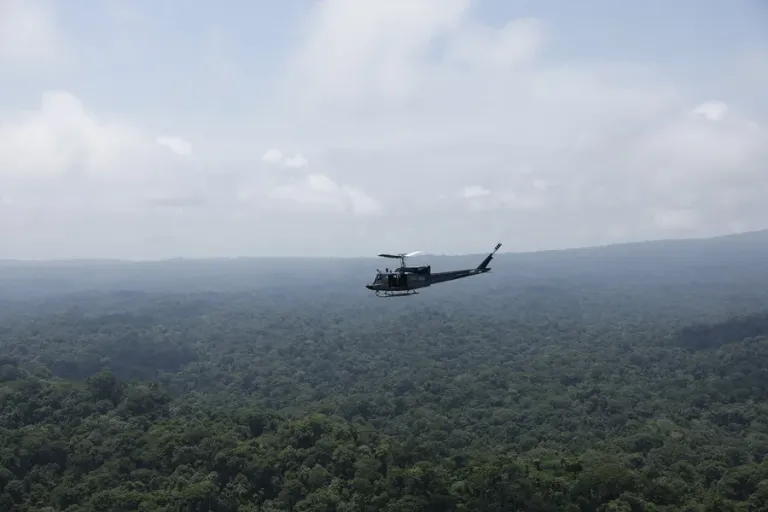
EFE confirmed this Friday during an aerial tour organized by Senafront that the coca plantation located in Colombian territory is just a few kilometers from the Alto Limón Binational Post. Local farmers are in charge of the plantation.
We recommend reading:
“Black Hawk helicopters arrive there, carrying a crew of 15 to 20 officials, who arrive with glyphosate and eradicate in the sector,” Vega recounted.

There are “about 500 hectares of coca crops. They are still there,” as these are complicated operations, in a territory far from command centers, difficult to access, and with the presence of armed groups.
The issue of security is vital, because although it is farmers who are in charge of the crops, there are also armed groups in the area and “the issue of eradication without security, well, it is complex,” pointed out Vega.
“So that is where the Panamanian brothers come in and help us with the security issue. While we carry out the eradication mission, they provide us with coverage against these armed groups, which are from the Clan del Golfo as I was telling my general,” said Vega.
Preventing the Clan del Golfo from entering Panama
Both the Senafront commissioner and the sub-lieutenant of the Colombian National Police pointed out that another objective of the binational posts is to prevent the Clan del Golfo from moving into Panama.

Vega said that given the change of Government in Colombia, with the arrival of the far-right president, Abelardo de la Espriella, who has promised a hard line against organized crime, groups like the Gulf Clan “are looking for alternatives to leave Colombia and we know that one alternative is Panama”.
“So we are working with the union with Panama so that these individuals cannot leave the country (Colombia),” said Vega.
De Sedas said for his part that “with the new policies in Colombia there is no information that they (the Gulf Clan) want to enter Panama, but we are taking preventive actions” to “deter those criminals from entering Panamanian territory”.