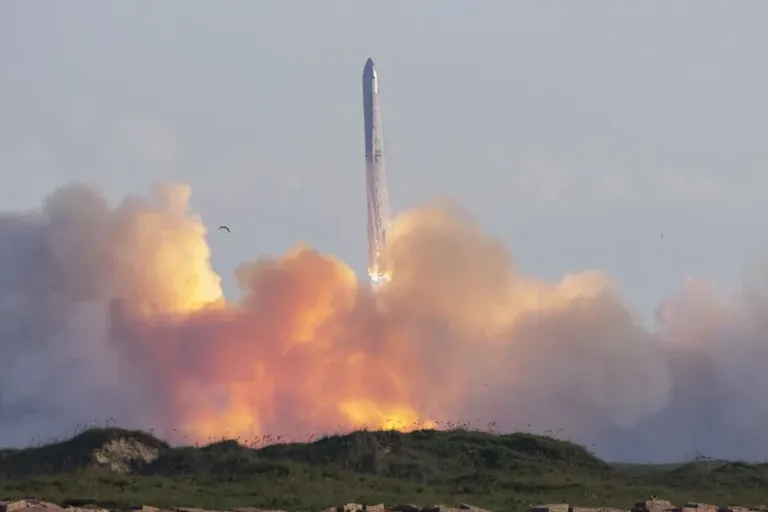
Washington .- Aerospace giant SpaceX decided this Thursday, due to bad weather in Texas, to postpone until tomorrow, Friday, the thirteenth test launch of its large tonnage Starship rocket that was scheduled for today.
Elon Musk’s company explained in a statement that due to weather conditions at its launch site in Starbase, on the Gulf of Mexico coast, the new launch window will open tomorrow, Friday, July 24, at 5:45 PM local time (22:45 GMT).
The launch had been originally scheduled for today after it had to be postponed last July 16th.
That day the operation was suspended when the rocket was already on the pad and failed to ignite at least four of its 33 engines during the countdown, which triggered the automatic shutdown in the computer systems.
We recommend reading: SpaceX suffers its second postponement in a week after aborting a Starlink flight
More Read

The launch, now rescheduled for tomorrow, is the second of this year and also the second of the third model of the projectile, which made its maiden flight on May 22nd.
Mission details
The company has stated that with this mission it seeks to fine-tune the performance of this third version of the most powerful rocket ever built, especially regarding its Super Heavy booster, which constitutes the first of the two stages of the space vehicle.

In addition to completing the launch, ascent, and stage separation phases, this mission seeks for Super Heavy to successfully perform engine relights during the return and landing phases, which must take place on a platform installed in the waters of the Gulf of Mexico.
More Read

This is the first time that the Starship has also been equipped with new-generation Starlink V3 satellites.
In this thirteenth mission, the rocket is scheduled to deploy twenty V3s on a suborbital trajectory, which will have twenty minutes to connect to the main Starlink constellation via high-capacity lasers before disintegrating during their reentry into the atmosphere.
NASA is closely monitoring the program, as it needs this third version of the Starship to transport astronauts to the lunar surface for the Artemis mission.
The crewed mission to the Moon is postponed from late 2026 to mid-2027, partly because the rocket’s development is accumulating delays.
SpaceX competes directly with Blue Origin, the aerospace company of tycoon Jeff Bezos, which offers its Blue Moon system as an alternative.