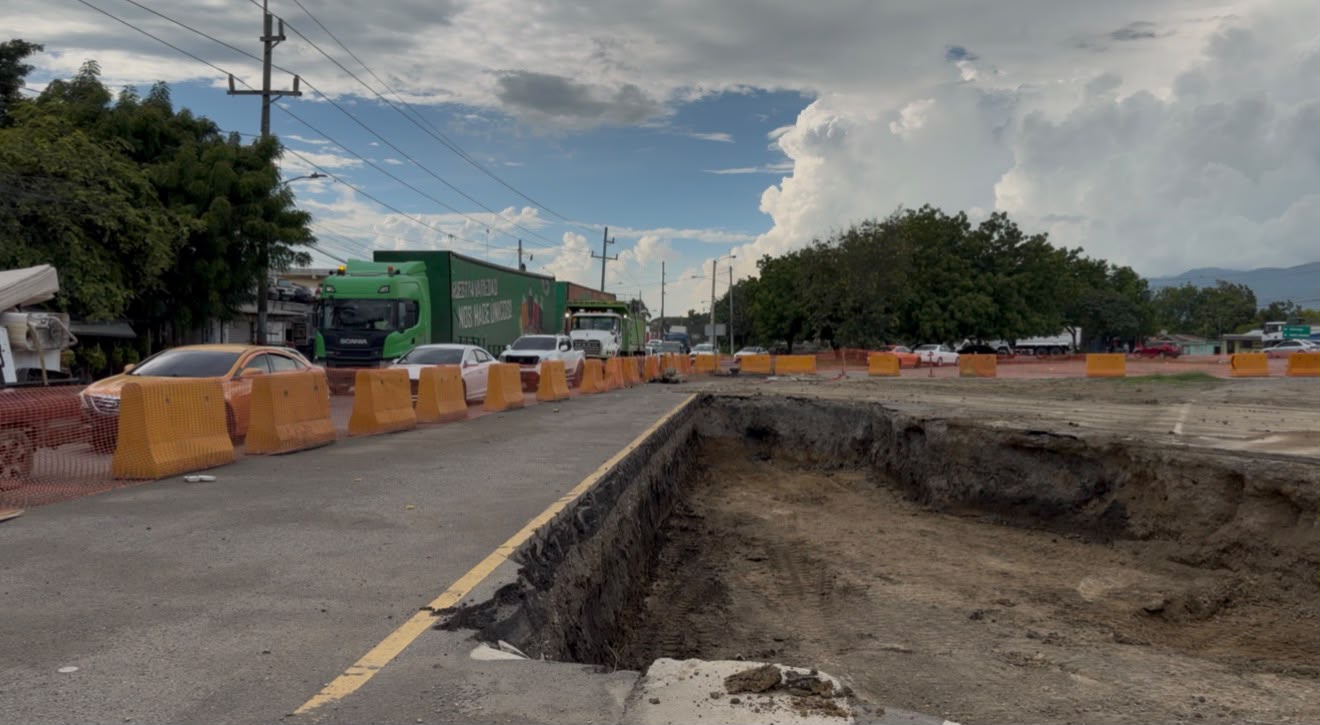

The journey to Puerto Plata, Montecristi, Valverde, or Dajabón via the Joaquin Balaguer highway has become up to 40 minutes slower and more tedious due to delays in the work related to the Navarrete Bypass.
This is despite the fact that, last June, the Minister of Public Works and Communications, Eduardo Estrella, announced that the project would be delivered between September and October of this year.
Before that announcement, it had been said that the work would be ready in February 2026.
However, during a visit to the area, De Último Minuto confirmed that the work has not only yet to be completed, but its completion will take up a significant part of the year 2027.

In both directions of this important northwest line road, only one lane has remained enabled, which produces endless traffic jams, especially when a heavy vehicle breaks down in that section.
Even emergency vehicles find it difficult to travel through that section, and they lose valuable minutes waiting to be able to pass, especially during rush hours.
This route is of utmost importance for this important productive area of the country, but also for the transit of goods destined for export to the neighboring country of Haiti.
Residents of the Villa Bisonó municipality, in Santiago, said that the chaotic situation has been going on for months, which is why they called on the Government to speed up said works, since when a heavy vehicle breaks down in the only enabled lane, it produces hours of traffic jams, which affects the competitiveness of transport work and increases the costs associated with fuel consumption.
With this important project, which entails an investment of over 12 billion pesos, the four provinces of the Northwest Line will benefit, and the connection to the Port of Manzanillo, in Monte Cristi, will be strengthened.