
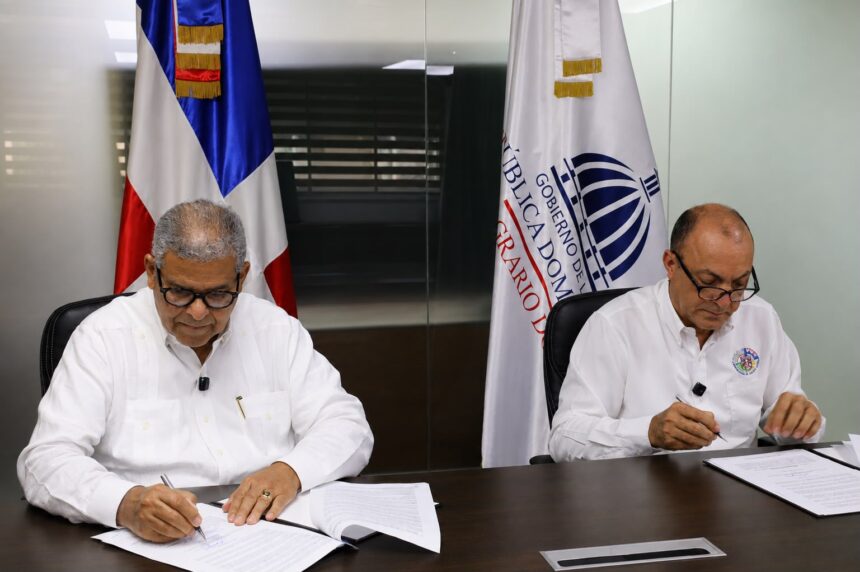
Santo Domingo.– The San Ignacio de Loyola Technological Institute (ITESIL) and the Dominican Agrarian Institute (IAD) have joined forces to launch a high-impact agro-industrial project that will transform more than 900 “tareas” of state-owned land in Montecristi into a center for research, innovation, production, and technical training, aimed at strengthening the development of the border region and the national agricultural sector.
The initiative will allow for the development of an experimental agro-industrial farm where students of Agronomy, Veterinary Medicine, and Food Industries will be able to train by covering the entire value chain, from the production of raw materials in the field to their agro-industrial transformation and commercialization, under a model of innovation, sustainability, and entrepreneurship.
To make this project possible, the Dominican Agrarian Institute made two portions of land available to ITESIL through an agreement signed by the interim general director of the IAD, Darío Castillo Lugo, and the general director of the San Ignacio de Loyola Technological Institute (ITESIL), Fr. José Rafael Núñez Mármol (Fr. Chepe), preserving the ownership of the properties in favor of the Dominican State.
During the activity, Fr. José Rafael Núñez Mármol (Fr. Chepe) highlighted that this initiative will allow for the training of highly qualified professionals to respond to the challenges of the agricultural sector, promoting scientific research, technological innovation, and entrepreneurship as pillars of national development.

We recommend reading: IAD begins the National Definitive Titling Plan in Azua, which will benefit more than 4,000 Agrarian Reform parcel holders
For his part, Darío Castillo Lugo expressed that the agreement represents a sign of the IAD’s commitment to putting State assets at the service of projects that generate value for the country, promoting strategic alliances that contribute to the development of communities and the strengthening of technical education.
More Read

The project will also serve as a space to validate technologies, production processes, and innovation initiatives that can be leveraged by the Ministry of Agriculture, the institution responsible for production functions and agricultural technical assistance to Agrarian Reform plot holders, as part of the transformation and restructuring process of the Dominican Agrarian Institute promoted by the Dominican Government.
With this alliance, both institutions contribute to the strengthening of agricultural education, applied research, technological innovation, and the sustainable development of the border, creating a model that could become a benchmark for the growth of the agro-industrial sector in the Dominican Republic.