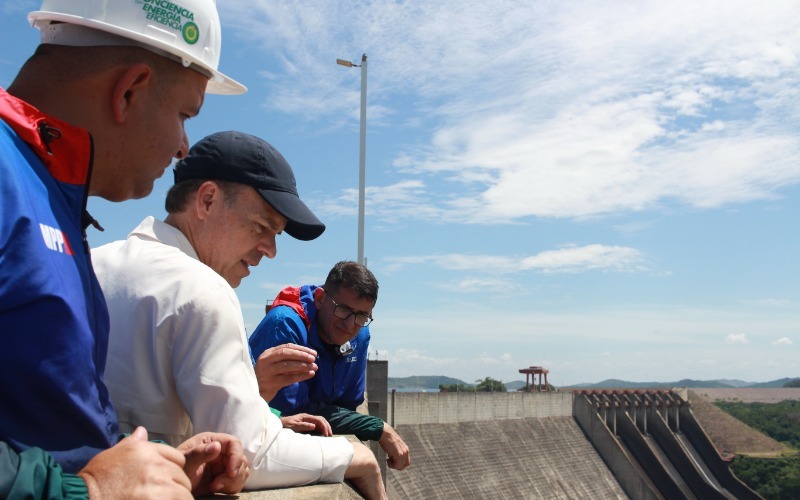
Caracas.- The United States Chargé d’Affaires in Venezuela, John Barrett, reported this Monday that a team of technical experts from that country’s Department of Energy conducted a technical diagnosis of the Caribbean nation’s main hydroelectric plant, in order to define a modernization roadmap for the electrical system.
In a message posted on X, the U.S. Embassy indicated that this work supports Venezuela’s economic recovery, within the framework of the three-phase plan presented by President Donald Trump and Secretary of State Marco Rubio.
Read more: United States advances in a possible formal indictment against Raúl Castro
The evaluation was conducted with the support of the Department of State and in coordination with the Venezuelan Ministry of Electric Energy and the state-owned Electric Corporation (Corpoelec).
The Embassy shared photographs of the inspection carried out by the Americans, without providing further details regarding the technical diagnosis.
More Read

On the eve, the acting president of Venezuela, Delcy Rodríguez, asked the country to save electricity and water in the face of the “Super El Niño” climate phenomenon and announced a plan to add 4,800 megawatts (MW) to the electrical system for the remainder of the year.

In a meeting with authorities, broadcast by the state-owned Venezolana de Televisión (VTV), the president said she has requested “specific plans” to address the increase in temperatures and the reduction of water sources, including incorporating 4,800 MW into thermoelectric generation.
These megawatts will be added to those that will be incorporated thanks to the contracts signed with companies such as the American General Electric (GE) Vernova and the US-Argentine IMPSA, according to Rodríguez.
More Read

For years, Venezuela has suffered from electricity supply failures, which Chavismo has blamed on foreign sanctions, while the opposition and experts assert that it is the result of corruption and a lack of maintenance in the electrical system.
Rodríguez also pointed out on Sunday that the devastating double earthquake on June 24 affected the system in question, with damage to towers, transmission lines, and the Termocarabobo thermoelectric plant, in the north of the country, which generated 600 MW.
In that sense, the acting head of state indicated that they have managed to restore 300 MW of the 600 referred to and that in the coming weeks they will move towards a “full recovery”.