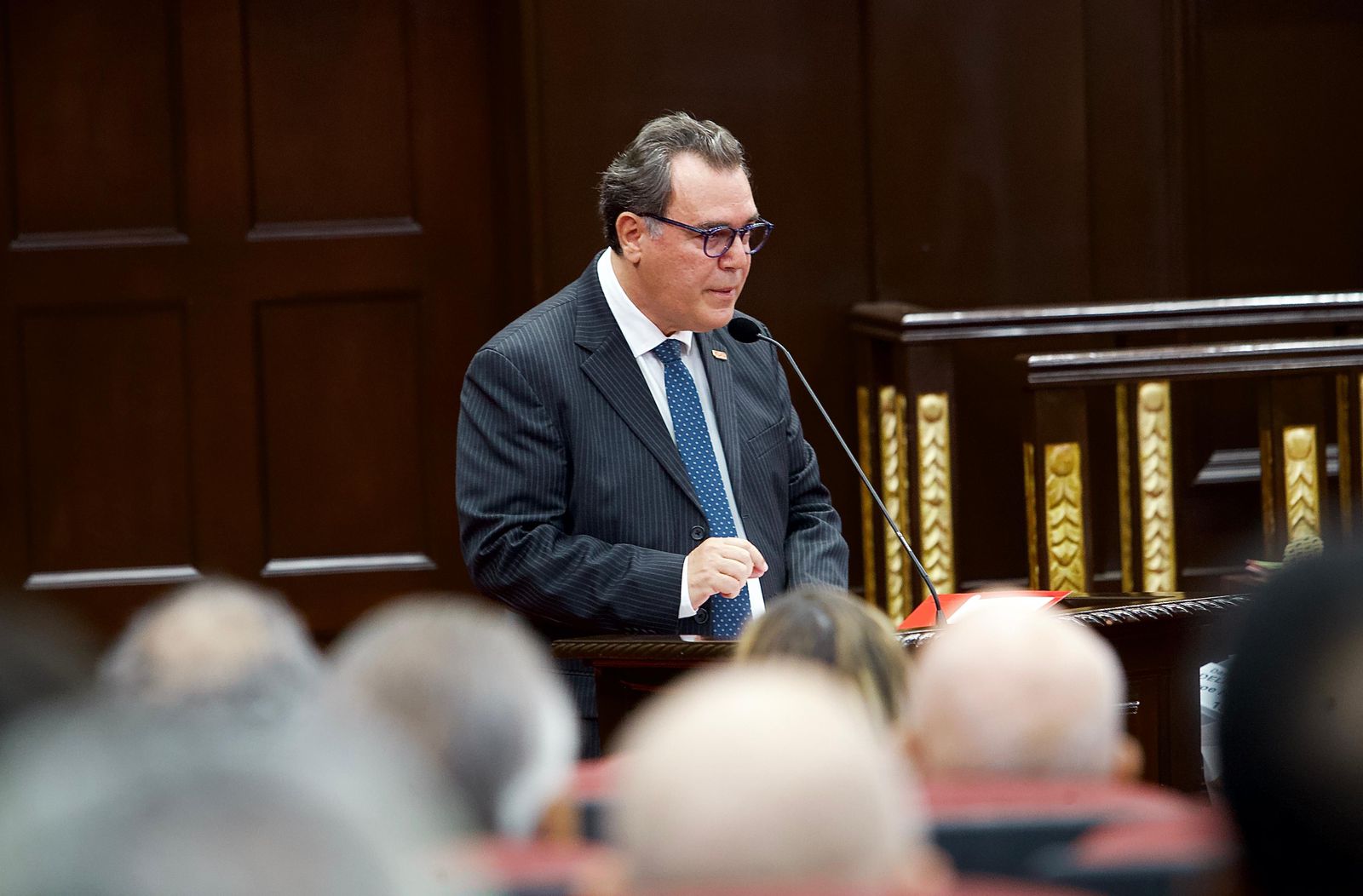
Santo Domingo.- Upon being sworn in as president of the Presidential Commission of the April Uprising Museum, created by Decree No. 200-26, Dr. Jottin Cury valued the notable interest that the government of President Luis Abinader has shown in recovering patriotic values and, especially, preserving Dominican historical memory.
During his inauguration speech, Cury thanked the distinction conferred by the Head of State to head this commission, along with Alberto Alexander Caamaño Acevedo, Bonaparte Gautreaux Piñeyro, Euclides Emilio Gutiérrez Félix, Fernando Arturo Báez Guerrero, Héctor Sucre de Jesús Feliz Carbuccia, Ilonka Nacidit Perdomo Sánchez, Isaac Rudman Majnsztejn, Juan Manuel Lora de León, Ludovino Fernández Fernández, Ramón Andrés Blanco Fernández and Raúl Tamayo Morilla Rodríguez.
The renowned jurist highlighted the significance of the April Revolution of 1965, which took place between April 24 and September 3 of that year, defined as an unprecedented event in republican history, whose purpose was to restore constitutional order and reinstate Professor Juan Bosch to the Presidency, after the overthrow of his government in 1963.
In that context, he highlighted the historical value of the 1963 Constitution, which he described as an advanced instrument for its time, by enshrining fundamental rights, promoting social justice, and establishing democratic principles that still serve as a reference for Dominican institutionalism.
Cury explained that the interruption of the constitutional order in 1963, a product of political, economic, and social tensions, gave rise to one of the most complex episodes in national history, in which thousands of Dominicans rose up in defense of democracy and sovereignty.
“The truth is that the April Revolution of 1965 left us with a painful lesson: a fratricidal struggle is not the ideal way to resolve our differences and institutional deficiencies,” he expressed.
He also called for strengthening historical education in Dominican society, in order to raise awareness of the meaning of the 1963 Constitution and the April 1965 uprising, avoiding the repetition of fratricidal conflicts and promoting democratic coexistence.
Within the framework of the activity, a documentary based on the work of photographer Milvio Pérez was also presented, who documented crucial moments of the armed conflict with his lens, leaving a visual legacy of incalculable historical value of more than two thousand invaluable images that describe those difficult times that the Dominican people experienced.
“Without that photographic testimony of this audacious protagonist, who carried his camera as a weapon, it would be difficult to visualize the hardships of our people, who fought against the most powerful army on earth to preserve their sovereignty and dignity,” he added.
The President of the Commission highlighted Pérez’s courage and commitment, noting that his more than two thousand images constitute an essential testimony to understand the human and social dimensions of that event.
Doctor Cury concluded his speech by paying tribute to the protagonists of the April feat, reiterating the commitment of the Presidential Commission of the April Feat Museum to preserve and disseminate this historical legacy for present and future generations.
Doctor Jottin Cury valora compromiso del Estado con la memoria histórica y valores patrios