
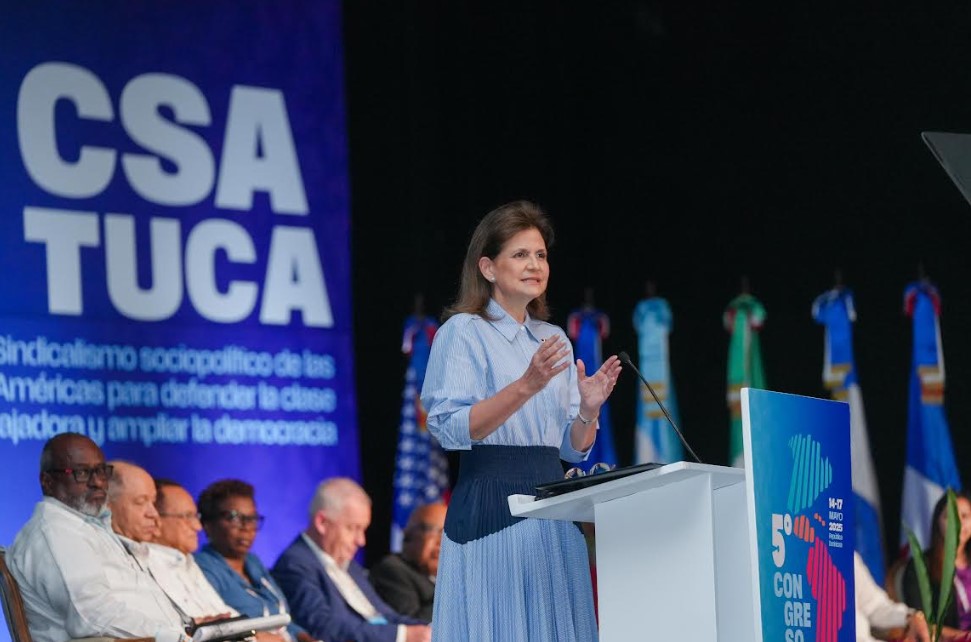

Punta Cana, R.D. – The Vice President of the Republic, Raquel Peña, led the opening of the V Continental Congress of the Trade Union Confederation of the Americas (CSA), which brings together in Punta Cana more than 400 representatives of the trade union movement of the continent, in a key meeting to outline the labor and social agenda of the region.
On behalf of President Luis Abinader, the Vice President delivered a speech in which she reaffirmed the Dominican government’s commitment to labor rights, tripartite dialogue, and the construction of a more just society.
“We recognize the fundamental role of unions in building more equitable societies committed to the well-being of their workers,” Peña expressed.
Read more: Raquel Peña encabezó la apertura del AC Hotel Marriott Santiago
He added that “without dignified workers, no society develops”, highlighting that development is measured in quality of life, purchasing power, and job opportunities.

“What you do as the Trade Union Confederation of the Americas is essential for that commitment to human rights, gender equality, and intergenerational solidarity,” he pointed out.
Peña also highlighted the progress made during the current government administration, including the expansion of INFOTEP, which went from 8 to more than 40 technical-vocational training centers; the creation of more than 165,000 formal jobs in 2024; and the reduction of the expanded unemployment rate from 16.8% in 2020 to 9.4%.
Participation of Dominican trade union centrals
During the ceremony, the leaders of the three Dominican trade union centrals affiliated to the CSA also intervened.
Santiago Zamora, general secretary of the CNTD, representing its president Jacobo Ramos, highlighted the urgency of a new social security law and an updated labor code.

He underscored that primary care, coverage for informal workers, and decent wages remain outstanding tasks.
He also demanded respect for trade union freedom and collective bargaining, reiterating the CNTD’s commitment to defending workers’ rights.
Rafael “Pepe” Abreu, president of the National Confederation of Trade Union Unity (CNUS), described the congress as a transcendental event for the region and expressed his satisfaction with the celebration in the Dominican Republic, noting that the country has become a benchmark for its labor peace and social stability.
Likewise, Pepe Abreu reaffirmed the firm position of the Dominican trade union movement to categorically reject the elimination of severance pay, a historic achievement that constitutes a fundamental pillar in the protection of workers against the termination of their contracts. He pointed out that any reform to the Labor Code must respect that acquired right, widely supported by the trade unions.

Gabriel de Río Doñé, president of the Autonomous Classist Trade Union Confederation (CASC), expressed his concern about the limitations that trade union freedom still faces in the country.
He said that, despite the progress, many workers continue to be fired when trying to organize unions, which prevents the strengthening of collective agreements and the effective defense of labor rights.
“Trade union freedom is still today a difficulty in organizing workers. Thousands of workers have been fired when they organize a union. Today we do not have full trade union freedom in our country, and that is a fundamental factor for development,” said De Río Doñé, underlining the urgency of guaranteeing this right as a basis for labor justice.
International union leaders present
The inaugural event also featured the participation of prominent figures from global trade unionism, including: Fred Redmond, president of the ITUC, Luc Triangle, general secretary of the International Trade Union Confederation (ITUC), Rafael Freire, general secretary of the ITUC, María Helena André, director of ACTRAV-ILO, Rafael Santos Badía, general director of INFOTEP
The congress is being held under the slogan “Sociopolitical Trade Unionism of the Americas”, addressing issues such as peace and democracy, social justice, trade union transformation, just transition, artificial intelligence, care economy, and trade union freedom.
With this event, the Dominican Republic strengthens its role as a meeting point for international trade unionism, reaffirming its commitment to social justice, decent work, and inclusive development.