NEW YORK.– President Luis Abinader highlighted this Monday the potential of the Dominican Republic in rare earths and assured that the country is advancing in the identification of its reserves, the development of technologies for their processing, and the creation of conditions that will allow for the first exports to begin around 2028.
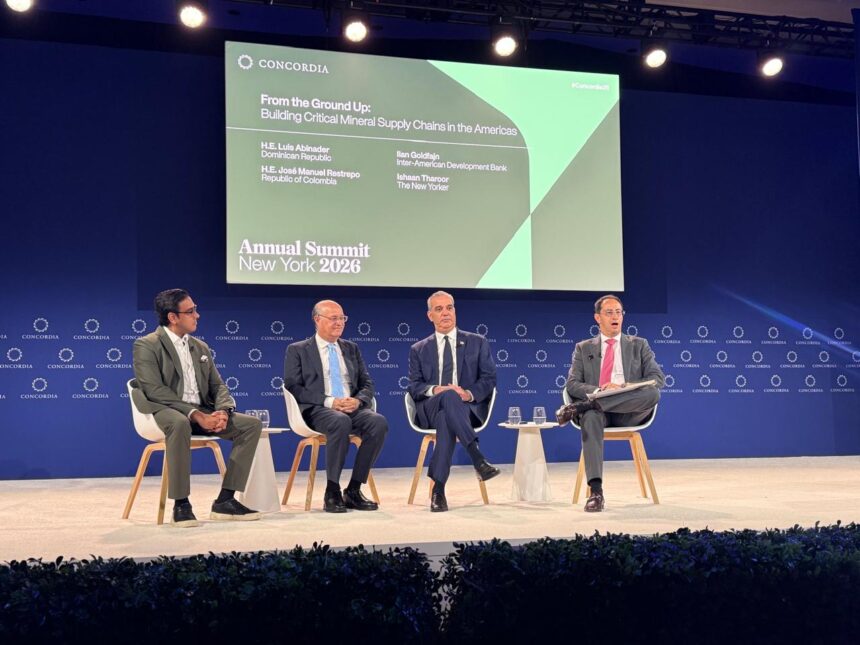
The president addressed the topic during the panel “From the Ground Up: Building Critical Mineral Supply Chains in the Americas”, held within the framework of the 2026 Concordia Annual Summit in New York, a meeting dedicated to analyzing the role of Latin America and the Caribbean in global critical mineral supply chains.
Abinader explained that the Dominican Republic has been working for several years together with the United States on the investigation of rare earth deposits existing in the country and noted that he expects a more precise evaluation of the available resources by the end of this year.
The head of state also highlighted the quality of the material located in Dominican territory and maintained that the studies carried out so far generate favorable expectations regarding its potential. The Government had previously reported gross deposits exceeding 150 million tons, while the Ministry of Energy and Mines plans to advance this year in the determination of resources and, subsequently, in the certification of reserves.
One of the main challenges, Abinader acknowledged, will be the refining of rare earths, due to the high concentration of that industrial capacity in China. He indicated that the Dominican Republic is working on technological alternatives that allow for the processing of these minerals and to advance beyond their simple extraction.

In that context, he pointed out that the state-owned Empresa Minera Dominicana (Emidom) will have a role in the monitoring and development of the project. Likewise, he expressed his confidence that during the next year tests related to the processing of the material can be carried out, with the prospect of subsequently advancing towards its commercialization.
Rare earths and cooperation
Abinader also valued the cooperation with the United States to develop a critical minerals supply chain in the Western Hemisphere and considered it necessary to combine technology, financing, and public and private investment to make these projects viable.

The Dominican Republic and the United States signed a cooperation framework on September 10th aimed at strengthening the security and resilience of critical mineral and rare earth supply chains, identifying projects of interest, and facilitating financing mechanisms.
During the panel, the president maintained that this type of agreement can contribute to generating supply and processing alternatives in the face of the high international concentration currently existing.
Rare earths and communities
Abinader dedicated part of his speech to the social and environmental impact of mining and argued that the communities where natural resources are located should directly receive the economic benefits generated by their exploitation.
In his view, one of the problems that must be corrected is that the revenue from mining reaches the central government without necessarily translating into sufficient improvements for the municipalities where that activity takes place.
The president stated that communities hosting mining projects must be able to verify that these resources represent greater opportunities, growth, and better living conditions, which, in his view, would help turn them into promoters of properly developed mining.
More Read

At another point in his participation, Abinader linked environmental protection with economic development and stated that “the greatest danger to the environment is poverty,” noting that the lack of economic opportunities can also generate pressure on natural resources.
The meeting also included the participation of José Manuel Restrepo, from Colombia, and Ilan Goldfajn, President of the Inter-American Development Bank (IDB), moderated by Ishaan Tharoor, from The New Yorker. The participants addressed the need for investment, technology, clear rules, sustainability, and community participation to convert the availability of critical minerals into growth and development for Latin America.