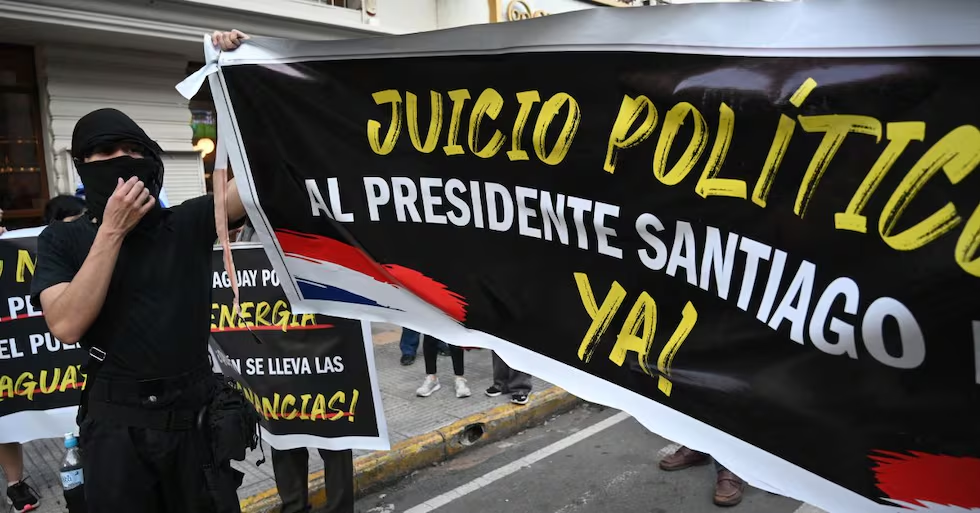

The Paraguay crisis began with the intervention of Ueno Bank due to solvency issues and spread, in just three days, to the government of President Santiago Peña, to Congress, to thousands of savers, and to workers of a technology company linked to the bank in Argentina.
Between Tuesday, November 3, and Thursday, November 5, 2026, the Central Bank of Paraguay (BCP) ordered the resolution process for the entity, customer protests occurred, the president submitted his resignation, and the Senate moved forward with an impeachment trial against him.
The situation also affected Itti, a technology company with more than 900 employees in Argentina, whose workers reported suspensions and salary delays.
Below is the chronology of events, according to information attributed to EFE.

Timeline of the crisis
AUGUST 2026: First employment record in Argentina
The technology company Itti, linked to Ueno Bank through the Vázquez Group, had laid off about 100 people in Argentina, according to testimonies collected by EFE. This precedent gained relevance following the bank’s closure.
TUESDAY, NOVEMBER 3: The Central Bank intervenes in Ueno Bank
The BCP ordered a resolution or closure process for Ueno Bank after detecting that its solvency ratio had fallen below 50% of the required minimum, following adjustments made to its financial statements. The measure affected an entity with approximately 2.9 million customers.
According to reports, numerous users were left without access to their funds and protests began. The Itti office in Buenos Aires also closed its doors and its workers temporarily switched to remote mode.

WEDNESDAY, NOVEMBER 4: measures for savers and legal actions
Santiago Peña promoted a law to guarantee the return of deposits up to a limit of 40 monthly minimum wages, equivalent to 121.7 million guaraníes, about 19,787 dollars. The Prosecutor’s Office requested preventive detention for Miguel Vásquez, identified as one of the founders of Ueno Bank and head of the Vázquez Group, as well as house arrest for seven other executives. In Argentina, Itti employees reported that they could no longer access the systems necessary to perform their duties.
THURSDAY, NOVEMBER 5 in the morning: Peña submits his resignation, but remains in office
The president announced his resignation amidst the controversy over Ueno Bank and his alleged ties to the entity. However, the Congressional session convened to address his resignation lacked a quorum, so it was not accepted. Peña formally remained as president while an impeachment proceeding advanced in the Senate. Presidential spokesperson Guillermo Grance confirmed that the president was still in Paraguay and would exercise his right to a defense.
On Thursday afternoon: payments to depositors begin
The BCP announced initial payments of up to 10 million guaranies, approximately 1,565 dollars, for a first group of savers who met certain conditions. Beneficiaries were required to have no debts with Ueno Bank and to have an account at another institution to receive the money.

Thursday night: The crisis reaches Argentine workers
Itti employees reported having received 30-day suspension notices, without having yet received their October salaries. Some workers expressed concern regarding the continuity of their medical coverage and the uncertainty surrounding their contracts, as they remain formally employed without being able to perform their duties.
Paraguay crisis: five keys
1. Why did Ueno Bank close?
The trigger was the deterioration of the entity’s solvency. According to the Central Bank of Paraguay, the indicator fell below 50% of the required regulatory minimum, following accounting adjustments made during a regularization process.
The bank’s resolution triggered mechanisms intended to manage its closure and meet obligations to its depositors.
The impact was considerable due to the number of customers: about 2.9 million, in a country of approximately 6.1 million inhabitants, according to the data included in the reports.
2. What is Santiago Peña’s relationship?
The crisis took on a political dimension because, according to EFE reports, Peña was linked to Ueno Holding, the conglomerate to which the financial entity belonged.
Questions also arose regarding the multi-million dollar resources that public agencies had deposited in Ueno Bank during its administration, including funds related to pensions.
In that context, Peña announced his resignation and requested that deposits be guaranteed and public resources be protected.
“May the Deposit Guarantee Fund fulfill its purpose and may public funds and the resources that belong to all Paraguayans be protected,” he expressed.
The resignation, however, did not become effective because Congress failed to complete the session convened to consider it. The president remains in office while the Senate moved forward with an impeachment trial. According to spokesperson Guillermo Grance, Peña would remain in the country to defend himself.
3. What will happen to the savings?
One of the main areas of concern is the return of deposits.
The reports mention two different amounts, which correspond to mechanisms or stages whose relationship must be clarified:
| Medida reportada | Monto | Situación |
|---|---|---|
| Primer grupo de pagos anunciado por el BCP | Hasta G. 10 millones (US$1,565) | Pagos iniciados el 5 de noviembre |
| Límite previsto en la ley impulsada por Peña | Hasta G. 121.7 millones (US$19,787) | Cobertura anunciada, pendiente de precisar su aplicación |
The first payment announced by the BCP was aimed at depositors with no debts to the entity and with accounts enabled at other banks.
The law described by EFE contemplated a return within a 24-hour period, which should not exceed five business days from its entry into force.
However, the reports do not sufficiently explain how both mechanisms are coordinated or when all depositors will receive their funds.
4. Why is there a criminal investigation?
The Paraguayan Public Prosecutor’s Office initiated proceedings against executives linked to the entity.
According to reports, the Public Prosecutor’s Office requested pretrial detention for Miguel Vásquez and house arrest for seven other executives.
These requests do not amount to convictions nor do they allow for criminal liability to be taken as proven. Investigations must determine whether there was any criminal conduct related to the bank’s situation.
5. How did the crisis reach Argentina?
The international impact is explained by the business ties between Ueno Bank and Itti, the company in charge of technological services for the financial institution.
Itti employs more than 900 people in Argentina, distributed between Buenos Aires and provinces such as Córdoba, Mendoza, Tucumán, Santa Fe, San Juan, and Neuquén.
Following the bank’s closure, employees reported the suspension of operations, temporary layoffs, and non-payment of salaries.
Susana Oliva, an employee in the Welfare department, told EFE that she received an email notifying her of a 30-day suspension. “We still haven’t received our salary for October, which we should be collecting these days. We will only have health coverage until the end of the month, and there are many people who depend on that,” she explained.
For her part, Belén Haves, product leader at Itti, described the workers’ uncertainty.
“We are in limbo: we are not disconnected from the company, but we were not paid for October, nor are they going to pay us, they were not compensated, and we cannot look for another job either because we are still employed,” he declared.
The complaints reflect that the consequences of the bank closure extended to workers who provided services from another country.
What is next in Paraguay?
The situation remains open on several fronts: the BCP had begun initial payments to depositors; the Prosecutor’s Office was investigating bank executives; the Senate was advancing the impeachment trial against Peña, who remained in the Presidency; and Itti workers were demanding answers regarding their jobs and salaries.
The Paraguay crisis thus brings together three dimensions: a financial one, related to the solvency of Ueno Bank and its clients’ funds; a political one, due to the situation of President Santiago Peña; and a labor one, due to the consequences of the closure in Argentina.
The outcome of each process will depend on the decisions adopted by the corresponding financial, judicial, and legislative authorities.