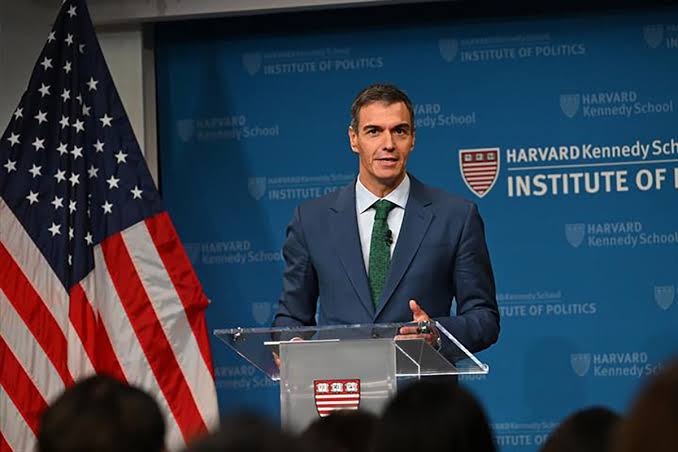
Boston.– The President of the Spanish Government, Pedro Sánchez, had to answer a series of questions from students this Thursday at Harvard University regarding corruption in Spain, the judicial cases involving his wife and brother, the Pegasus espionage, and Spain’s position on the Sahara or Venezuela.
Sánchez gave a speech dedicated to warning about the risks of techno-oligarchs, and, following it, there was a series of questions from students that dealt first with the subject of his speech but later addressed other types of issues.
You might be interested in: Pedro Sánchez argues that it is time for a Latin American woman to lead the UN
Thus, one of them asked the President of the Government about the judicial cases involving his wife, his brother, and the former Attorney General of the State, Álvaro García Ortiz, stating that they were related to corruption cases and have led to other people being in prison, and asked him what he thinks about those who believe that he is one of the reasons for that corruption.
Sánchez said that of course there have been some cases of corruption and that when they happen, whatever the country may be, one must ask the Government to respond effectively.
More Read
That is what he claimed he did with the corruption cases that he regretted had occurred in his government and his party, but he specified that this is different from the cases affecting his wife and his brother.
“Those are not cases of corruption or scandals. Those are other matters, and, for me, the opposition and some far-right associations have crossed certain red lines that lead me to reflect,” Sánchez pointed out.
A reflection that consisted of how rewarding it is to be president because one can do many things for their country, and there he said that his results are there, but that suffering that personal attack is very difficult to accept.
More Read

“And it is much more difficult because a young student like you already condemns them, because you say that my brother and my wife are guilty and that is not fair because they are not,” Sánchez pointed out, addressing the person who asked the question before stressing: “that is another matter that leads to dirty politics, but not to corruption.”
Questions for Sánchez
Another student referred to the espionage with the Pegasus program on his mobile phone and that of several ministers, for which Morocco is blamed, and asked if that had anything to do with Spain’s change of position on Western Sahara.
Sánchez replied that it is true that there was that Pegasus hack and that it is not known who did it, but an investigation was opened and it was reported.
He added that he may be criticized for many things as President of the Government, but he does not believe that his political decisions show dependence or a lack of defense for what he considers valuable for the interest of the Spanish people.
Next, he defended the Spanish position on the Sahara, explaining that it supports the UN resolution for an autonomous region within Morocco, and highlighted that Spain is the country most committed to financing humanitarian aid for the Sahrawi people.
He also pointed out that he should not have to defend himself against fake news and urged that if anyone has any information regarding this, they should make it public.
The Spanish position regarding the situation in Venezuela, mentioning the ties of former Prime Minister José Luis Rodríguez Zapatero to this country, was the subject of another question from a university student, pointing out that this does not align with the policies he claims to defend.
Given this, he/she asserted that Spain did not recognize Nicolás Maduro’s electoral results and that it always advocates for free elections, and emphasized that the future of Venezuela must be decided by the Venezuelans.