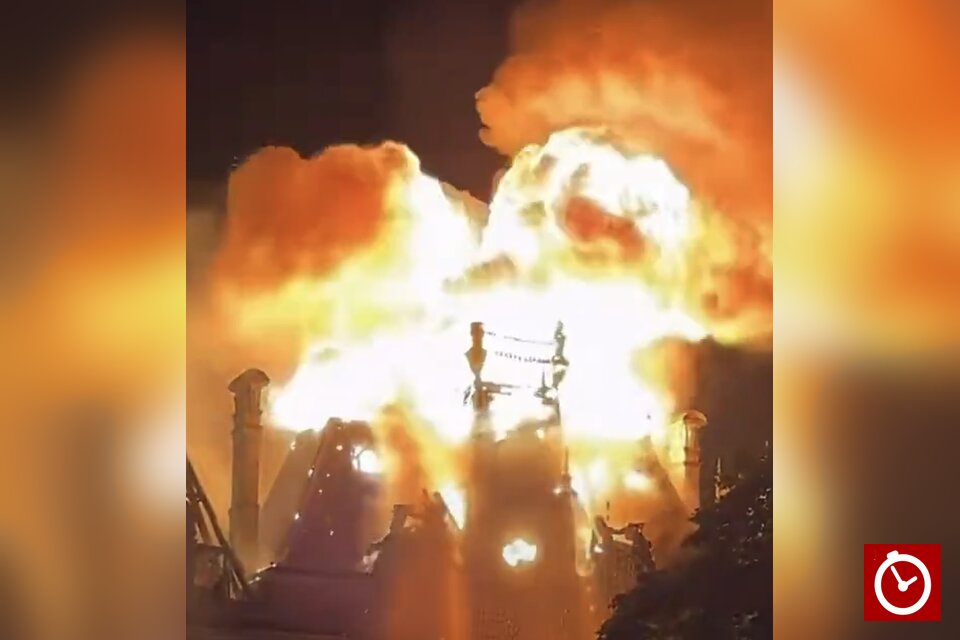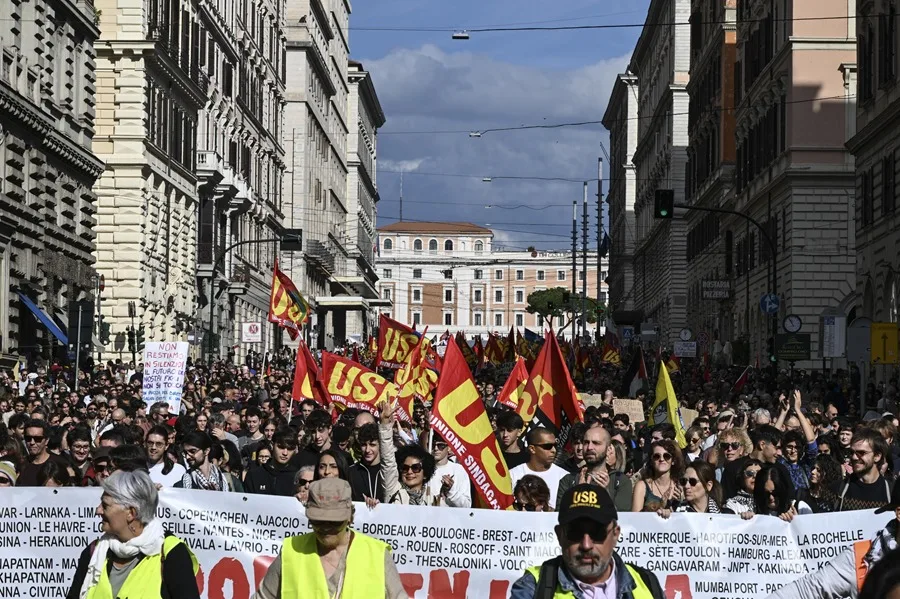

Thousands of people demonstrated this Friday in Italy’s main cities against the high cost of living, the policies of Giorgia Meloni’s government, and rearmament, in a day that had one of its main focal points in Rome, with a sit-in in front of the Colosseum that will continue until Sunday.
The demonstrations were part of a general strike called by the Unione Sindacale di Base (USB) and were mainly supported by students, public sector workers, and housing rights organizations.
The demonstrations, which took place mostly peacefully, spread through cities such as Milan, Florence, Naples, Genoa, Turin, and Bologna, as well as various parts of Sicily.
From the national executive of the USB, Stefano De Angelis said that, according to his organization’s data, more than a million and a half people had participated in the protests held throughout the country, although there are still no official figures.

“Workers, popular sectors, the homeless, and agricultural producers have mobilized against the economic crisis that this Government is imposing on us to finance rearmament and military spending that has nothing to do with the interests of the population,” he stated.
Camping in front of the Colosseum until Sunday
In Rome, where authorities estimated an influx of nearly 20,000 people, the main demonstration started from the Piazza del Cinquecento, called by grassroots unions and student groups, and advanced to the vicinity of the Colosseum.
Once there, the organizers announced their intention to occupy the Via dei Fori Imperiali, the avenue that connects the central Piazza Venezia with the monument, and set up tents until Sunday, coinciding with the holding of a national assembly.
The initiative, promoted by the USB and the Lotta per la Casa (Fight for the House) collective, aims to turn the place into a space for mobilization and participation for the different sectors that have supported the protests in Italy.

“This demonstration does not end here. We will continue with the mobilization until Sunday, when in this square, under the Colosseum, we will hold a great national assembly which will be attended by representatives of all the mobilizations that have taken place in the country today,” explained De Angelis.
The union leader also denounced the restrictions that, according to him, prevent protesters from approaching Montecitorio, the seat of the Chamber of Deputies, and described them as “undemocratic.”
“In any country where demonstrations against the Government are held, one can reach the seats of Government and Parliament. In Italy, this is prohibited,” he asserted.
And he added: “We will stay here until Sunday, in front of the Colosseum, to demonstrate that, in any case, this city must also be a point of participation in the protest mobilizations.”
Protests and road blockades
The main episode of tension of the day occurred in Turin (north), where clashes were recorded between protesters and security forces in the central Piazza Castello.
March participants threw eggs, bottles, and red paint at riot police, to which the officers responded with charges and the use of high-pressure water hoses.
Following the clashes, the participants returned to the occupied university campus and announced a new gathering at 6:00 PM local time (17:00 GMT) to continue the protests.
In Rome, objects were also thrown at the police near the Colosseum.
The demonstrations also caused significant traffic disruptions, especially in Bologna (north), where protesters blocked access to several educational centers and marched along the ring road, which forced the temporary closure of the A14 motorway.
In Genoa (north), participants blocked access to the port, while other mobilizations affected daily activity in major Italian cities.
This Friday’s demonstrations mark the beginning of a calendar of mobilizations in Italy that will continue on November 20th with the general strike of all sectors called by the CGIL, the country’s largest trade union, and the taxi sector strike scheduled for December 14th.
The day was marked by a strong security presence throughout the country following the violent incidents recorded on October 17 and 18 in Milan, Turin, and Bologna, which led the Meloni Executive to approve an extraordinary security decree and deploy 500 soldiers to support the police forces.