
The UN renews the mandate of its office in Haiti amid a security and political crisis

5:38 pm
United Nations. – The UN Security Council unanimously approved this Thursday the renewal for one year of the mandate of the United Nations Integrated Office in Haiti (Binuh), whose current extension expired at the end of January, in a context of growing violence by armed gangs, a cumbersome political process and a generalized deterioration of security in the Caribbean country.
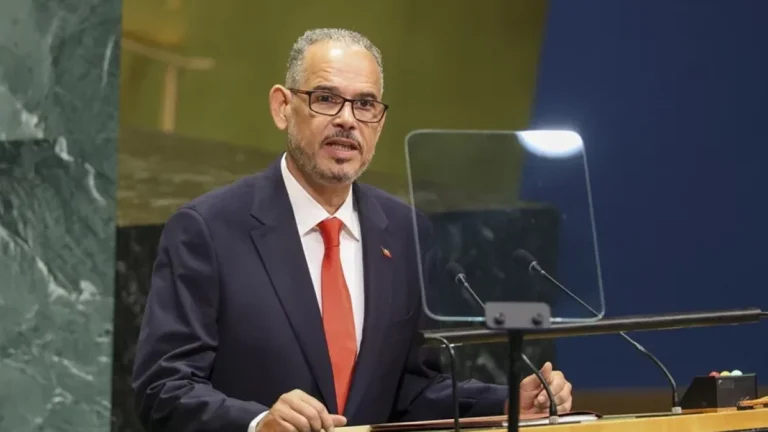
The Deputy Permanent Representative of Panama, Ricardo Moscoso, stated after the vote that the new mandate, drafted by his country along with the United States, seeks to strengthen the UN office in Haiti in a “complex” context due to the insecurity situation. You may be interested in: http://ONU y Haití critican measures adopted by Abinader against Haitian migration “This text aligns with the current context and seeks to maintain a balance between supporting the political and electoral process and supporting its justice system,” he noted. The diplomat added that the mandate will reinforce “the disarmament of gangs and their reintegration, as well as the protection of human rights”. For her part, U.S. Representative Jennifer Locetta said that the fight against gangs is a priority and must be “curbed with strong leadership and with the support of the Haitian people.” Locetta said that the international community must assist the Haitian authorities to facilitate the holding of elections in the country, a process that must promote an “inclusive representation” in decision-making. He also recalled that the mandate of the Presidential Transition Council (TPC) expires on February 7. Before that date, Haitian political actors must reach an agreement or organize elections to avoid a power vacuum that could worsen the security crisis. For his part, Ericq Pierre, Haiti’s representative to the UN, stated in the Council that the Haitian government believes that the reduction of violence should advance “gradually” and emphasized the need to “protect the population, restore the rule of law and create the conditions for institutional stability through dialogue.” The renewal of Binuh’s mandate comes at a critical moment for Haiti, marked by the territorial control of large areas of the country by armed gangs, the collapse of basic services, and a prolonged stagnation of the political transition process following the assassination of President Jovenel Moïse in 2021. In this context, the Security Council emphasized in previous resolutions that Binuh, a political mission without a military component, does not have the capacity to confront armed violence, so its work focuses on institutional accompaniment, political mediation, the defense of human rights, and the coordination of the international response. Faced with the accelerated deterioration of security, the Council approved last September the creation of the Gang Suppression Force (GSF), a multinational operation with an explicit mandate to combat organized crime and support the Haitian National Police (HNP). The GSF will replace the previous Multinational Security Mission (MSS), deployed in 2024, whose results were considered insufficient in the face of the advance of the gangs, which control ports, roads and entire neighborhoods of the capital, Port-au-Prince. Although they are different mandates, the UN indicated that the work of Binuh and the deployment of the GSF are complementary. The first contingents of the GSF are expected to arrive in Haiti in April, while the full deployment is scheduled for October, with up to 5,500 personnel provided by at least 18 countries.
We are a multiplatform outlet offering news and television content. The fastest-growing news outlet in audience in the history of Caribbean communication.


#Most read
- 1.Armed men attack U.S.-flagged vessel in Haiti’s Port-au-Prince Bay
- 2.VIDEO: Guatemalan teenager wakes up inside her coffin after being presumed dead
- 3.5D Cinema in Japan surprises the world with an immersive experience that goes viral
- 4.VIDEO: Witnesses say man prayed and bowed to tiger before fatal zoo attack in England
- 5.Dominican man shot by ICE in the Bronx had robbery conviction and pending drug charges
- 6.VIDEO: iPhones and luxury perfumes float in the Strait of Hormuz after cargo ship sinks
- 7.The Panama Canal begins evaluation of companies interested in building two ports
- 8.VIDEO: Father throws chair at judge after driver gets 120 hours of community service for killing his daughter
- 9.Iguazú Falls surge forces closure of Devil’s Throat walkway in Brazil
- 10.UN documents Dominican Army and police ammunition in hands of 400 Mawozo

Newsletter
Subscribe to our newsletter to receive our latest articles instantly!