Port-au-Prince (EFE).- Despite the lack of infrastructure and an adequate legal framework, with the capital taken over by armed gangs, football remains a widely practiced and followed sport in Haiti, which has been reinforced by the country’s recent qualification for the World Cup after half a century of absence.
This euphoria for sport contrasts with the situation of insecurity in which the country has been submerged since 2018, with at least 90% of the capital controlled by armed gangs that continue their offensives in new provincial cities, multiplying the attacks and massacres against the civilian population.
Nor do the authorities help.
«I have never had the feeling that the Haitian State cares about the development of sport in a rational way,» assures Dr. Yves Jean Bart, president of the Haitian Football Federation (FHF) between 1993 and 2020, to EFE.
What little has been done belongs to the past. In addition to the Ministry of Sports, which still exists, and three sports centers that are no longer functioning, the National Academy of Sports Development (Anasport) and the National Academy of Football Development (Anafoot) have not been operating for years.
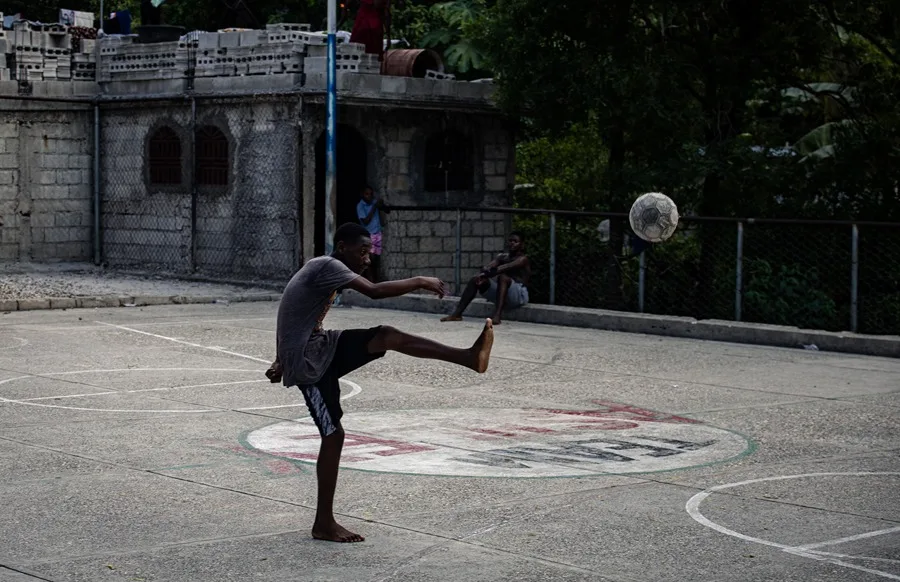
Fotografía que muestra a personas jugando fútbol, en Puerto Príncipe (Haití). EFE/ Mentor David Lorens
“Since then, nothing more, neither in terms of infrastructure, except for some lands announced pompously by the State within the framework of a substantial loan from Venezuela (Petro Caribe case), but nothing serious and without any explanation having been given to justify the use of the funds. It is an issue that divides the nation,” says Jean Bart.
“The constructions, where they have been raised, are almost junk,” he adds.
Soccer Gains Ground in Haiti
Due to the lack of sports infrastructure, football fans train in abandoned spaces, vacant lots, streets or roadsides, where mobile structures are installed in the afternoons or on weekends.
Haitians play football sometimes barefoot, other times with sandals, because buying cleats is a luxury in this impoverished country that not everyone can afford. Balls made with socks or plastic bottles allow children to practice the king sport, which unites and encourages them thanks to an insatiable passion.
“Football and its practice have no cultural, social, or religious taboos. Along with carnival, it is the only activity within reach of all Haitians, both rich and poor,” says Jean Bart.
Classifieds with tooth and nail
The Caribbean country qualified for the 2026 World Cup after fighting to the limit against nations that have more resources and acceptable sports infrastructure, unlike Haiti, where the economic and security crisis is compounded by natural disasters that frequently hit the island.
Fotografía de personas que juegan fútbol Haití. EFE/Mentor David Lorens
In Haiti, more than 16,000 people have died due to the violence of armed gangs since the beginning of 2022, and more than 4,000 of those homicides occurred in the first half of this year, according to official data, to which is added the impact of earthquakes such as the one in 2010, which left more than 200,000 dead and a destroyed country, with 1.3 million people homeless.
Since the beginning of 2020, no official football competitions, neither male nor female, have been played in Haiti.
“This classification comes after more than 50 years of work by many tireless leaders who have dedicated their time and their modest personal income, by hundreds of coaches, by the involvement of fans and doctors,” remarked Jean Bart.
Last November, before the match against Nicaragua that would give them qualification to the 2026 World Cup, the captain of the Haitian national team, Duckens Nazon, encouraged the rest of the team with a speech in which he made it clear why there was no room for defeat.
“They have nothing, guys. They have nothing in their pockets. They count on our feet. Today there’s a match and we can make them smile. We can make them cry with joy,” stated the captain of the Haitian national team, in a huddle in the locker room with his teammates, before the victory against Nicaragua, last November 18th.
That night, thousands of Haitians took to the streets to celebrate it.
We are a multiplatform outlet offering news and television content. The fastest-growing news outlet in audience in the history of Caribbean communication.