
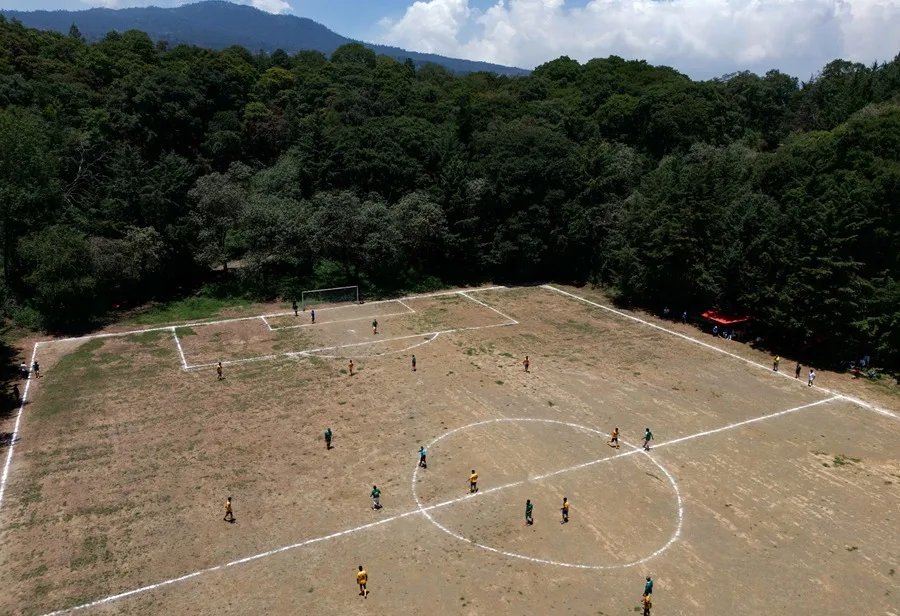

Mexico City (EFE).- For more than seven decades, residents of southern Mexico City have maintained a soccer field inside the crater of an extinct volcano without ceding control of the space, even as the site gains prominence days before the 2026 World Cup.
You might be interested in: Lamine Yamal, Nico Williams and Víctor Muñoz miss friendly against Peru
Located at an altitude of over 2,600 meters and surrounded by vegetation, the field occupies the center of a natural depression that its inhabitants know as El Teoca, an ancient volcanic crater where teams from different towns and neighborhoods of Xochimilco gather every Sunday.
The history of the place goes beyond its unusual location and is marked by decades of community organization that have kept the court under its own rules.

“The hill is communal, the hill belongs to the people and that is how we are fine. We want to hold a tournament and it is independent, we don’t ask anyone for permission,” summarizes Joel Becerril, one of the league’s representatives, to EFE.
His father participated in the construction of the field more than 70 years ago, when local residents transformed a plot of land where corn was grown and set up the first goalposts there using trunks from the local trees.

Since then, he adds, the community has rejected projects that involved ceding part of the control of the space, such as a recent proposal to install lighting, which the inhabitants opposed to protect the fauna that inhabits the crater, where it is still possible to find rabbits, squirrels, opossums, cacomistles, and armadillos.
“What we are trying to do is conserve it, so that it (the wildlife) doesn’t disappear,” remarks Becerril.
The World Cup effect
That unique combination of landscape, history, and community organization has attracted attention in the lead-up to the 2026 World Cup, including promotional activities linked to the tournament such as a recording with players of Mesoamerican ballgame, a sport with more than 3,000 years of history.
“We want to take advantage of all the promotion the World Cup is getting to promote the ball game,” says Juan Luis Zapata, a practitioner of this pre-Hispanic discipline.

Summoned for an activity related to a World Cup marathon, which will be held during the World Cup, several of the participants -coming from Azcapotzalco, in the north of the capital, got to know Teoca for the first time during the visit.
“I didn’t know that a league actually existed here. I’m surprised that people follow it, that they visit it, and that there is a community that keeps it alive,” acknowledges Jorge Torres, instructor of the ball game.

Like them, more and more people are arriving at Teoca, drawn by curiosity and the attention it has gained ahead of the 2026 World Cup, although its administrators claim that the league does not receive financial benefits from these visits.
The maintenance of the court continues to depend on the community itself, which organizes work sessions and finances improvements with league resources and avoids commitments with external actors.
“The league here is autonomous,” maintains the manager.
For those who play every week at Teoca, the value of the place is not in the recordings or the recent attention.
Emmanuel Torres, a member of one of the league’s teams, believes that this space continues to maintain the community spirit of soccer, in contrast to the 2026 World Cup, which—in his view—has “very marked social differences.”
“People here have a deep-rooted sense of belonging, it is full of tradition(…) it is a field that has its own mystique, it makes you feel like you are from here,” says the player, with more than seven years in the league.

That bond is also passed down “from generation to generation,” adds Gabriel Rosas, who has played on this field since he was a child.
“It belongs to the people, to all of us,” Rosas highlights, recalling that when he began training, it was the veteran members who guided him, a teaching he now seeks to share with the younger ones.