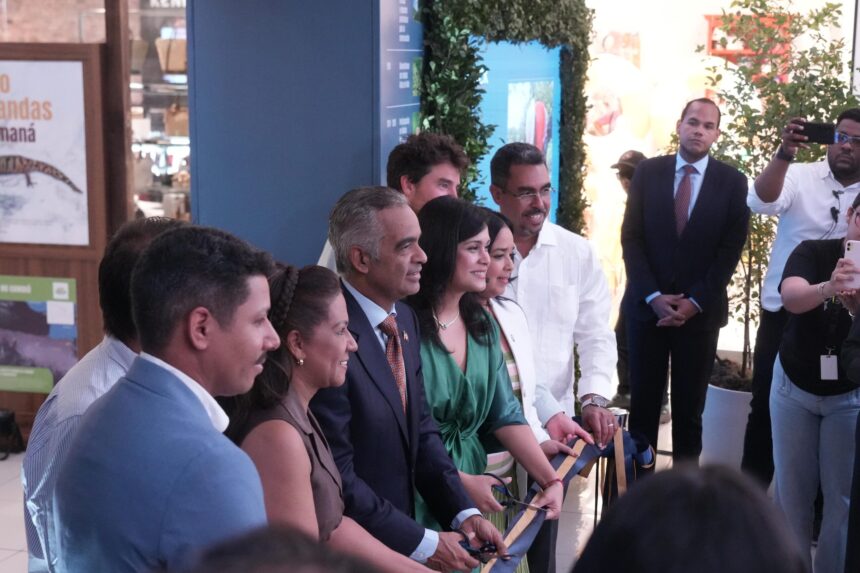
Santo Domingo.— With some 40 photographs showing the richness of the flora and fauna present in the mine’s surroundings, Barrick Pueblo Viejo inaugurated the exhibition “Pueblo Viejo and its biodiversity: responsible management of modern mining“, an exhibition that seeks to bring the public closer to the scientific and environmental work that the company carries out for the conservation of ecosystems.
The exhibition, open to the public from this Wednesday the 13th until August 30th in the central atrium of Galería 360, presents images of different species and ecosystems recorded in the mining operation area, as well as elements related to the research, monitoring, and environmental management processes carried out by the Pueblo Viejo Environment department.
During the inauguration, the president of Barrick Pueblo Viejo, Gisselle Valera, highlighted that the exhibition is part of the company’s initiatives aimed at promoting responsible and sustainable mining.
“It is an exhibition that highlights and denotes everything that is the flora and fauna found within Pueblo Viejo. It is part of our initiatives as a responsible and sustainable mining operation,” explained Valera.
The executive added that the purpose of the exhibition is also to showcase the natural wealth existing in the area of operations and to foster greater awareness regarding the conservation of Dominican biodiversity.
Valera also highlighted the participation of the Dominican photographer Timoteo, a native of the Sánchez Ramírez province, whom he defined as a “one hundred percent local talent.” The exhibition brings together around 40 photographs and will be available throughout the month of August.

You can also read: Barrick Pueblo Viejo and union sign agreement
Meanwhile, the Biodiversity manager of Barrick Pueblo Viejo, Eli Bobadilla, explained that the exhibition seeks to share with society and the authorities the conservation and environmental management actions that the company is developing.
“The main objective of this photographic exhibition is to share some of the biodiversity conservation and general environmental management actions that we carry out at Barrick Pueblo Viejo,” noted Bobadilla.
The specialist maintained that the images allow for the appreciation of the species that coexist in the environment where the mining operation takes place and constitute a sample of the research and environmental monitoring work being carried out in the area.

“What we are doing here is a sample of the species that coexist with our development model,” he stated.

Bobadilla defended the possibility of combining economic activity with the protection of natural resources and stated that the exhibition seeks to demonstrate that both objectives can coexist.
“It is possible to have an economic model where development and environmental management coexist successfully,” he stated.
One of the central themes of the exhibition is precisely the link between science and conservation. Among the contents presented is the history of the Samaná Banded Gecko (Sphaerodactylus samanensis), an endemic species of the Dominican Republic whose scientific re-evaluation allowed for expanding knowledge about its distribution and contributing to the update of its conservation status before the International Union for Conservation of Nature (IUCN).
The sample also incorporates species considered natural indicators of ecosystem health, including birds, amphibians, reptiles, and pollinating insects such as bees.
Educational activities

In addition to the photographic tour, activities for children and educational talks on the preservation and conservation of biodiversity in the Dominican Republic will be held during the weekends.
Valera invited the public to visit the exhibition and participate in the activities scheduled during its stay at Galería 360.
“On weekends we have very interesting activities, activities for children, talks about the preservation and conservation of what biodiversity is in the Dominican Republic, so you can’t miss it,” he/she expressed.
The exhibition thus proposes a journey through species, ecosystems, and scientific findings linked to the Pueblo Viejo environment, with the aim of showing how research, monitoring, and environmental management can become tools to strengthen biodiversity conservation.