
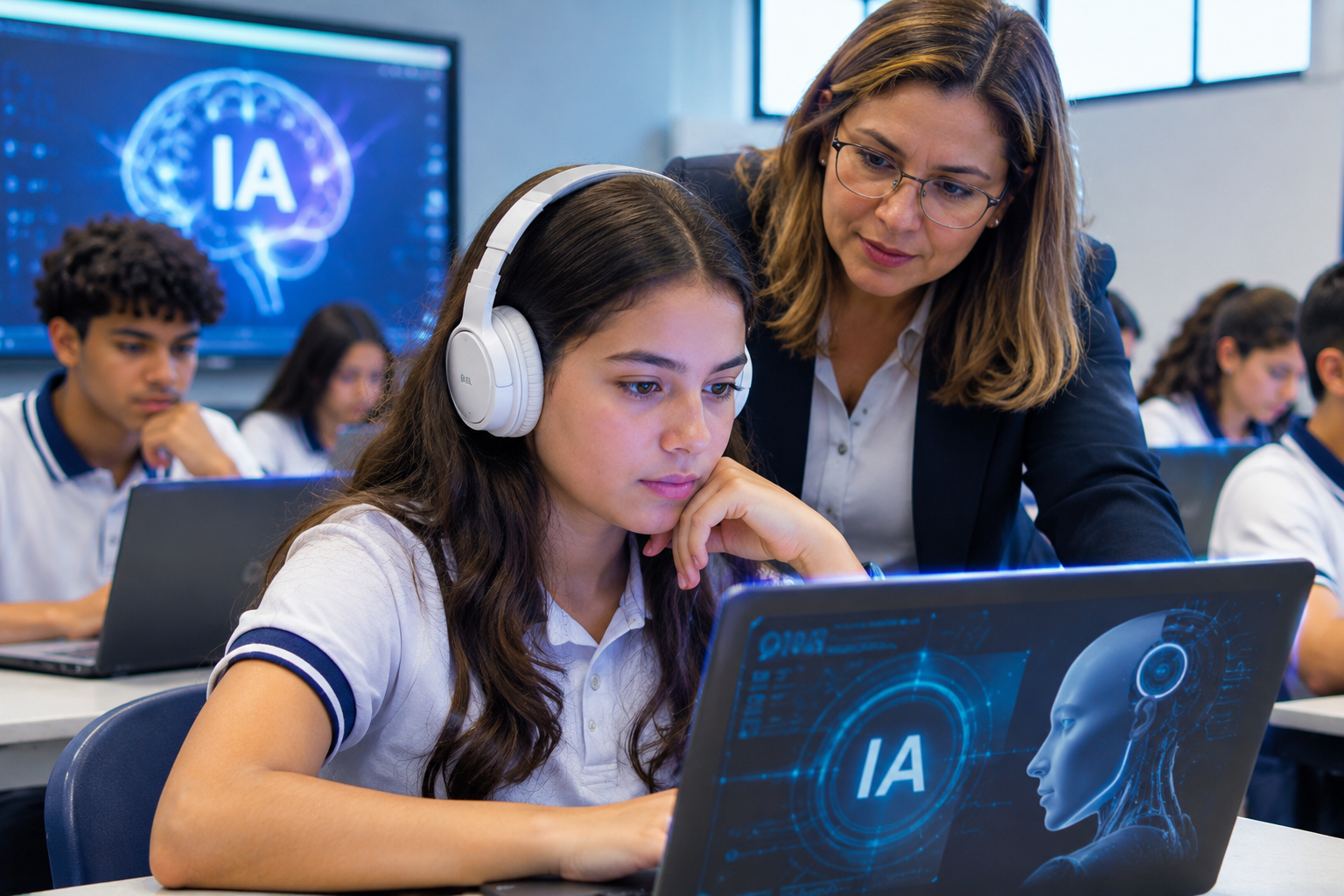

The incorporation of generative artificial intelligence (AI) in classrooms is transforming teaching methods in the United States, where educational institutions and technology companies defend its potential to accelerate learning, while researchers warn about the risks of cognitive dependency and the loss of fundamental skills.
One of the most innovative models is that of Alpha School, a network of private schools with tuition that can reach 75,000 dollars per year and which claims that its students can double their academic pace by dedicating just two hours a day to learning through digital applications.
However, these claims have raised questions among specialists, who believe that there is still not enough scientific evidence to prove that artificial intelligence can replace traditional teaching methods with better results.
Schools replace teachers with learning guides
At Alpha School, students carry out their academic activities primarily using computers, while traditional teachers are replaced by figures called “guides,” who are responsible for providing emotional and motivational support.

Bianca de la Riva, admissions director at Alpha Miami, explained to EFE that the system uses educational applications and the Pomodoro technique, which organizes learning into short periods of concentration and rest.
“It is 25 minutes of focus on a subject (…) and then 5 minutes of rest; then 25 minutes of focus and 15 minutes in the yard,” he/she detailed.
As explained, students must learn the content autonomously through digital platforms and, when they need academic assistance, they can connect with a virtual team.
However, an investigation by The New York Times revealed that nearly half of the elementary school students in this network did not reach the goal of doubling their learning in mathematics.

Experts question accelerated learning promises
Jan L. Plass, Professor of Digital Media and Learning Sciences at New York University (NYU), expressed doubts about the effectiveness of these educational models.
“I am curious to know which randomized controlled trial they base that figure of learning twice as fast on; that does not exist, those are made-up numbers for marketing,” he stated.
The researcher warned that teaching goes far beyond transmitting information, because it also involves the development of social, emotional, and cognitive skills.
“Teaching is not just transmitting data, it is an integral process of student socialization,” he maintained.

Along those same lines, UNESCO has warned about the importance of preserving the pedagogical and social role of teachers, avoiding automated tools replacing human interaction in the educational process.
Google bets on AI tools for students
As the debate grows, technology companies like Google continue to develop tools aimed at facilitating learning through artificial intelligence.
Among them are Google Classroom, used to manage academic activities, and Guided Learning, an assistant designed to guide students through progressive questions and explanations.
Brit Mennuti, Google Classroom product lead, explained that these tools seek to stimulate reasoning rather than providing immediate answers.
As detailed, the system poses open-ended questions and offers step-by-step explanations to help students understand the content.
In addition, Google announced that it will disable access to Gemini and its AI assistant by default for primary and secondary school accounts, unless educational administrators authorize their use.
More than half of teenagers use AI for schoolwork
The use of these technologies is already part of the academic routine of numerous American students.
According to data from the Pew Research Center, 54% of teenagers in the United States use chatbots to do schoolwork, while six out of ten believe that students at their schools use these tools to cheat.
These figures have intensified concerns about the use of artificial intelligence as a mechanism to obtain answers without developing the necessary reasoning processes.
Plass believes that the problem is also related to an educational system that prioritizes grades over learning.
“We have conditioned students to care only about a good grade and not about learning; if they see AI as the perfect method to obtain it, they will use it,” he warned.
Digital surveillance and lack of regulation cause concern
Some educational institutions have incorporated monitoring systems to control student behavior while using digital tools.
At Alpha School, for example, technologies are used that monitor eye movements and keyboard activity to analyze students’ reading and writing speed.
These practices are part of a broader debate on privacy, autonomy, and the limits of technological surveillance in educational institutions.
Another of the main challenges is the absence of uniform regulations regarding the use of artificial intelligence in American schools.
While Boston is pushing initiatives to train teachers as AI specialists, school districts in New York and Los Angeles have established restrictions on student access to certain chatbots.
The advancement of these technologies thus poses a challenge for educational systems: to leverage the advantages of artificial intelligence without compromising critical thinking, creativity, and the ability to learn independently.