
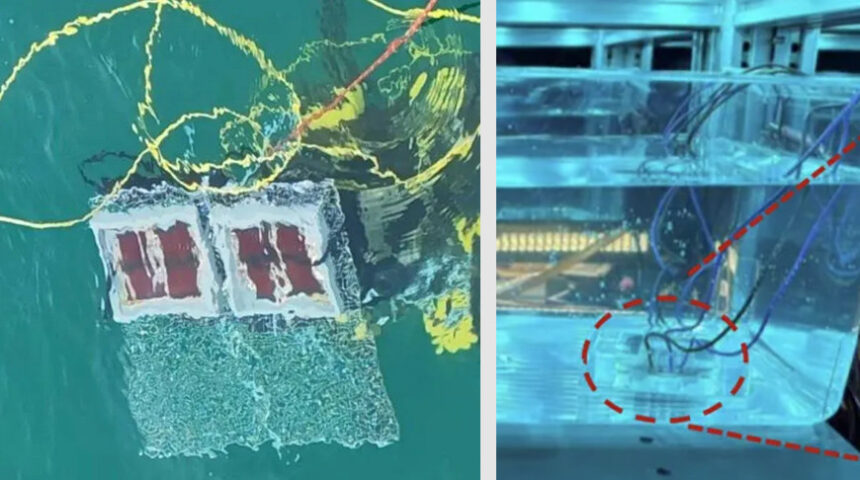
cientists from China’s Yunnan University have successfully tested what researchers describe as the world’s first practical underwater solar power plant in the South China Sea.
The team developed lead-halide perovskite solar cells designed to capture the blue-green light that remains underwater after water filters out much of the red and infrared light used by conventional silicon panels. At a depth of 10 meters, only a small portion of sunlight remains.
In laboratory tests, a small cell converted 34.71% of the weak light into electricity. Researchers then protected the cells with rubber, glass and resin to withstand seawater and pressure.

Near Weizhou Island, a robot deployed the system at depths of two, six and 10 meters. The panels generated enough electricity to charge batteries and power an LED, producing 1,416 milliwatt-hours at two meters, 752 at six meters and 324 at 10 meters.
The researchers say the technology could eventually provide autonomous power for underwater sensors, cameras and robots.