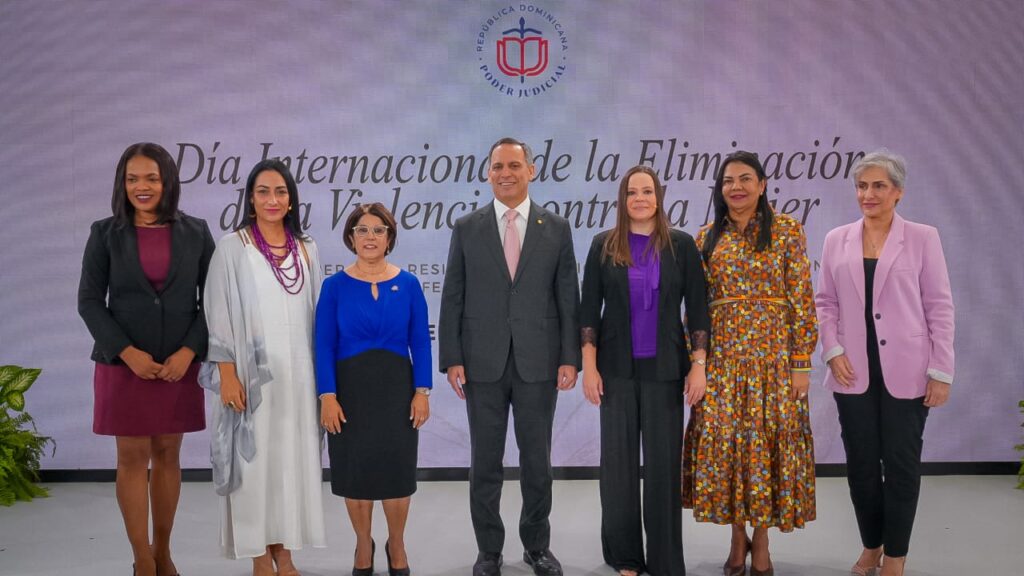
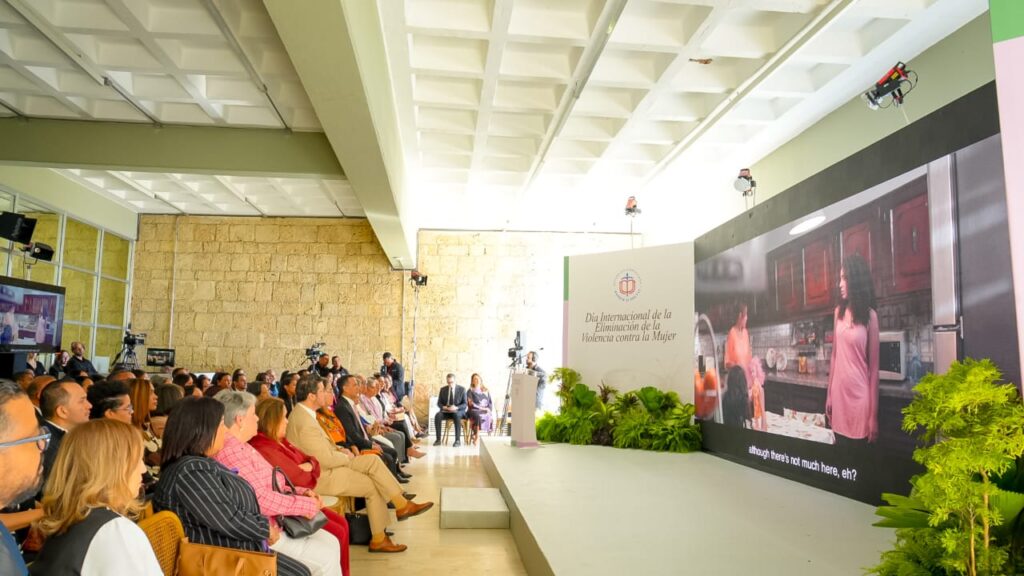
The Judiciary of the Dominican Republic commemorated this Tuesday the International Day for the Elimination of Violence against Women, in which act the president judge of the Supreme Court of Justice (SCJ), Henry Molina, revealed that 55% of the cases entering the system in criminal matters are directly related to violence and, of these, 36% correspond to gender-based and domestic violence. Magistrate Molina stated that these figures are not just statistics, but rather constitute a map that allows to dimension the problem, make informed decisions, and execute actions that constantly improve the justice service. He also indicated that access to justice is not a privilege, but an inalienable human right that must be exercised without fear or obstacles, regardless of gender, economic, migratory or other similar situations.
The magistrate considered that the fight against violence neither begins nor ends in the courts, but rather requires the joint action of the family, school, the community, the media, the church, and society as a whole.“Each of us has the responsibility to educate to prevent, to challenge the cultural patterns that have normalized violence and to break the silence when any form of abuse occurs,” affirmed Henry Molina.
You can also read: 36% of births in DR during 2024 were Haitian | De Último Minuto
Magistrate Nancy Salcedo, judge of the Second Chamber of the Supreme Court of Justice and coordinator of the Gender Equality Commission of the Judiciary, indicated that this day established by the United Nations in honor of the Mirabal sisters, is much more than a symbolic date in the Dominican calendar, it is a constant call to action, to the moral and legal duty to protect the fundamental rights of more than half of the population and mother of the other half. “The response we give as a judicial system will set the course for the next 30 years, which is why we are putting all our effort into fulfilling the responsibilities demanded by the historical moment in which we are already building the justice of the future,” said Salcedo, highlighting the State Power’s resounding response since 2007 with a gender equality policy that advocates for justice with a gender perspective. During the activity’s development, the documentary “A Leap into the Void” by the writer and visual artist, Mary Frances Attías, was presented. Also, the conference “Vicarious Violence” was held, with speakers Raiza Cajiga, a first instance judge of the Judicial Power of Puerto Rico, and Dr. Elithet Silva Martínez, a Social worker from the University of Puerto Rico, Río Piedras campus. A relevant element was the presentation of the study analyzing judicial sentences from the Dominican Republic in cases of gender-based and domestic violence, torture or barbarity, and cyberviolence, which describes the characteristics of the decisions analyzed in this matter during the period 2020-2024. The study was analyzed in the panel: “Woman: Victim of violence, torture and barbarity”, in which the magistrates Natividad Ramona Santos, judge of the Third Chamber of the Criminal Chamber of the Court of Appeal of Santo Domingo (who coordinated the investigation) and Esther Agelán Casasnovas, judge Emerita of the SCJ participated with the topic “Cyberviolence, relevant aspects in the new penal code”. Magistrate Vanessa Acosta, judge of the First Chamber of the SCJ and sub-coordinator of the Commission for Gender Equality of the Judiciary, moderated the panel.Presents sentence analysis