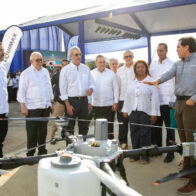
Santiago.- President Luis Abinader conducted a supervision tour of the Santiago Monorail workshops, whose civil works are expected to be completed in August of this year, to then, during the last quarter of the year, give way to dynamic train movement tests on the E1-E11 route.
The president announced that by the month of December new train units will arrive to begin what is known as a blank run or test period for this important mobility infrastructure that will transform the urban transport system of the capital of the Cibao.
The head of state toured the monorail workshops and the underground station located in the monumental area, which was conceived with the purpose of preserving the view of this area where the Monument to the Heroes of the Restoration and the gardens of the Gran Teatro del Cibao are located, thus mitigating the impact of the project on Monumental Avenue.
Jhael Isa Tavárez, executive director of the Trust for the Development of Mass Transit (Fitram), reported that, 4 years and 72 days after the start of construction, the Santiago Monorail shows an overall progress of 92.6%, reflecting the sustained compliance with the different stages of construction, installation, and commissioning of the systems that will make up the railway operation.
Among the main achievements reached is the total manufacturing of all structural elements required for the project, completed in accordance with the established technical specifications.
More Read

Among the project’s advances, the construction and installation of 100% of the viaduct piles, equivalent to 4,246 units, and the total number of beams manufactured for 1,132 units, which constitutes an industrial milestone, were highlighted.
You can also read: President Abinader orders Mescyt to evaluate from
Likewise, the installation of 679 piles (support columns), 619 capitals (beam supports), and 637 footings was reported. “The delay in the construction and installation of these elements is due to the modification in the route of the work in Reparto Universitario, a layout that was modified at the request of the community,” stated Isa.
Likewise, he reported that work continues to be developed regarding the electromechanical and railway phase, including the implementation of the electrical power supply network and associated equipment, the installation and configuration of signaling systems, integration of operational and backup telecommunications, logistical and technical preparation for the incorporation of rolling stock, and the coordination of the different systems that will allow for safe and efficient operation.
More Read

As part of the work in the monumental area, 180 parking spaces were recovered that can be used by users to leave their vehicles and board the monorail at that station.

Isa Tavarez highlighted that the project is progressing according to the established schedule and is at a decisive stage for its completion. Likewise, she emphasized that the Santiago Monorail will represent a transcendental change for urban mobility, by offering a modern, safe, efficient, and sustainable system that will contribute significantly to the reduction of travel times and improve the quality of life for thousands of citizens.
With this project, Santiago is on its way to having a state-of-the-art mass transit system that will strengthen connectivity between the city’s main sectors, boost the region’s economic and urban development, and consolidate the comprehensive transformation of mobility in the Cibao.
About the Santiago Monorail
The Santiago Monorail is a high-tech rail transport system, with the capacity to transport 20,000 passengers per hour per direction, which is equivalent to 200,000 passengers per day.
It moves on a reinforced concrete rail structure, on a viaduct that will cross the entire city, from Cienfuegos to Pekin, over a 15-kilometer route.

The system is composed of 13 kilometers of viaduct, 3.2 kilometers of workshop yard, with 14 stations and a central integration terminal with the cable car.
The Santiago Monorail, together with line 1 of the cable car, integrates the most populated sectors and the two main workplaces in the city.
This project will directly impact 501,094 beneficiaries, reducing domestic transport expenditure by 30%, reducing traffic congestion, increasing productivity, and decreasing environmental impact.