

Santiago, Chile.- The death toll as a result of the intense storm battering Chile rose to four this Friday, following the death of one person in the central region of Valparaíso, where authorities have declared a red alert due to the high risk of flash floods and landslides.
“We continue to face a complex scenario (…) We will still face hours that will be especially demanding, so the call is not to expose yourself and to avoid travel that is not necessary,” assured the Minister of the Interior, Claudio Alvarado, in a press conference.
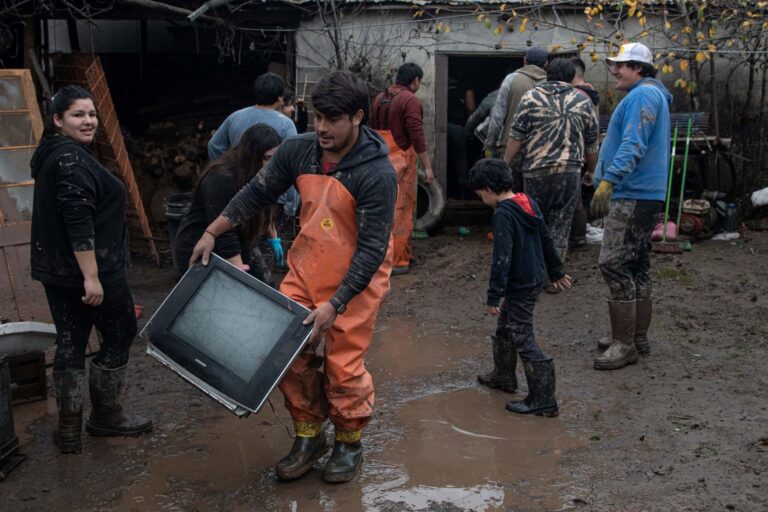
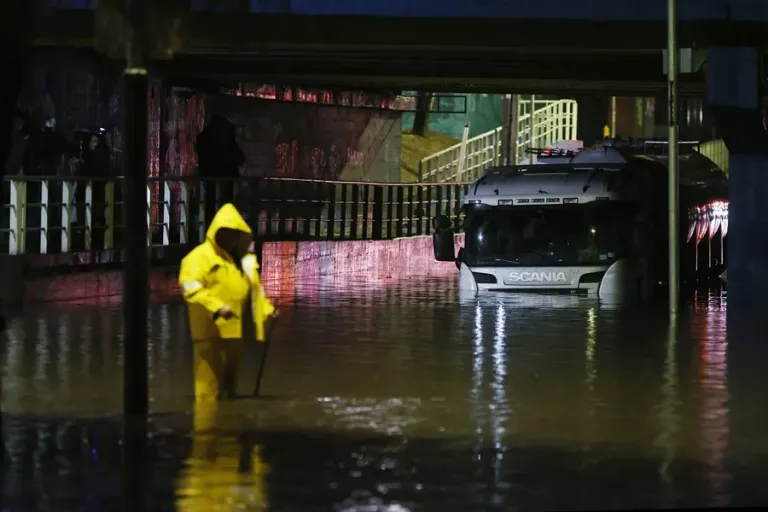
The frontal system, which began in the south-central zone and is moving north, is affecting ten of the country’s sixteen regions, leaving flooded streets, power outages, intense storm surges, stranded vessels, overflowing rivers, and strong wind gusts of up to 160 kilometers per hour in some areas.
The Meteorological Directorate of Chile (DMC) considers this “train of frontal systems accompanied by an intense atmospheric river” to be one of the most significant storms recorded in recent years.

If the precipitation forecasts issued by the DMC are met, it could become the most intense rainfall episode recorded for a month of July since measurements began.
We recommend reading: At least two dead and 53,000 homes without power due to a storm in France
“We are experiencing the ‘peak’ of rainfall in the central zone of our country: in Valparaíso, Coquimbo, and the Metropolitan Region (to which Santiago belongs),” indicated the Undersecretary of the Interior, Máximo Pavez, during the same press conference.
Affected areas
According to the most recent report from the National Disaster Prevention and Response Service (Senapred), there are currently more than 2,500 people isolated in the city of Coquimbo (north), a hundred houses destroyed or with major damage, and almost 400,000 homes without electricity, mainly in Valparaíso, 110 kilometers northwest of Santiago.
Precisely in the Valparaíso region, Senapred declared a red alert in the afternoon due to a “high probability” of landslides and mudslides in both the coast and the coastal mountain range.

A dozen towns near estuaries such as the Marga Marga or the Quilpué were evacuated due to the risk of overflowing.
In the Valparaíso region, attention is also focused on the Petorca River, which for years was a symbol of the extreme drought that Chile experienced in the last decade and had been without flow for years.
Chilean President José Antonio Kast visited the Biobío region today, five hundred kilometers south of the capital, and toured the commune of Penco, one of the areas most affected by the rains and which was also the epicenter of the devastating forest fires in January.
The train of frontal systems, which is expected to last until Sunday night and arrives after an especially warm and dry autumn, is moving north, where preparations have been intense in recent hours to receive the rains.
There is particular concern regarding the rains in Atacama, located eight hundred kilometers north of Santiago and the epicenter of the major floods of 2015, and in Coquimbo, where authorities have acknowledged that the region “is not prepared.”