

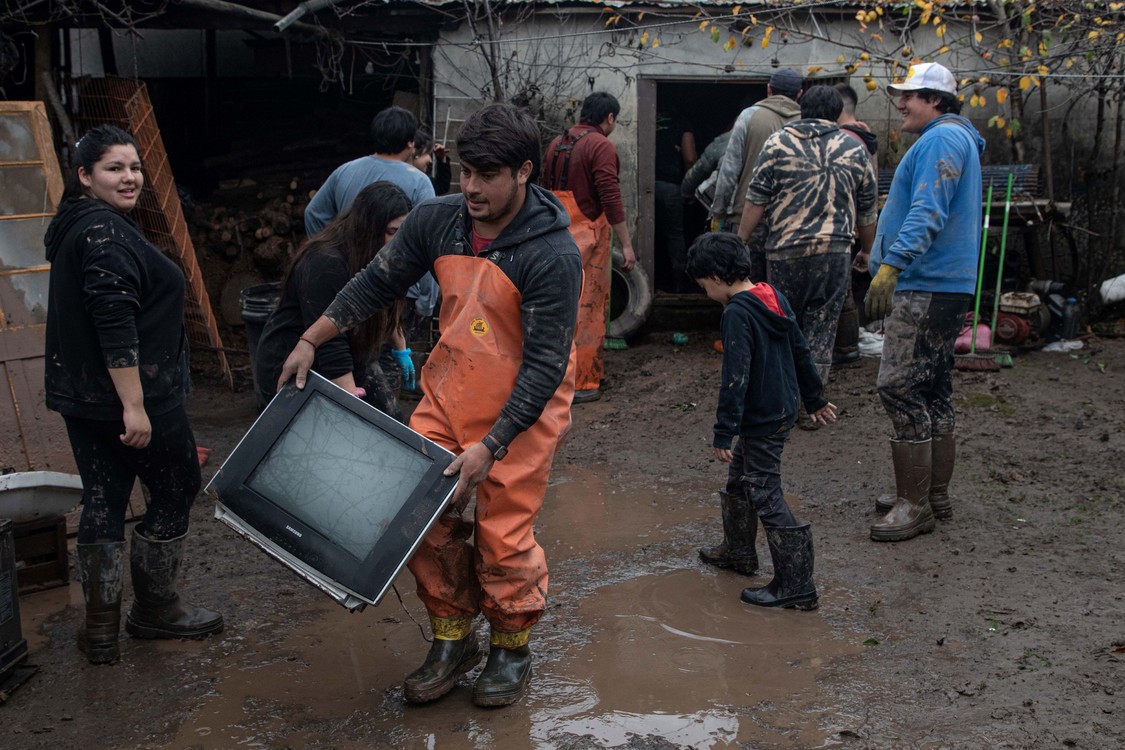

Chile.- The death toll from the intense storm battering Chile rose to ten this Monday, according to the latest report provided by the National Disaster Prevention and Response Service (Senapred) regarding the frontal system affecting ten of the country’s sixteen regions.
The president of Chile, José Antonio Kast, traveled in the afternoon to Coquimbo, in the northern zone, which he declared in a state of catastrophe, as well as the province of Huasco in Atacama, located 460 kilometers and 850 kilometers from the capital, respectively, due to the ravages of the weather event.
The death toll could rise in the coming hours, as the agency reported that there are police reports of four other people who have been classified as “presumed missing.”
The report, provided at the Senapred headquarters in Santiago, Chile, indicates that as a result of the emergency, there are a total of seventeen injured people, 2,422 affected, and 104,504 isolated, concentrated mostly in Atacama and Coquimbo due to road closures and overflowing riverbeds.

The Ministry of Health, for its part, declared a health alert in both regions that have sectors without a supply of drinking water, while the Chilean Armed Forces sent the first shipment of six tons of humanitarian aid.
“Lamenting the passing of ten compatriots in the nation, some of them while providing service to other compatriots, has forced us to ask every brigade member and rescuer to take care of themselves,” stated Kast from the affected area in the north of the country, where he thanked volunteers from civil society, firefighters, and all the institutions that have placed themselves at the service of the community.
You can also read: Chile declares catastrophe in the northern zone, where the storm leaves four missing
The president described the meteorological event as “quite unprecedented because different factors such as wind, rain, snow, and storm surges have come together, affecting each of the ten regions in different ways” and due to its intensity, extent, and duration.
Senapred counts, so far, 76 destroyed homes, 2,121 with major damage, 16,948 with minor damage, and 888 properties that continue to be evaluated by municipal teams.

The Meteorological Directorate of Chile (DMC) reported that the Coquimbo region has recorded between 155 and 287 millimeters of rainfall in various sectors since last Tuesday, which in some cases represents almost double the total rainfall for all of 2025.
“The region is literally under mud right now, we still have high-risk situations involving people,” declared Coquimbo Governor Cristóbal Juliá this Monday afternoon.
While the Minister of Public Works, Louis de Grange, also present in the affected area, said that the climate disaster is the greatest “of the last forty years in the Coquimbo region”.
Meanwhile, the Minister of the Interior, Claudio Alvarado, announced the suspension of classes this Tuesday and Wednesday in public and private preschool, primary, and secondary educational establishments throughout the Coquimbo Region and in areas of Atacama, Valparaíso, and the Metropolitan Region.
The weather event, related to the El Niño phenomenon, began on Thursday in the central-southern zone and moved northward, leaving isolated towns, floods, landslides, and undermined roads, in addition to strong wind gusts of up to 160 kilometers in some areas, and power and water outages.
The storm, one of the most significant recorded in recent years due to its geographical extent and intensity, will continue its oscillation between the north, center, and south of the southern country which, according to expert forecasts, will extend until the end of the week.